



Cutting Costs in Continuous Fiber 3D Printing: Innovations & Strategies
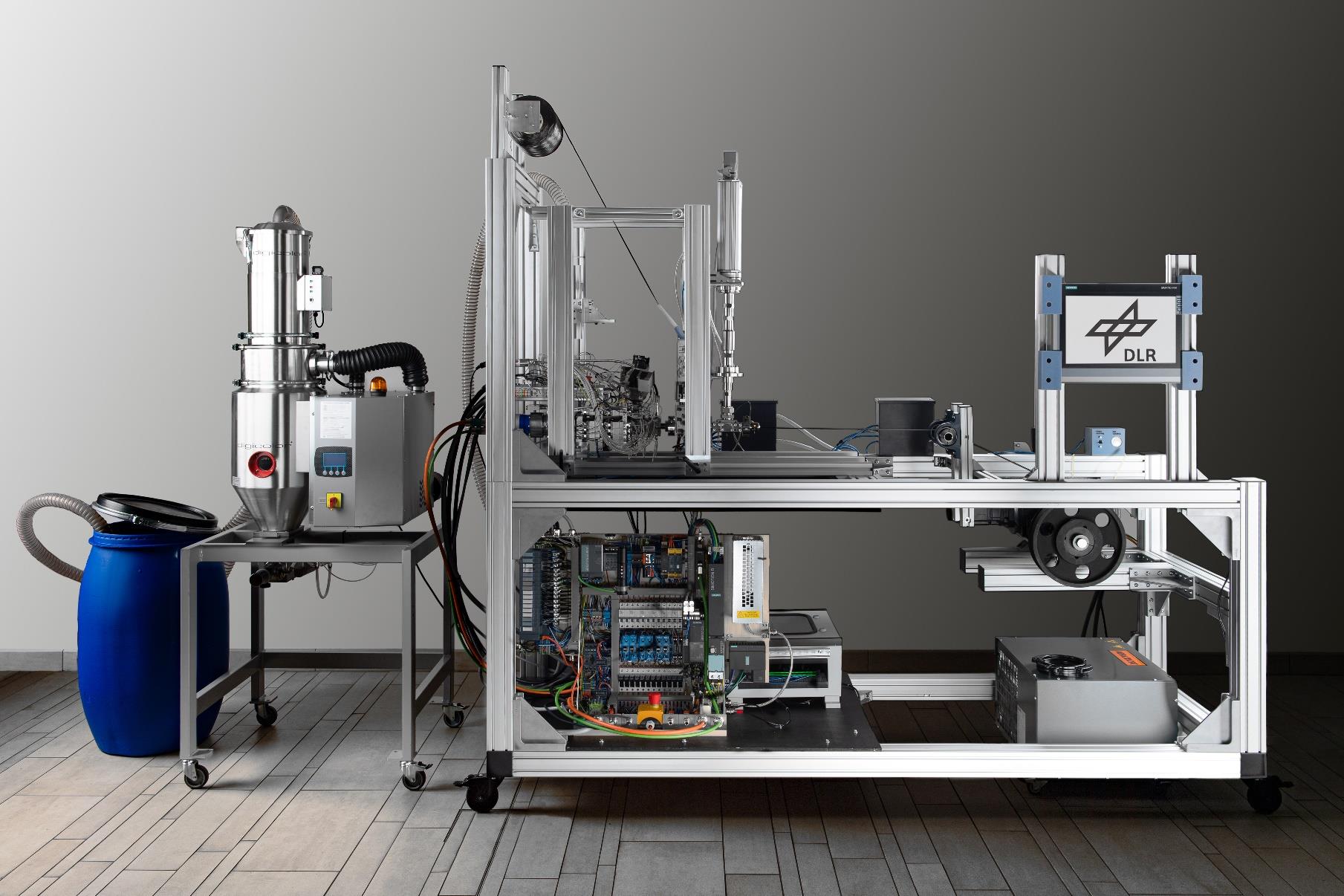
DLR Institute of Composite Structures and Adaptive Systems (Braunschweig, Germany) is a leading research institution in lightweight construction, pursuing new technologies in four strategic fields: design to certification, digitalization and Industry 4.0, recycling and additive composite structures. CW reported earlier this year on the institute’s EmpowerAX Innovation Lab to accelerate, strengthen and broaden the transfer of additive extrusion to industry for 3D-printed composites. is also completing an array of R&D projects including simulation of additive extrusion, modification of thermoplastics for improved performance in 3D printing and production of printer filaments with continuous fiber.
This last project, titled ENDLOSEFFEKT (“endless effect”), is designed to improve producibility, quality and cost of endless length fiber-reinforced materials. “The availability of pre-impregnated continuous fiber printing filaments is limited,” explains Maik Titze, responsible for additive manufacturing at DLR Institute of Composite Structures and Adaptive Systems in Braunschweig. “This limited availability and variety of usable materials, as well as the material prices, constitute a barrier to application. We wanted to design an impregnation nozzle so that the same equipment used to produce standard, chopped fiber-filled filaments for FDM [fused deposition modeling] could also produce continuous fiber-reinforced filaments. This equipment would be for companies that manufacture 3D printer filaments, with the goal to reduce the cost of 3D printing with continuous fiber-reinforced materials.”
Currently, most continuous fiber-reinforced 3D printer filaments are made by the same companies that sell continuous fiber printing machines, with each material developed and optimized for one particular printing system. These materials tend to be somewhat costly.
“Our idea is to begin with any size dry fiber, for example 1K carbon fiber tow up to 50K, and then use direct melt impregnation from commodity thermoplastic pellets or granules via extrusion because it is very cost-effective,” says Titze. “You don’t need to produce polymer powder or foils, nor use expensive presses or hundreds of rollers to achieve impregnation of the fiber. So, the processing becomes much more accessible and affordable.”
Instead of presses, belts and rollers, DLR devised a system using ultrasound. “We use a 19.5-kilohertz sonotrode that directs vibration into the melted thermoplastic that surrounds the fiber,” Titze explains. “This the matrix and reinforcement at 19,500 times per second, which results in very good impregnation.”
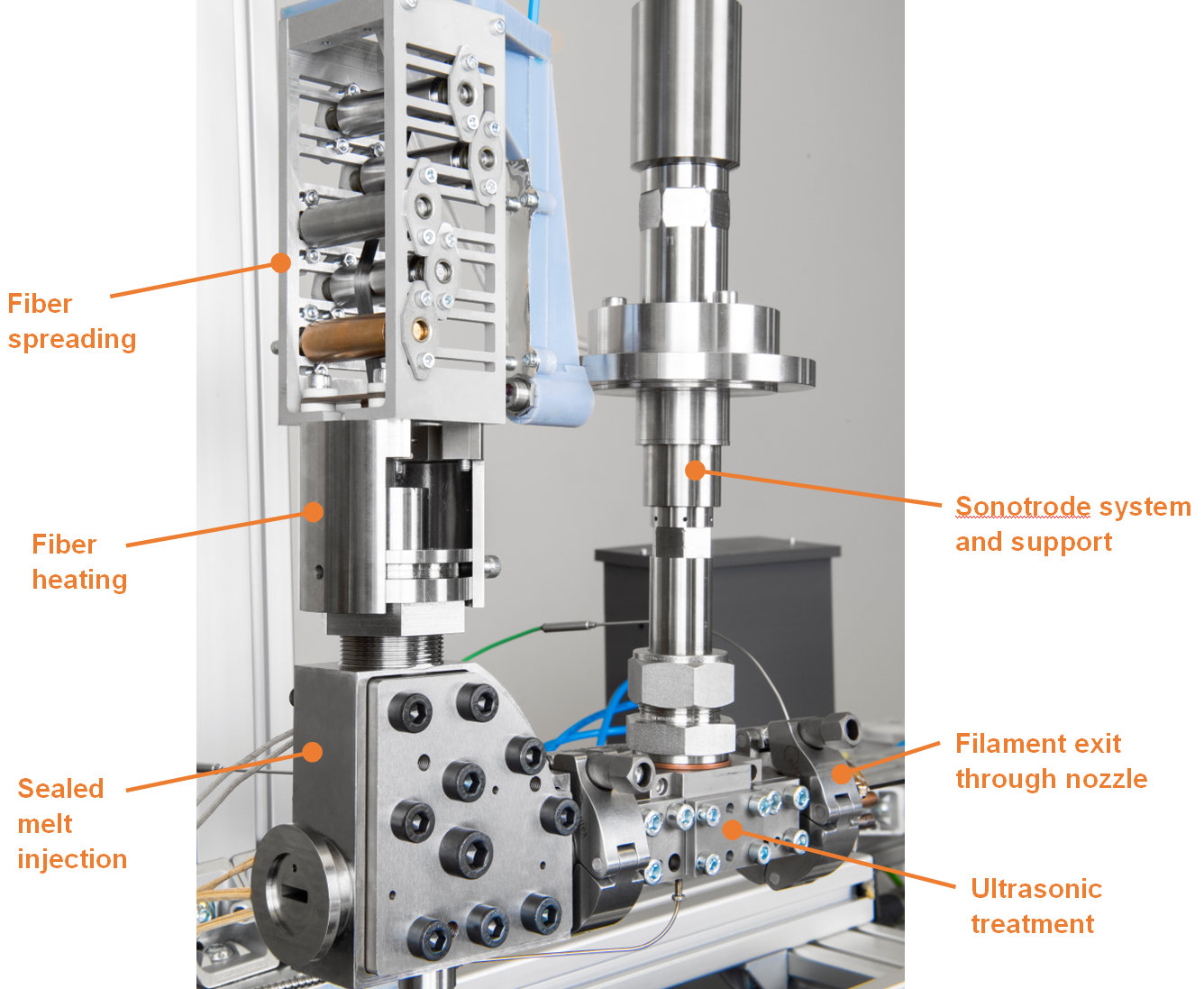
The process path begins with fiber spreading and heating (Fig. 1). This reinforcement is then fed into a sealed chamber into which the melted polymer is injected. As the fiber passes through this chamber, melted resin coats the fiber. “The fiber and polymer then proceed to an ultrasound chamber, which at 80 millimeters in length, is very small and compact,” notes Titze. “The sonotrode-emitted vibrations the fiber-reinforced polymer filament, which then exits the nozzle in whatever shape you want. For example, the nozzle can be circular or flat.”
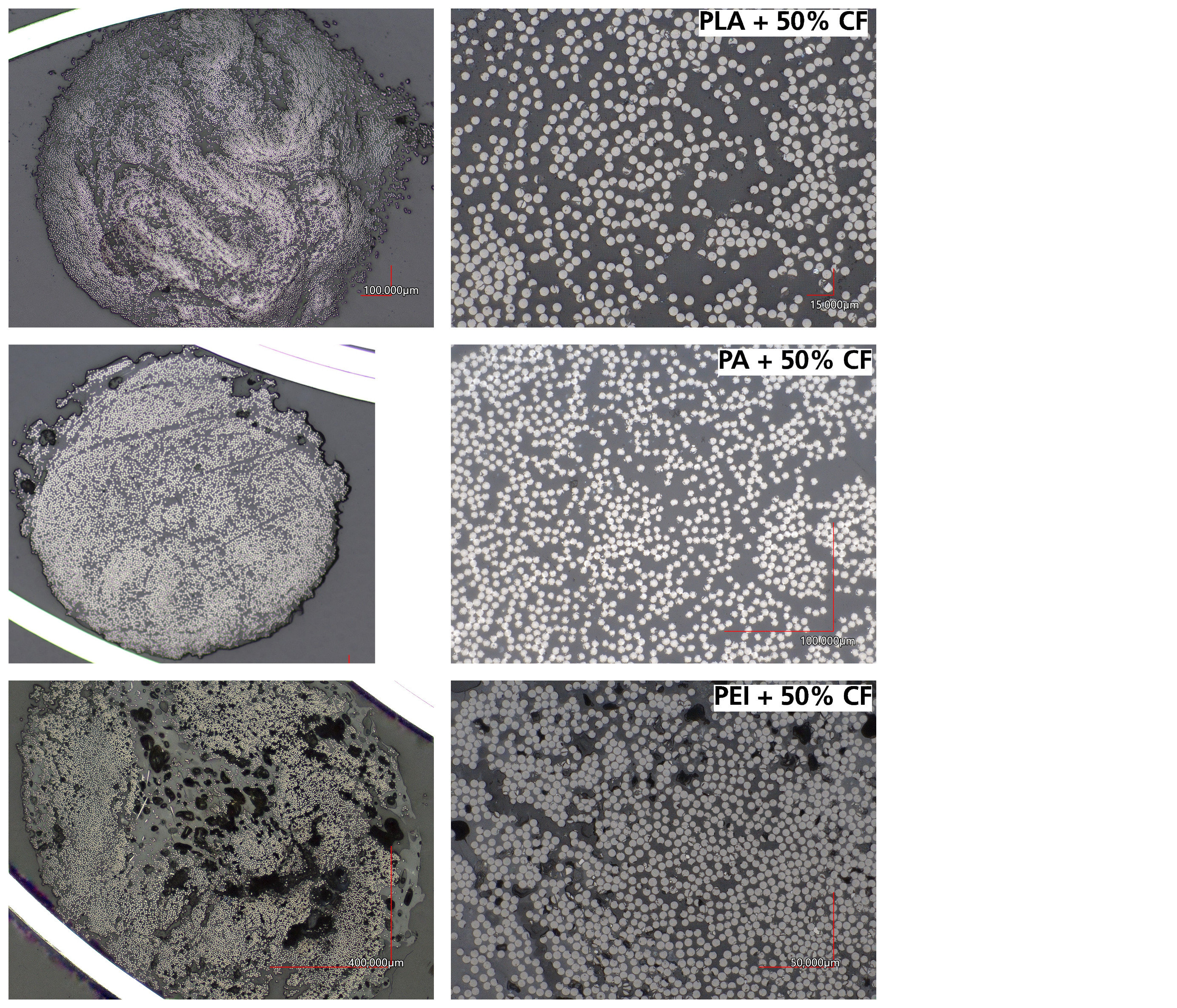
The micrographs in Fig. 2 show 12K carbon fiber impregnated with polylactic acid (PLA), polyamide (PA) and polyetherimide (PEI) at 50% fiber volume. The fiber volume is adjustable (30-50%) through the design of the die nozzle, says Titze. “We believe up to 60% will be possible. Overall, more work is needed on the process,but we have showed it works with good initial results and a line speed of 5- millimeters/second.” He concedes this is slow, and not economical, but a new equipment design was set to be tested in June, aimed already to reach3 meters/minute.
“Typically, speeds would be closer to 10 meters/minute,” says Titze. “However, the technology also intends to allow flexible production of new material combinations, so a slightly lower speed could help to make smaller production runs affordable.
The process that DLR has developed is not selective toward one material — any fiber or polymer can be used, says Titze. “This is important as processes continue to hybridize and new materials are needed. Materials for 3D printing must become more competitive, or continuous fiber 3D printing will not have a great future. By using thermoplastic pellets or granules, we can significantly lower the cost and the equipment fits into a small installation space so that even small companies can implement it.”
DLR Institute of Composite Structures and Adaptive Systems started this project in October 2019 and will complete it in January 2022. “Our goal is to further miniaturize the technology and integrate it into a print head,” says Titze. “So, this would be direct impregnation inline with the printing. Both approaches will be transferred into industry.” He explains that as a governmental non-profit, DLR will not be “selling” anything and therefore exclusive rights. “Our aim is to involve print head suppliers in order to bring down material prices across the board and widen the industrial application of continuous fiber additive manufacturing.”
Resin
- 6 Proven Strategies to Cut 3D Printing Costs
- Understanding the Economics of 3D Printing: ROI & Cost Analysis
- Unlocking Commercial Potential of UV-Curable Thermosets in Continuous Fiber 3D Printing
- Desktop Metal Launches Continuous‑Fiber Desktop 3D Printer for Engineers
- Industrializing Continuous Fiber Composite 3D Printing in Delft: Advancements & Production Success
- Continuous Fiber Manufacturing: Merging 3D Printing with Advanced Fiber Processing
- Advancing 3D Printing: Continuous Fiber‑Reinforced Composite Manufacturing
- Brightlands Materials Center Drives Continuous Fiber 3D Printing for Lightweight Limberg Bike
- Top High-Strength 3D Printing Filaments for Durable, Impact-Resistant Parts
- Cutting 3D Printing Costs: Proven Strategies from Design to Post-Processing