



Trackwise Achieves 26‑Meter Flexible Printed Circuit, Reducing UAV Wiring Weight 60%
Flexible Printed Circuits in unlimited lengths
Earlier this year, Trackwise (Gloucestershire, UK) shipped a 26-meter long multilayer flexible printed circuit (FPC) —believed to be the longest ever produced — for distributing power and control signals across the wings of a solar-powered, unmanned aerial vehicle (UAV). In fact, Trackwise supplied more than 50 FPCs for this vehicle, cutting weight by 60% versus using conventional wire harnesses for aircraft power and control.
This weight savings enables the US-made UAV to achieve higher payload and/or improved speed and range. Trackwise manufactures the FPCs using Improved Harness Technology (IHT), a patented, reel-to-reel manufacturing technique. IHT overcomes conventional manufacturing limitations which have kept most FPCs below two meters in length, and enables Trackwise to produce FPCs in unlimited lengths.
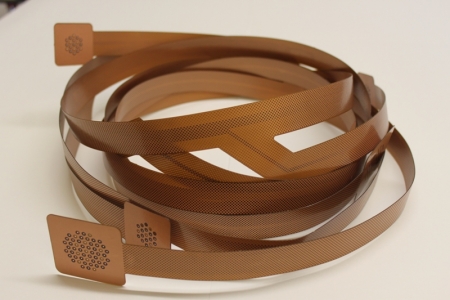
A 5-meter long, 6-layer flex PCB manufactured by Trackwise.
The FPCs that Trackwise delivered for the 26-meter-wingspan UAV were based on a polyimide substrate. Their planar structure dissipates heat better than conventional wiring, enabling higher current carrying capacity for a given weight of copper conductor. Other benefits include:
- Printed manufacturing ensures circuit consistency
- Fewer connection points are needed so reliability is enhanced
- The FPC is easier to install than wire harnesses, reducing a vehicle’s assembly time and cost.
According to Trackwise CEO, Philip Johnston, many new aerospace and automotive applications are emerging for these long, lightweight flexible, multilayer, printed circuit boards (flex PCBs). Both industries are seeing a push toward electrification simultaneous with a need for more sensors and control.
FPCs in composites?
Curious to know if Trackwise was embedding this FPC into composites, I began a discussion with Neil Bartlett, Trackwise director of sales and marketing. “For the UAV application highlighted in our March press release, the flex [flexible PCBs] were not embedded into a composite,” he concedes. “However, their planar nature makes them entirely suited to embedding into composites and enabling multi-functional structures. We are in preliminary discussions regarding incorporating flex — both power and signal variants — across a broad range of possible applications including aerospace, defense and construction. Trackwise is also a member of Advanced Concepts for Aero‑Structures with Integrated Antennas and Sensors (ACASIAS) – a consortium of 11 partners which is developing innovative technologies for integrating antennas into composites and aircraft structures.” (http://www.acasias-project.eu/)
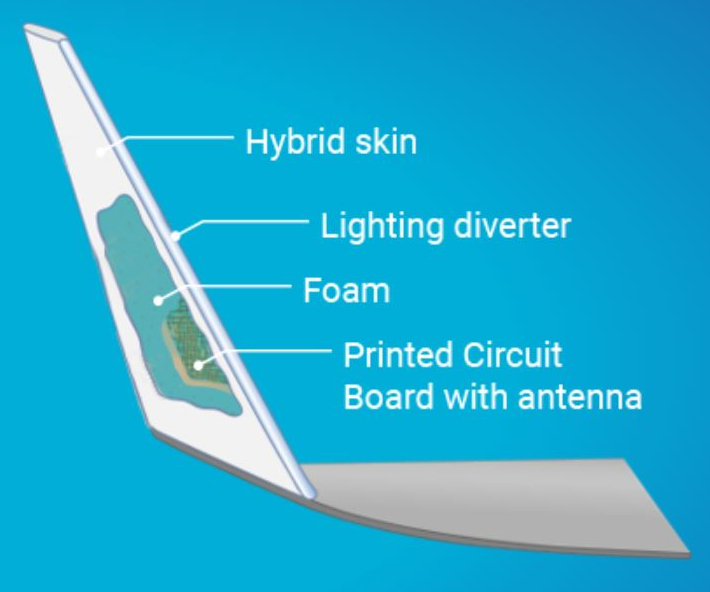
A smart winglet with integrated blade VHF (Very High Frequency) antenna.
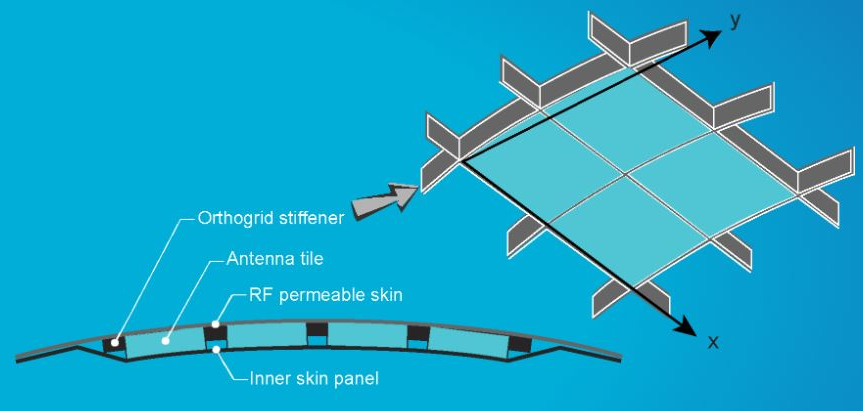
Stiffened orthogrid fuselage panel for the integration of a Ku-band SATCOM antenna array.
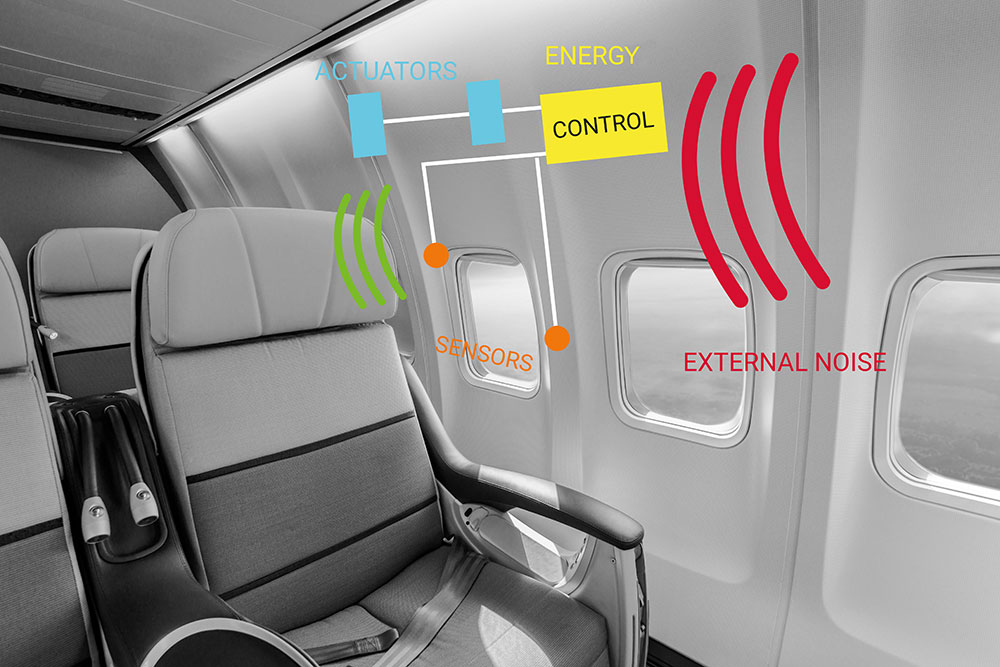
Active Structural Acoustic Control system for reduction of CROR cabin noise with minimal impact on weight. SOURCE | http://www.acasias-project.eu/files/Acasias_poster_v2.pdf
Bartlett says that flex PCBs made using IHT and composites are very synergistic in what they are offering the market and the advantages of combining/embedding them are compelling, including:
- Weight savings (elimination of fixing fixtures)
- Improved ruggedness/protection offered by composites = improved reliability/reduced maintenance
- Reduced space envelope = improved payload capability/structural efficiency
- Improved installation = less labor touch points (improved reliability), less time and cost.
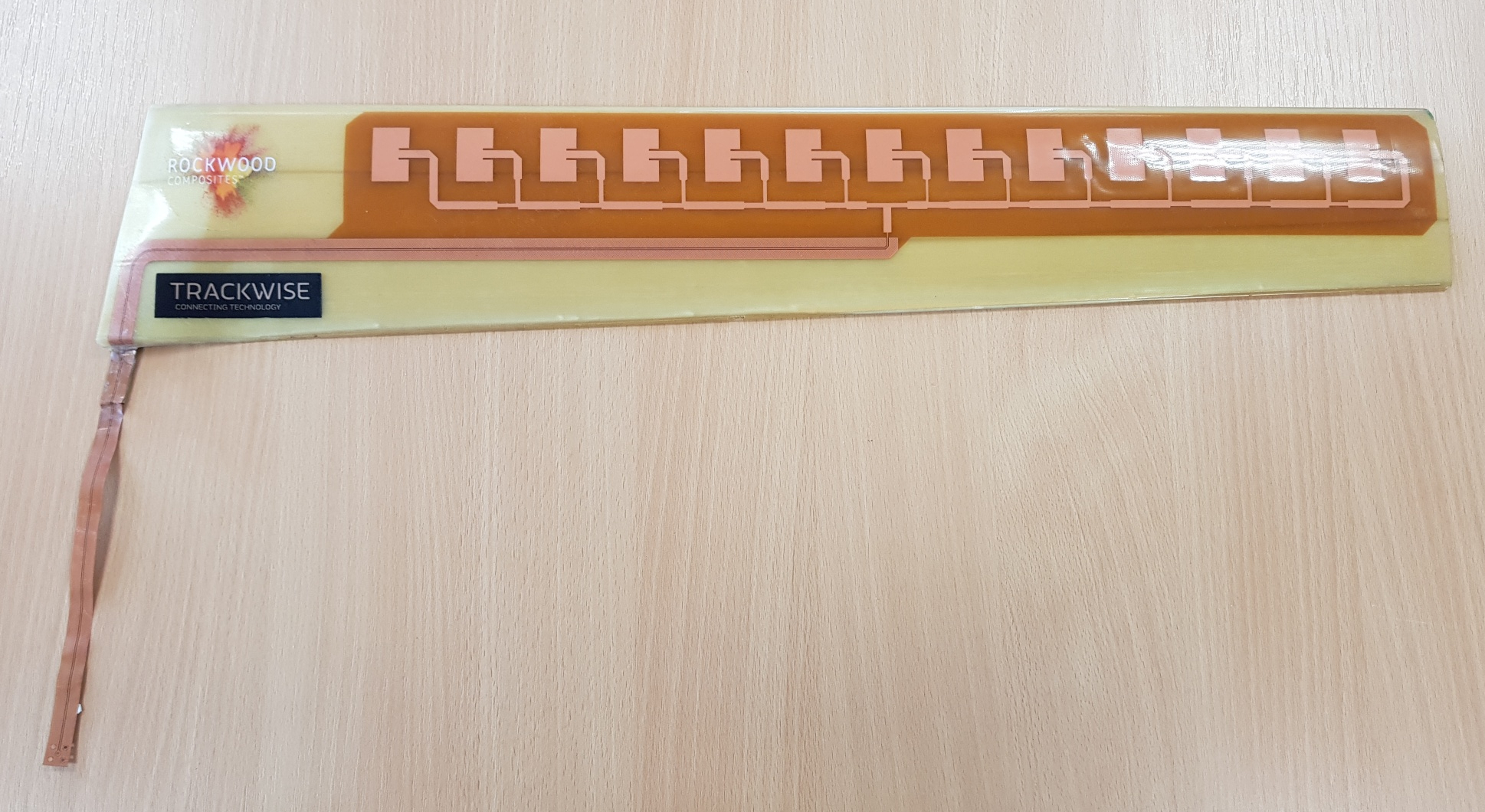
This demonstrator flex antenna embedded into a glass fiber composite was manufactured by Trackwise in collaboration with Rockwood Composites and exhibited at JEC World 2019. SOURCE | Trackwise
Moving forward
IHT revenues are up 217% with customers and development opportunities increasing from 7 at the start of 2018 to 45 by March 2019. Trackwise has also installed two new process lines.
Several ACASIAS projects will be presented at the 2019 European Conference on Multifunctional Structures (EMuS, June 11-12, Barcelona, Spain), which is co-chaired by ACASIAS coordinator Dr. Harmen Schippers, Netherlands Aerospace Center (NLR, Marknesse). Highlights include:
- Airbus Defense and Space has explored embedding an electronic steerable SATCOM antenna operating at Ka band in the wing to fuselage fairing of a passenger aircraft. The project is partly funded under Clean Sky 2 and include partners GILAT, RAYSAT and FBM Composite Materials Ltd.
- NLR is exploring an orthogrid structure for integrating square antenna elements into a composite fuselage, using a radio-transparent glass fiber skin and carbon fiber composite ribs.
- The German Aerospace Center (DLR) and China’s AVIC Beijing Institute of Aeronautical Materials (BIAM) have investigated the use of recycled carbon fibers to increase the mechanical strength and multifunctional aspects of bio-composites, looking at electrically conductive composites for electromagnetic interference (EMI) shielding and lightning strike protection (LSP) via the ECO-COMPASS project.
Resin
- C++ Structures vs Classes: A Practical Guide for Embedded Developers
- DOMMINIO Virtual Workshop: Advancing Multifunctional Composite Airframe Parts
- DLR Institute of Structures and Design Advances Thermoplastic Composite Fuselage Technology
- Portable Repair Kits Simplify In-Field Composite Structure Maintenance
- Advanced Composite Isogrid Structures Created with Cutting‑Edge Deposition Technology
- Future Composite Manufacturing: AFP and Additive Manufacturing Synergy
- Advancing the Multifunctional Fuselage Demonstrator: Pioneering Sustainable Aircraft Innovation
- Solvay Expands Global Innovation with New Thermoplastic Composite Centers in U.S. and Belgium
- Revolutionizing Automotive Design: Automated Hybrid Metal–Thermoplastic Composite Joining
- FACC Secures ArianeGroup Contract to Produce Composite Structures for Ariane 6 Launch Vehicle