



3D Printing Precious Metals – A New Frontier in Additive Manufacturing

According to a recent SmarTech analysis, the additive‑manufacturing market for precious‑metal materials is projected to reach $250 million by 2028. While still emerging, 3D printing of gold, silver, and platinum is already reshaping high‑end, low‑volume sectors that demand unparalleled customization and design freedom—particularly in jewelry, watchmaking, dentistry, and electronics.
In this article we explore how 3D printing with precious metals works, the current limitations, and the potential evolution of its applications.
Direct vs. Indirect Manufacturing
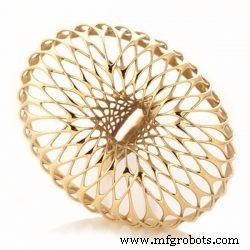
Manufacturers typically choose between two approaches: indirect and direct 3D printing.
Indirect manufacturing uses a 3D‑printed wax pattern (usually produced by stereolithography, SLA) as a mold in a lost‑wax casting process. The pattern is coated in a refractory material, baked to remove the wax, and then filled with molten precious metal. This method saves the artisan’s time while still allowing intricate, custom designs.
Direct manufacturing builds the final part directly from a CAD file, typically using Direct Metal Laser Sintering (DMLS) or Material Jetting. The finished part emerges from the printer without the need for post‑processing cast molds.
Direct Manufacturing in Detail
Direct 3D printing of precious metals is still nascent compared to indirect methods. The main hurdles are the high cost of research, the reflective and thermally conductive nature of gold and silver, and the difficulty of achieving complete fusion with conventional AM lasers. Nonetheless, a handful of advanced systems now overcome these challenges.
Market‑Ready Machines
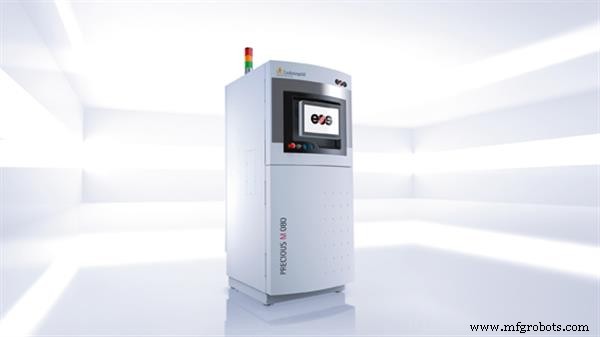
EOS, in partnership with UK‑based Cooksongold, launched the EOS PRECIOUS M 080 in 2014. This system accepts a broad spectrum of precious‑metal powders—gold, silver, platinum, palladium—and other alloys. Jewelry brand Boltenstern leveraged the machine to produce its “Embrace” collection in gold and platinum, achieving unprecedented levels of customization.
Italian manufacturer Sisma introduced the mysint100 in 2014, capable of processing bronze, gold, and other precious‑metal alloys. The larger mysint300 followed in 2016, catering to small series and medium‑sized components.
Printing Platinum
Platinum’s high melting point and reactivity make it difficult to cast. DMLS offers a cleaner alternative, achieving densities above 99.9%—a significant improvement over the 99.2% typical of cast parts, according to Cooksongold.
Applications in Dentistry
Dental restorations—crowns, inlays, and onlays—benefit from the ability to produce fully dense, custom components on demand. Argen, a dental digital‑technology leader, uses Concept Laser machines to print noble and non‑precious alloys, delivering bespoke dentures with high precision.
Electronics and Printed Conductors
Material Jetting differs from DMLS by depositing fine droplets of conductive ink—often silver or gold—layer by layer, then curing them with UV light. This process enables the creation of antennas, PCBs, sensors, and other electronic components.
Israeli firm Nano Dimensions pioneered this with its DragonFly 2020 Pro, capable of simultaneous deposition of conductive and dielectric inks. U.S. company Optomec’s Aerosol Jet HD further expands the palette, using aerosolized silver, gold, copper, and platinum inks to print resistors, antennas, and strain gauges. Researchers at Carnegie Mellon University have demonstrated high‑temperature strain gauges made with silver nanoparticles that outperform commercial counterparts, opening doors for aerospace and nuclear applications.
Future Outlook
Although indirect printing remains the dominant method for precious metals, the industry is gradually shifting toward direct AM as equipment becomes more affordable and powder/ink chemistries mature. We anticipate a surge in directly printed jewelry and dental products, driven by consumer demand for customization and rapid turnaround. In electronics, the continued development of metal inks could herald a new era of printed sensors and antennas, accelerating the Internet of Things.
3D printing
- 3D‑Printed Concrete Bridge: Pioneering Construction Innovation
- Prodways Launches Rapid Additive Forging: A New Frontier in Metal 3D Printing
- Innovative Research Promises Stronger, Energy‑Efficient 3D‑Printed Plastics
- Advanced 3D‑Printed Materials Revolutionize Professional Sports Equipment
- How 3D Printing Is Revolutionizing Aerospace Design and Production
- Introducing Endur™ – Advanced Polypropylene‑Like 3D Printing Material
- Stratasys Unveils Revolutionary FDM Innovations: Infinite-Build and Robotic Composite Demonstrators
- Stratasys Unveils Antero800na & Nylon12‑CF, New High‑Performance 3D Polymers for Aerospace, Automotive, and Industrial Parts
- Expert Guide to Efficiently Machine Precious Metals
- Revolutionizing CNC Turning: High Dynamic Turning & FreeTurn Tooling