



How 3D Printing Is Revolutionizing Aerospace Design and Production

Since its first application in 1989, aerospace has been a pioneer in additive manufacturing. Today the sector accounts for 16.8 % of the $10.4 B AM market and remains a major driver of research and development.
Leading firms such as GE, Airbus, MOOG, Safran and GKN not only adopt 3D printing to lower costs and create complex components, but also push the technology’s boundaries through continuous R&D.
This article examines how the aerospace industry harnesses 3D printing to innovate aircraft design and manufacturing.
The benefits of 3D printing for aerospace
Low‑volume production
In aerospace, highly complex parts are often produced in small batches. 3D printing eliminates the need for costly tooling, enabling OEMs to manufacture intricate geometries at a fraction of the cost. The result is a streamlined, cost‑effective production pathway for low‑volume runs.
Weight reduction
Weight is a critical factor in aircraft performance and sustainability. 3D printing facilitates the creation of lightweight parts that directly reduce fuel consumption, lower CO₂ emissions, and increase payload capacity for both aircraft and spacecraft. When combined with generative design and topology optimisation, the potential for further weight savings is essentially limitless.
Material efficiency
Traditional manufacturing often yields a high buy‑to‑fly ratio—for example, titanium components may require 12:1 to 25:1 raw material to finished part. Metal 3D printing reduces this ratio to 3:1–12:1 by depositing material only where needed, generating minimal waste. This efficiency translates into significant cost savings, especially for expensive alloys such as titanium and nickel.
Part consolidation
One of the standout advantages of additive manufacturing is part consolidation: merging multiple components into a single part. This reduces assembly time, simplifies maintenance, and cuts down on the number of parts that must be tracked and stored. GE, for instance, has reduced the number of jet‑engine fuel nozzle components from 20 to just one by leveraging AM.
Maintenance and repair
With aircraft lifespans of 20–30 years, maintenance, repair, and overhaul (MRO) are essential. Direct Energy Deposition and other metal AM processes are now routinely used to repair turbine blades and other high‑performance components, restoring material to worn surfaces and extending service life.
Pioneering 3D printing technologies in aerospace
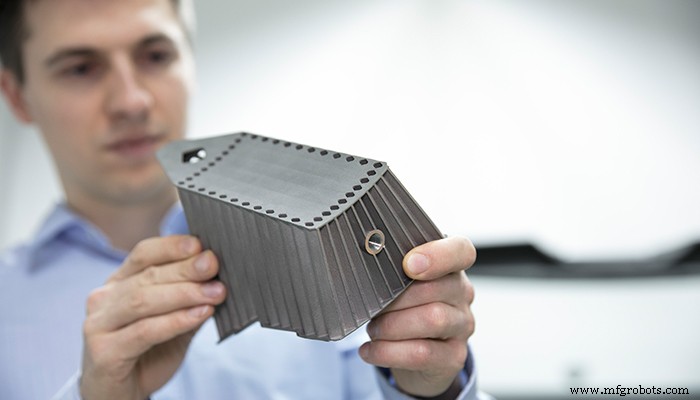
Aerospace companies employ a wide spectrum of AM techniques. Fused Deposition Modelling (FDM) is commonly used for rapid prototyping and tooling, as seen with French manufacturer Latécoère, which cuts lead times by up to 95 %. For end‑use metal parts, powder‑bed fusion methods such as Selective Laser Melting (SLM) and Electron Beam Melting (EBM) produce dense, high‑strength components. Large‑scale AM innovations, including Wire‑Arc Additive Manufacturing (WAAM), are also emerging for structural applications.
Industry leaders such as Sciaky, Airbus, and Aubert & Duval are collaborating to develop new manufacturing methods for titanium‑alloy aircraft parts, while GE is advancing metal binder jetting to enable mass production of AM parts.
3D printing materials for aerospace
While prototypes can be produced from a variety of plastics, end‑use parts must meet rigorous flight‑grade standards. Qualified materials include engineering‑grade thermoplastics such as ULTEM 9085, ULTEM 1010, and Nylon 12 FR, as well as high‑performance metal powders—titanium, aluminium, stainless steel, and nickel alloys. Titanium, in particular, offers an attractive blend of light weight and strength; waste is minimized through design optimisation and material recycling.
Aerospace 3D printing applications
Tooling
Aerospace OEMs and suppliers increasingly use 3D printing to produce manufacturing aids like jigs, fixtures, and coordinate‑measuring‑machine (CMM) tooling. For example, Moog Aircraft Group now fabricates CMM fixtures in-house via FDM, cutting production time from 4–6 weeks to just 20 hours and reducing costs from over £2,000 to a few hundred pounds.
Spare and replacement parts
Predicting spare‑part demand is challenging, so on‑demand 3D printing offers a compelling solution. By printing parts at the point of need, airlines and maintenance operators can dramatically shorten turnaround times, cut shipping costs, and virtually eliminate the need for bulky inventory. Lufthansa Technik’s AM centre has produced gaskets, longerons, and other components for aging military aircraft, while Rocket Lab prints engine parts on demand.
End‑use parts
Manufacturers are increasingly turning to AM for structural components, from cabin interiors to propulsion systems. Diehl Aviation’s 3D‑printed curtain header, assembled from 12 thermoplastic parts, is the largest fully printed passenger‑aircraft part yet and is being line‑fitted into A350s. Rocket Lab has been using AM for all primary engine components—combustion chambers, injectors, pumps, and valves—since 2013.
3D printing challenges in aerospace
Certification remains the foremost hurdle. Aircraft components must meet stringent safety and performance standards, and regulators must ensure that 3D‑printed parts are as reliable as traditionally manufactured ones. Standards are evolving: SAE International’s Aerospace Material Specifications (AMS) for metal and polymer AM were first released in 2018, with additional AMS7100 polymer guidelines added in 2023. ASTM International’s F42 committee is developing further standards covering feedstock, part properties, system performance, and qualification principles.
Ensuring process repeatability is also critical. Robust qualification protocols, combined with workflow automation tools such as AMFG, help trace every production step and guarantee consistent, certifiable parts on demand.
The future of 3D printing in aerospace
Despite regulatory and technical challenges, the aerospace sector continues to lead AM innovation. Collaborative efforts among OEMs, government agencies, and research institutions are accelerating certification pathways. Market forecasts project 3D‑printed end‑part production to surpass $3 B by 2024, and the trend toward more metal and polymer components in aircraft and spacecraft is poised to accelerate in the coming years.
3D printing
- Choosing the Right Plastic for 3D Printing: A Comprehensive Guide
- ACEO® Unveils Breakthrough Silicone 3D Printing Technology
- A Practical Guide to Ceramic 3D Printing: Techniques, Materials, and Design Tips
- 3D Printing with Resins: A Comprehensive Guide to Technologies, Materials, and Applications
- 3D Printing Precious Metals – A New Frontier in Additive Manufacturing
- Titanium 3D Printing: Applications, Benefits, and Emerging Technologies
- CatalystEX 4.5: New Features, Enhanced Compatibility, and GrabCad Print Integration
- Solukon & Siemens Launch Advanced 3D Printing Depowdering System
- Master 3D Printing with Wood Filament: Techniques & Benefits
- Enhancing 3D Printing: Mastering Support Structures for Complex Builds