



Merging 3D Printing and Robotics: Pioneering Smart Factory Solutions
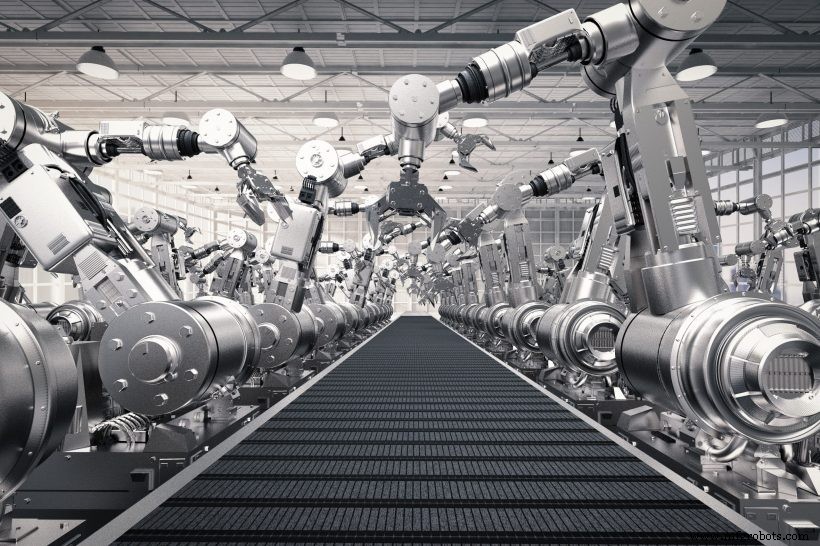
Integrating 3D printing with industrial robots is emerging as a powerful strategy for the next generation of manufacturing.
Two primary forces drive this trend: the need to produce large, highly accurate parts additively, and the opportunity to embed 3D printing into fully automated, digital production lines. As the industry moves toward digitisation, robotic additive manufacturing stands out as a key enabler of smart factories.
How Robotics and 3D Printing Work Together
The synergy can be achieved in two main ways:
- Robotic arms equipped with material deposition heads. Stratasys demonstrated this approach with its Robotic Composite 3D Demonstrator at IMTS 2016. The system combined an FDM extrusion head with an 8‑axis industrial robot, producing larger, lighter, and more precise thermoplastic parts.
Voodoo Manufacturing’s industrial robot automates the manual task of swapping build plates, boosting factory floor productivity. Methods 3D showcased Fanuc robot‑driven washing, curing, and finishing of printed parts at the same event.
Key Benefits of Robotic Additive Manufacturing
Larger, Complex Parts
Robots offer high repeatability and multi‑axis freedom, while 3D printing excels at creating intricate geometries quickly and cost‑effectively. Together, they enable the production of truly large‑scale objects.
Freeform Manufacturing
A multi‑axis robotic arm can print at varied angles, eliminating the need for support structures. Overhangs become feasible by reorienting the build platform, expanding design possibilities.
Reduced Material Waste
Material is deposited only where needed, making robotic 3D printing a sustainable manufacturing approach that conserves resources.
Although still nascent, the market for robotic additive manufacturing spans multiple sectors. For example, Viridis3D’s Robotic Additive Manufacturing (RAM) system, developed with EnvisionTEC, uses binder‑jetting technology on an ABB robot to build sand‑based parts. Hazleton Casting Company credits RAM with revolutionising custom sand core production.
Real‑World Use Cases
Construction stands to benefit significantly. French start‑up XtreeE equips an ABB robot with a concrete extruder, printing structures up to 14 m tall. Their portfolio includes façade panels, columns, benches, and pavilions, all designed with the freedom of robotic movement.
Metal additive manufacturing also sees robotic integration. MX3D Metal combines an industrial robot with a welding unit to produce large, free‑form metal constructions. Their 12‑metre steel bridge, fabricated last year, exemplifies this capability.
London‑based Ai Build develops AI‑powered robotic heads (AiMaker) that attach to any robot arm, enabling large‑scale architectural printing from plastic. AI and computer vision monitor the process, detecting issues in real time.
Looking Ahead
Intelligent robots paired with additive machines and AI open new avenues, such as automated repair. Swinburne University of Technology, in partnership with the Innovative Manufacturing Cooperative Research Centre and Tradiebot Industries, is developing “Repair Bot” to 3‑D print and assemble replacement plastic car parts using 3‑D scanning.
Ultimately, the fusion of robotics and 3D printing not only makes large‑scale parts possible but also integrates additive manufacturing seamlessly into conventional automated production. This integration will unlock the full potential of smart manufacturing for the future.
3D printing
- How 3D Printing Drives Innovation in Formula One – 5 Key Trends
- 3D Printing & Prototyping at Mar‑Bal: Accelerating Composite Innovation
- Agile Manufacturing & 3D Printing: A Guide to Rapid, Custom Production
- 3D Printing Today and Tomorrow: What You Can Create Now and What the Future Holds
- Yaskawa & Realtime Robotics Unveil Advanced Logistics Automation Solution
- Industrial IoT & Smart Manufacturing: Transforming Plant Operations
- Design Jigs & Fixtures Using CNC Machining & 3D Printing
- Create a 3D Printing Profile: A Step-by-Step Guide to FDM Success
- Proven Strategies for Crafting High-Quality 3D Prints
- Mastering Accuracy, Precision, and Tolerance in 3D Printing