



How 3D Printing Drives Innovation in Formula One – 5 Key Trends

In Formula One, every fraction of a second counts. Teams must constantly refine their cars to stay ahead of rivals and comply with the ever‑evolving FIA regulations. That rapid iteration demands a culture of relentless innovation, and additive manufacturing has become the engine behind many breakthroughs.
3D printing excels at producing fast iterations and intricate geometries that would be impossible—or prohibitively expensive—to create with traditional methods. From prototyping to lightweight tooling, the technology is reshaping how teams design, test, and produce race‑car components.
1. Faster prototyping
Reducing production time and cost is a top priority when developing new parts. 3D printing lets engineers transform a digital CAD model into a functional prototype almost instantly, bypassing the need for patterns, molds, or secondary machining steps.
For example, Williams F1 can produce over 2,000 3‑D printed parts each month, a volume unattainable with conventional manufacturing at that scale. Rapid prototyping also means design flaws can be identified and corrected early, saving time and resources that would otherwise be spent on full‑scale production.
2. Greater design flexibility
Design iterations are often the difference between a marginal gain and a championship. Additive manufacturing allows teams to tweak geometries on the fly and re‑print components within hours, enabling a quick feedback loop.
In the cramped, aerodynamic chassis of an F1 car, space is at a premium. 3D printing makes it easier to create tightly fitted parts that still allow pit‑stop accessibility, improving both performance and serviceability.
3. Enhanced wind‑tunnel testing
Wind‑tunnel models—typically 60 % the size of a real car—are critical for refining aerodynamics. 3D printing provides durable, accurate replicas that can be tested on the treadmill at high speeds, revealing subtle airflow changes that influence lap times.
Alfa Romeo Sauber F1 routinely uses SLS and SLA printers to produce front wings, brake ducts, and suspension covers for wind‑tunnel rigs. They can print 200–300 plastic parts per workday, a throughput impossible with machining or hand‑built models.
4. Rapid tooling production
Tools such as jigs, fixtures, and sacrificial molds are essential for production and maintenance. 3D printing delivers these tools on demand, reducing lead times and costs while allowing custom geometry.
McLaren has leveraged FDM with ULTEM 1010 to print a lay‑up tool for a rear wing flap extension in just three days, cutting the traditional lead time by a significant margin. On‑track tool production also eliminates costly courier services, enabling teams to address last‑minute adjustments during a race weekend.
5. Enhanced part performance
Weight reduction is paramount in motorsport. 3D printing of lightweight, complex thermoplastic and metal components can yield substantial performance gains.
Alfa Romeo Sauber prints metal parts—such as upright covers and exhaust components—directly onto the final car, achieving structural integrity while keeping mass down. In some cases, additive manufacturing cuts production time by 20‑25 % compared to machining.
The challenges of 3D printing in motorsports
#1 Ensuring consistency
Variation in material properties or dimensions can occur when parts are outsourced. Many teams are therefore bringing more of their additive manufacturing in-house to maintain tighter quality control.
#2 Education
Adoption of 3D printing hinges on skilled designers and engineers. Motorsport organisations are investing in targeted training programs to build internal expertise and ensure that new capabilities translate into competitive advantage.
#3 Managing 24‑hour production
High‑volume, 24‑hour printing operations require robust workflow management. Automation software can streamline request handling, job scheduling, and traceability across multiple facilities, preventing bottlenecks and ensuring every part meets the team’s exacting standards.
Current use cases
3D‑printed roll hoop

The Alfa Romeo Sauber team prints a roll hoop in Scalmalloy using Direct Metal Laser Sintering. This lightweight metal, tailored for additive manufacturing, reduces weight while preserving structural integrity. Lead time drops by 20‑25 % compared to conventional aluminum machining.
Structural car parts
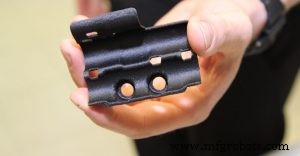
McLaren used an FDM Stratasys printer to create a carbon‑fiber‑reinforced nylon bracket in just four hours—an order of magnitude faster than the two weeks required by traditional methods.
3D Printing for Motorsports: a competitive advantage
As regulations tighten and the margins of victory shrink, 3D printing offers Formula One teams a decisive edge: faster development cycles, lighter and stronger parts, and the agility to adapt designs on the fly. The trend is clear—additive manufacturing will continue to be a cornerstone of high‑performance motorsport engineering.
3D printing
- 5 Key 3D Printing Trends Shaping 2019
- 5 Emerging Trends Shaping 3D Printing Software
- 2019 3D Printing Materials Market: Trends, Growth, and Emerging Opportunities
- 3D Printing & Prototyping at Mar‑Bal: Accelerating Composite Innovation
- Agile Manufacturing & 3D Printing: A Guide to Rapid, Custom Production
- Top 3 3D Printing Trends That Defined 2018
- Industry Trend: 3D‑Printed Tooling & Fixtures Slash Costs by 95%
- 3D Printing Trends 2019: Metal Innovation, Binder Jetting Breakthroughs, and Advanced Plastics
- Mastering Accuracy, Precision, and Tolerance in 3D Printing
- Exploring 3D Printing Technologies in Education: Fundamentals and Key Advantages