



Interview: HP’s Global Head of Metals Discusses the Game-Changing HP Metal Jet Technology
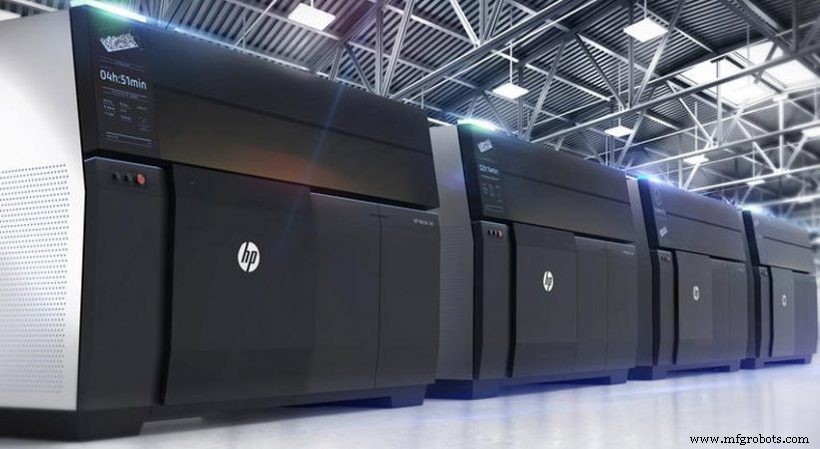

HP has long been a trailblazer in 3D printing, setting industry milestones with its 2016 Multi Jet Fusion launch. That breakthrough opened the door to high‑volume, production‑grade parts made from polymer. Now, two years later, HP is expanding that vision with HP Metal Jet, a new 3D‑printing solution engineered for mass production of finished metal components.
We spoke with Dr. Tim Weber, HP’s Global Head of Metals for 3D Printing, to learn how the company’s metal strategy fits into the broader goal of transforming manufacturing at scale.
Disrupting a $12 trillion industry
“Since we entered the plastics arena two years ago, our focus has been on delivering real value to customers,” says Weber. “Today, most 3D‑printing use cases remain confined to prototyping and niche production. Even when accounting for hardware, materials, and software, the market is roughly $10 billion—just a fraction of the $12 trillion global manufacturing sector.”
HP’s ambition is to reshape that landscape, including the metal segment. To do so, the company must first tackle three key challenges:
1. Reliability for mass‑scale production. “The system must endure everyday manufacturing environments while consistently producing parts that qualify as end‑use components.”
2. Cost‑effective materials. “Material pricing remains a major barrier. We need to reduce overall material costs and streamline selection across the thousands of available metal alloys.”
3. Open materials platform. “We’ve launched an open‑materials framework that unifies plastics and metals, making it easier for customers to choose the right feedstock.”
The starting point: HP Multi Jet Fusion
Before HP Metal Jet, the company pioneered its Multi Jet Fusion (MJF) line—a binder‑jet process that spreads plastic powder, jets a fusing agent, and uses infrared energy to melt the material layer by layer. HP’s MJF portfolio includes the 4200 and 4210 models, as well as the smaller, color‑printing Jet Fusion 500/300 series.
One U.S. customer, Forecast 3D, now operates 24 printers 24/7, producing millions of parts—demonstrating the transition from prototyping to production.
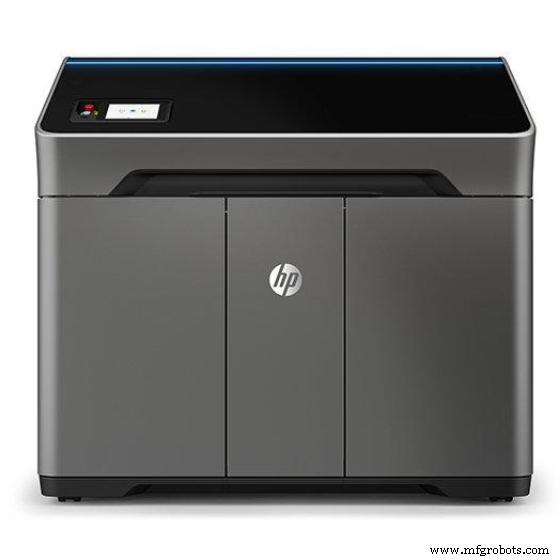
“With plastics, we’re making the leap to production,” Weber says. “Our goal is to democratize additive manufacturing, allowing users who previously only prototyped to go straight to manufacturing with the same technology.”
From plastics to metals
“3D printer makers must deliver superior economics to compete not only with other additive solutions but also with conventional methods such as investment casting, metal injection molding (MIM), and CNC machining.”
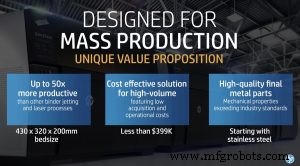
HP’s MJF platform served as the foundation for Metal Jet, which adapts the binder‑jet concept for metal powders. Metal Jet can achieve up to 50× the productivity of competing binder‑ and laser‑sintering systems, producing isotropic parts that meet ASTM standards.
“We re‑engineered the core MJF hardware to accommodate metal powders instead of plastics,” explains Weber. “Rather than a fusing agent, we jet a binding agent derived from HP Latex Ink technology. The binder’s low weight (<1 % by mass) eliminates the need for high‑temperature binder burnout, reducing cycle time and cost.”
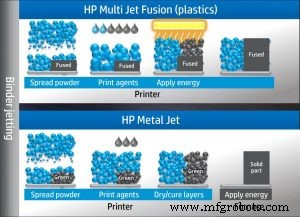
HP’s long‑standing expertise in thermal inkjet printing—developed over three decades—underpins this breakthrough binder, ensuring strong green parts and efficient sintering.
Initially, HP launched the system with 316 I stainless steel, a widely used industrial alloy. “We focused on mastering one material end‑to‑end to establish robust process controls and meet stringent tolerances,” says Weber. “Future plans include low‑carbon and alloyed stainless steels.”
The power of strategic partnerships
HP’s Metal Jet debut is accompanied by strategic alliances that accelerate adoption across key sectors.
GKN Powder Metallurgy—a global leader that produces 13 million parts daily—has partnered with HP. This collaboration has already secured major automotive clients such as Volkswagen and pump manufacturer Wilo. Volkswagen’s multi‑year strategy involves integrating Metal Jet into its production chain, enabling rapid prototyping of mass‑customizable components (e.g., key rings, nameplates) and high‑performance functional parts like gearshift knobs and mirror mounts. As electric vehicles enter mass production, HP Metal Jet is positioned to support lightweight, safety‑certified metal parts.
Parmatech, with 40 years of MIM expertise, focuses on the medical industry. HP aims to embed Metal Jet production services at Parmatech sites, allowing medical device manufacturers to test and qualify designs for mass production.
“While HP excels at printing, we partner with specialists who know how to manufacture metal parts for industry,” Weber explains. “Through GKN and Parmatech, we can deliver tailored Metal Jet services across automotive, medical, and industrial markets.”
Looking toward the future
When asked about the next five years, Weber emphasized the shift toward distributed manufacturing.
“We’re on the cusp of a new industrial revolution where distributed manufacturing will be pivotal. As 3D printing moves from prototyping to full‑scale manufacturing, the industry will experience rapid adoption.”
HP plans to launch the Metal Jet Production Service in early 2019, allowing customers to upload, test, and qualify designs for mass production. Commercial systems are slated for general release in 2020, priced below $399,000.
For more information, visit HP Metal Jet.
3D printing
- How Industry 4.0 Transforms Modern Manufacturing: Benefits, Practices, and ROI
- MELD Manufacturing CEO Nanci Hardwick on Revolutionizing Metal 3D Printing
- Top Metal 3D Printing Materials: Unlocking Additive Manufacturing’s Potential
- How Sensors Transform Manufacturing Efficiency and Insight
- Tracing the Evolution of Metal Manufacturing: From Ancient Tools to Modern Tech
- How Industry 4.0 Revolutionizes Manufacturing: Benefits & Opportunities
- How Global Manufacturing Networks Boost Efficiency, Quality, and Market Reach
- Maximizing Profitability in Metal Machining: Cost‑Efficiency and Quality
- Metal Additive Manufacturing: Transforming Production for Aerospace and Beyond
- CNC Machining: Transforming Manufacturing for Speed, Precision, and Sustainability