



9 Fortune 500 Companies Leading the Industrial 3D Printing Revolution
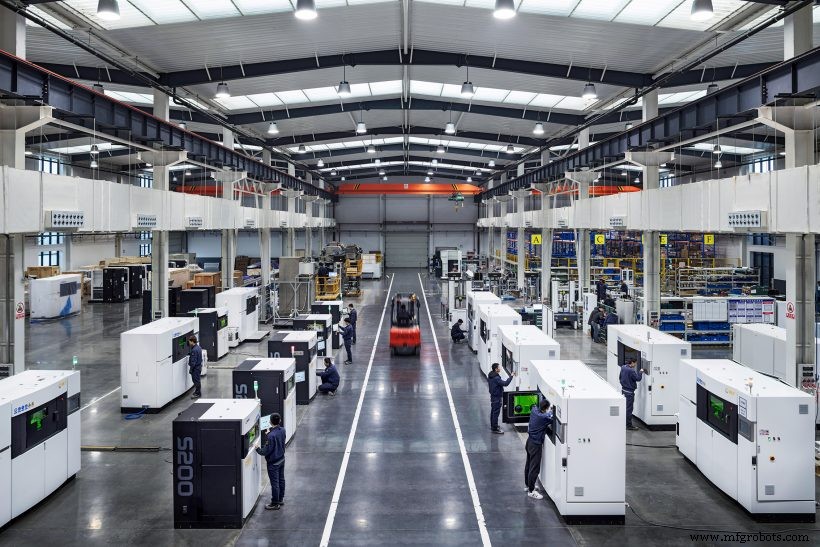
Fortune 500 companies are at the forefront of industrial 3D printing, turning the technology into a competitive advantage across sectors.
For these global leaders, additive manufacturing delivers rapid product development, supply‑chain resilience, and the ability to bring truly innovative products to market.
Below we examine nine Fortune 500 firms that are redefining their industries through 3D printing, exploring the role the technology plays today and its trajectory for the future.
1. Airbus – Aerospace Pioneer
Airbus has invested in 3D printing for over 15 years, beginning with plastics and rapid prototyping before expanding into production parts. In 2010, the company launched an “innovation cell” that seeded a Europe‑wide platform in 2014, enabling the adoption of additive manufacturing across its industrial processes.
That same year, Airbus conducted its first test flights featuring 3D‑printed titanium brackets, proving the viability of AM for aircraft components. In 2017, a collaboration with Liebherr produced a titanium hydraulic flight‑control component for an A380 test plane, and the partnership now supplies serial‑produced AM parts such as A350 XWB nose‑landing‑gear brackets.
Beyond parts, Airbus routinely 3D‑prints tooling—jigs, fixtures, and on‑demand components—to shorten lead times. Recently, it teamed with LM Industries to launch Neorizon, a start‑up focused on autonomous mobility that blends polymer and metal printing expertise.
Airbus’s continued investment signals a bright future for 3D printing within its aerospace portfolio.
2. Volkswagen Group – Automotive Leader
Volkswagen’s portfolio—including Audi, Porsche, and Lamborghini—has embraced additive manufacturing, largely through its Wolfsburg 3D Printing Center. The center explores AM technologies and produces tooling and end‑use parts, while larger production runs are handled by external service providers.
In 2014, VW piloted Ultimaker desktop printers to produce tooling at its Autoeuropa factory in Portugal. The success of this pilot led to a company‑wide shift toward 3D‑printed tooling.
Electric‑vehicle development has also accelerated AM adoption. Volkswagen Motorsport used 3D printing to develop the electric I.D. R Pikes Peak race car in just eight months, meeting critical launch deadlines.
Luxury brands such as Porsche and Bugatti regularly use AM: Porsche prints replacement parts for classic cars, while Bugatti applies metal printing to produce titanium brake calipers for the Chiron. Bugatti recently collaborated with APWORKS to create titanium exhaust finishers that reduce turbulence and improve high‑speed handling.
Volkswagen’s partnership with HP and GKN introduces HP’s binder‑jet metal technology, enabling the Wolfsburg Toolmaking unit to print high‑volume steel parts ranging from 2 to 5 cm in length.
3. ExxonMobil – Oil & Gas Innovator
In the oil and gas sector, 3D printing is a strategic tool for rapid prototype development. ExxonMobil leveraged AM to accelerate the design of its cMIST™ system, which removes H₂O, CO₂, and H₂S from natural gas to meet safety and quality standards.
Key components include a patented droplet generator that sprays solvent droplets to capture water, and an inline separator that utilizes gas velocity to remove impurities. Rapid prototyping of the droplet generator via 3D printing allowed quick design iterations, enhancing performance and reliability.
Although a small component, the droplet generator is critical for cleaner natural gas production in challenging offshore and unconventional reservoirs.
4. Equinor – Energy Sector Forward‑Thinker
Equinor, active in oil, gas, wind, and solar, uses 3D printing to prototype products and, increasingly, to produce spare parts. Long lead times for certain components—such as cooling fans for electric motors—are mitigated by on‑demand printing, saving both time and capital.
Equinor envisions a future where digital inventory replaces physical stock, with localized 3D printing centers near supply bases to deliver parts faster and more cost‑effectively.
5. L’Oréal – Consumer Goods Trailblazer
As consumer expectations evolve, L’Oréal is accelerating its digital transformation, with 3D printing at its core. While the brand has used AM for over 27 years—initially for packaging prototypes—it expanded its use in 2018 to functional prototypes, automation components, spare parts, and limited‑edition directly printed packaging.
Twenty‑five of L’Oréal’s 40 global production sites now house AM equipment, spanning polymers and metals. The La Maison Jasmins Marzipane Lancôme perfume collection showcases a metal 3D‑printed jasmine flower packaging, exemplifying the brand’s commitment to unique consumer experiences.
By scaling AM, L’Oréal aims to maintain its leadership in a rapidly evolving manufacturing and retail landscape.
6. Medtronic – Healthcare Pioneer
Medtronic has integrated 3D printing across its product development lifecycle—from prototype devices to anatomically accurate models that aid in design optimization and surgical training.
In 2018, the company launched TiONIC Technology, a 3D‑printing platform that enabled complex titanium spinal implants. The resulting ARTiC‑L Spinal System features a honeycomb structure to promote osseointegration, turning the implant into a permanent part of the body.
Medtronic is also exploring the fusion of AM with regenerative medicine, paving the way for bioartificial tissues and potentially implantable organs.
7. Deutsche Bahn – Railway Innovator
Deutsche Bahn has printed over 10,000 parts across 130 use cases in four years, including coffee‑machine components, coat hooks, steering‑wheel covers, headrest frames, and Braille signposts for visually impaired passengers.
When legacy components—such as a wheel‑set bearing cover for a 1960s Class 294 locomotive—became unavailable, Deutsche Bahn turned to additive manufacturing. A 13‑kg part was printed in just seven hours using Wire Arc Additive Manufacturing, dramatically reducing downtime and cost.
The company participates in Mobility goes Additive (MGA), a German network that accelerates 3D printing adoption in transportation. MGA’s recent approval of a 3D‑printed brake suspension link demonstrates the expanding role of AM in railway safety components.
8. Caterpillar – Industrial Equipment Leader
Caterpillar began with SLA printing in 1991 and has since built a robust additive manufacturing ecosystem. In 2016, the company launched its Additive Manufacturing Factory, hosting 10 industrial printers, including a Carbon M1 resin printer.
By 2017, Caterpillar produced its first end‑use part—a fuel swirler—through its Solar Turbines subsidiary. A partnership with FIT AG (2017) expanded AM to aluminium and titanium components.
With over 80 3D‑printed parts released by 2018, Caterpillar demonstrates how AM can streamline supply chains, enable design improvements, and provide on‑demand replacement parts for legacy machinery.
9. BASF – Chemical Industry Innovator
BASF supplies a wide range of 3D‑printing filaments, resins, and powders. The company has forged key material partnerships with HP, BigRep, Essentium, and BCN3D, among others.
In 2017, BASF established BASF 3D Printing Solutions GmbH, later rebranded as Forward AM, to strengthen its presence in the additive manufacturing market. The acquisition of Sculpteo, a leading French 3D‑printing service bureau, further solidifies BASF’s commitment to the industry.
As professional 3D‑printer sales grow, BASF’s advanced polymer materials position the company as a leading solution provider for high‑quality additive manufacturing.
Fortune 500 Companies Driving 3D Printing Industrialisation
The adoption of 3D printing by Fortune 500 firms underscores their willingness to invest in transformative technologies. These companies not only integrate AM into existing operations but also foster new applications, materials, and collaborations, accelerating the industrialisation of additive manufacturing.
Early adopters often start with prototyping and tooling to balance cost and benefit, gradually building expertise before scaling to high‑volume production.
3D printing
- Leading Global Companies Driving Investment in 3D Printing Research
- 12 Companies Revolutionizing 3D Printing
- 10 Essential Features Every 3D Printing Workflow Software Should Offer
- Industrial 3D Printing Drives Mass Manufacturing Toward Additive Technologies
- Three Companies Leading the Charge to Blockchain the Supply Chain
- Industrial Digital Transformation: Current Status and Future Outlook
- 10 Innovative DIY Open-Source Projects Leveraging 3D Printing
- 10 Leading Industrial Robot Companies Driving Innovation
- How COVID‑19 Reshaped Industrial Automation: Trends, Challenges, and Opportunities
- Top Professions and Sectors Driving 3D Printing Innovation