



12 Expert Takeaways on 3D Printing’s Future from AMFG’s 2020 Digital Conference – Part 1
In April, AMFG hosted its inaugural Additive Manufacturing Landscape Digital Conference 2020, bringing together industry leaders and experts to discuss the current state of 3D printing.
The event focused on three core themes: the role of 3D printing in battling COVID‑19, its impact on global supply chains, and the continued maturation of additive manufacturing technology, materials, and software.
For those who missed the live session, this article distills the conference’s key learnings. Watch the full presentations on our YouTube channel.
1. The Industry Is Growing Stronger
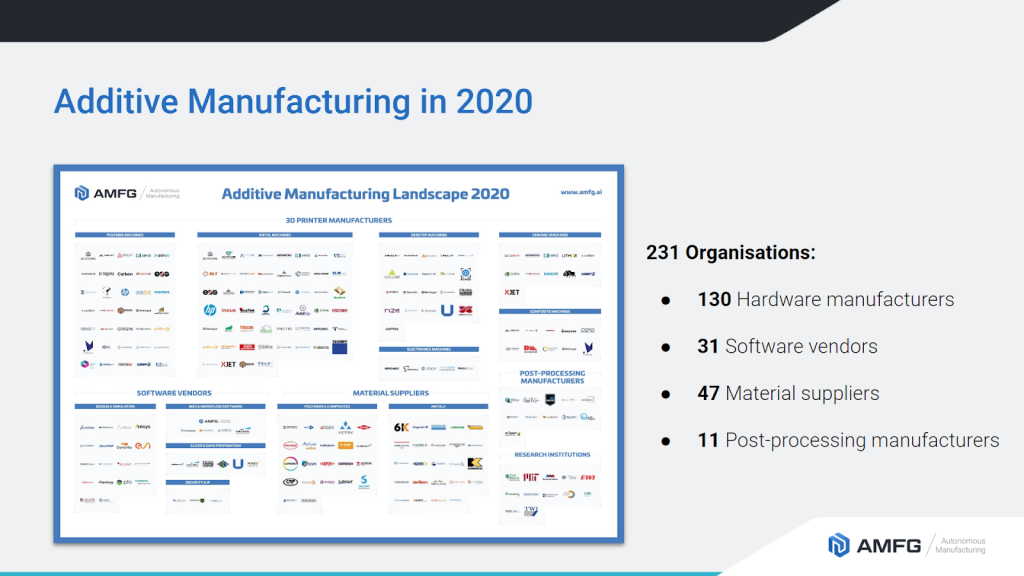
Senior Marketing Manager Victoria Akinsowon opened the conference with a keynote outlining the 2020 AM landscape. Despite the COVID‑19 pandemic, 3D printing continues to industrialize, attracting new entrants, acquisitions, and partnerships.
AMFG’s forthcoming infographic on the Additive Manufacturing Landscape 2020 highlights this momentum. Connectivity—both at the machine and workflow levels—and collaboration remain pivotal drivers of industry evolution.
2. Materials Are Only One Piece of the Puzzle
High‑performance polymers unlock advanced applications across aerospace, medical, and automotive sectors.
Global Product & Business Development Manager Brian Alexander of Solvay discussed the development of high‑performance plastics for 3D printing and the collaborative effort required to bring them to market.
“The process of developing high‑performance materials is not easy,” Alexander noted. “Additive manufacturing is a three‑legged stool: you can have any material, but without the right equipment and processing knowledge, the stool collapses.”
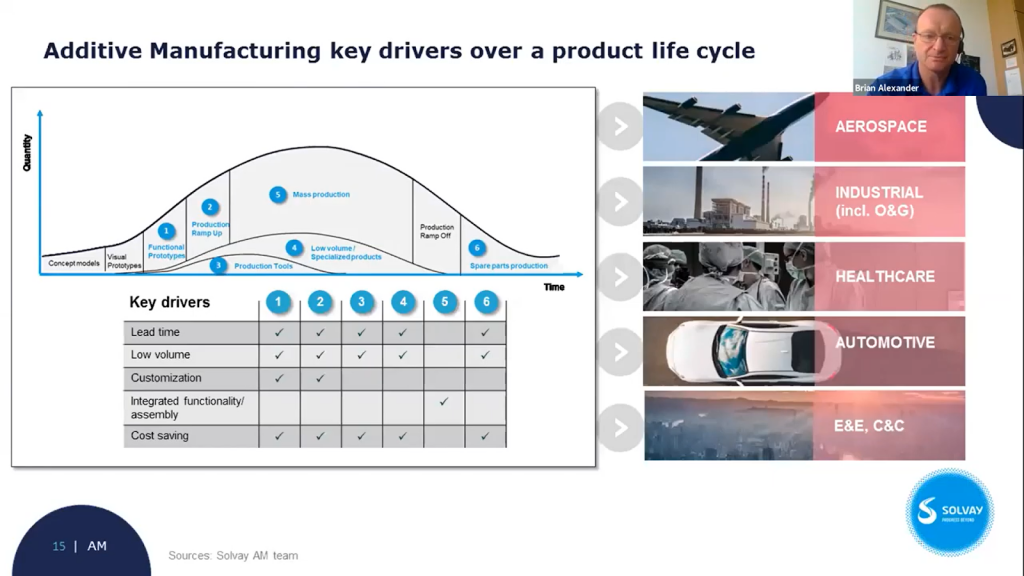
Solvay leads the market for PEEK filaments and is expanding into powdered materials for powder bed fusion, such as SLS.
Alexander emphasized the role of simulation in predicting material behavior, optimizing design, and ensuring mechanical reliability—an essential integration of materials, processes, and design for dependable 3D‑printed parts.
3. Software & Automation Enable Mass Customisation
Mass customisation allows companies to produce tens of units cost‑effectively, a shift from traditional mass production of millions.
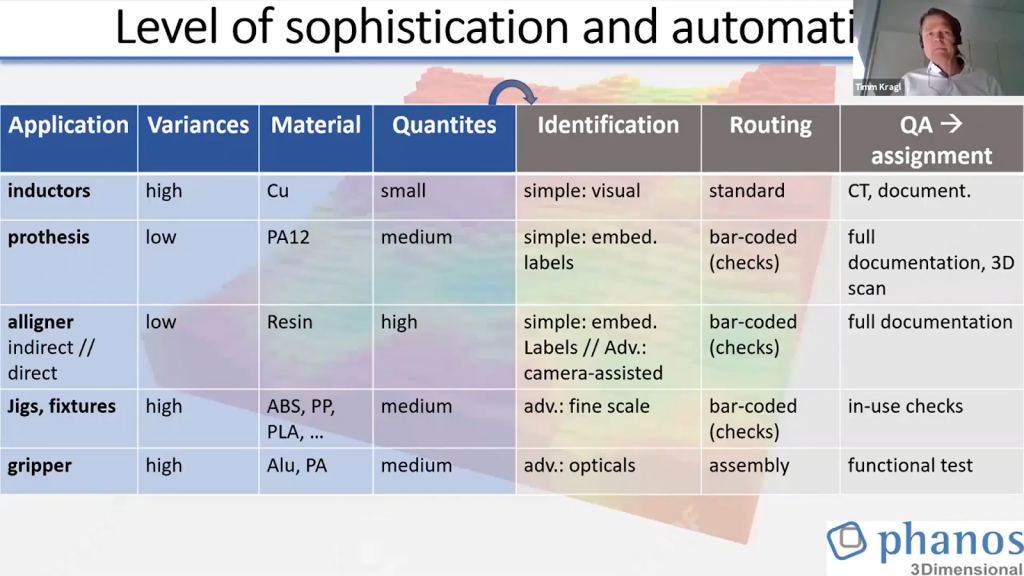
Senior Consultant Timm Kragl of Phanos GmbH explained how 3D printing facilitates customised production, the typical workflow, and associated challenges—such as identifying similar parts within a single build.
Kragl highlighted methods like printed labels, 3D scanning, and file comparison, noting that each application may require a unique QA strategy.
He argued that advanced software and workflow automation—encompassing 3D scanning, augmented reality, QR codes, and MES—are essential for scaling customisation.
4. Pillars of Additive Production
James Ashby, Additive Production Development Manager UK at Bowman AP, visualised the four pillars that underpin successful production‑grade 3D printing: traceability, repeatability, accuracy, and verification.
Traceability involves assigning serial numbers, recording material batches, inspection history, and process parameters.
Repeatability requires a consistent, tweak‑free system; otherwise, “you’re building models, not customer parts.”
Accuracy reflects the required tolerances, while verification confirms build parameters, material provenance, and inspection outcomes—crucial for aerospace, automotive, military, orthotics, and prosthetics.
“Only when all four elements are in place can you claim production parts, not prototypes,” Ashby concluded.
5. Large‑Format 3D Printing Is Maturing
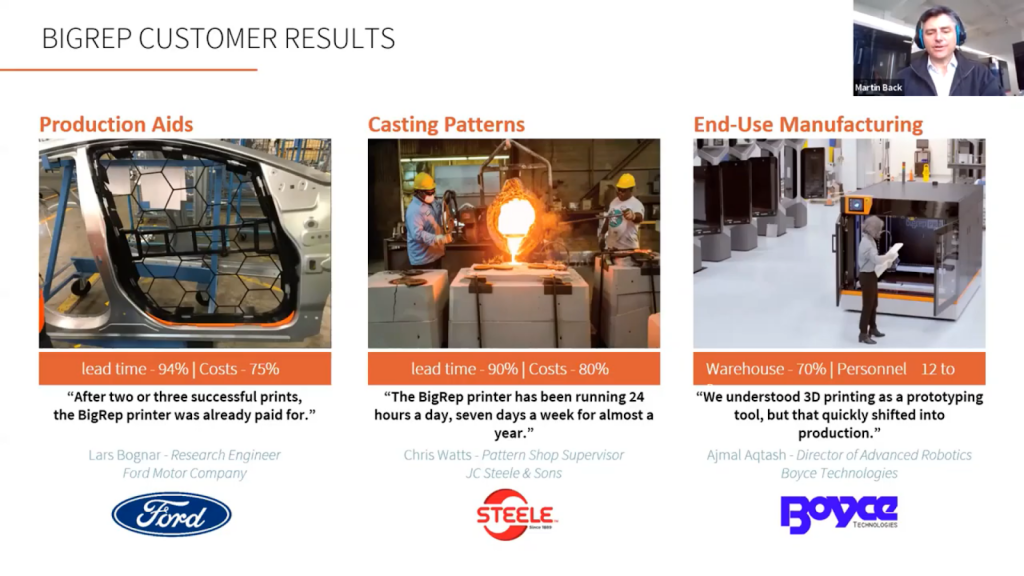
Martin Back, Managing Director of BigRep, showcased how large‑format polymer printers are transforming supply chains.
While production aids and casting patterns dominate, about 20 % of BigRep customers use large‑format 3D printing for production parts—such as electronic housings and on‑demand spare parts for trains.
A highlighted case: a plastic box for Airbus, traditionally outsourced with long lead times, is now produced locally in just a few days, cutting lead times from weeks to days.
Back introduced the Metering Extruder Technology (MXT), a breakthrough that speeds extrusion fivefold and enhances precision.
He stressed that widespread adoption hinges on simplifying design creation and data handling so that additive manufacturing becomes an everyday tool.
6. Software Eliminates Workflow Bottlenecks
Felix Dörr of AMFG identified common workflow bottlenecks—especially post‑production and QA management—and outlined how integrated software can resolve them.
He highlighted that while request and project management systems have improved, manual post‑processing often causes parts to pile up, delaying delivery.
“If you don’t solve post‑processing and quality management, the entire workflow collapses,” Dörr warned.
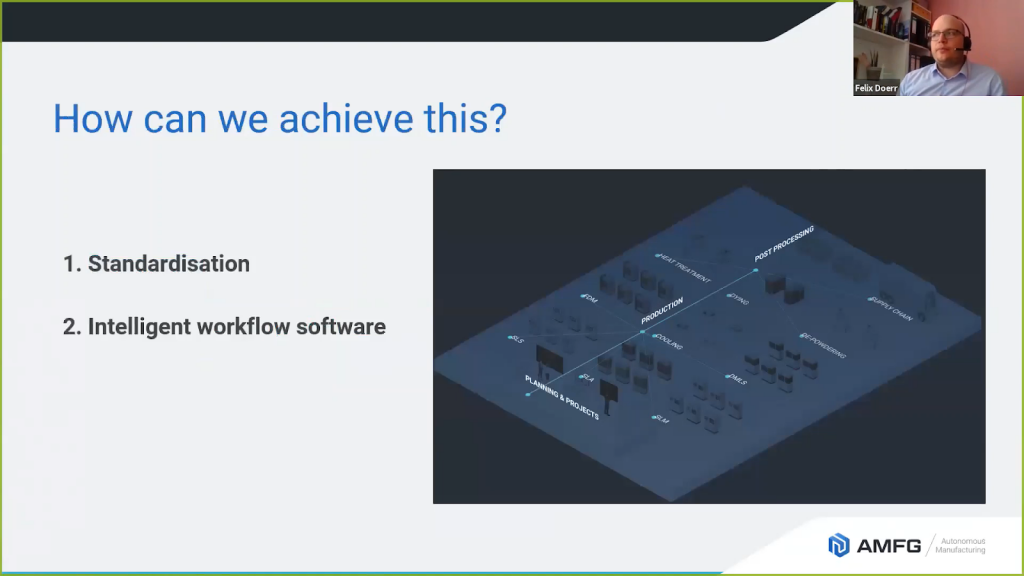
The solution lies in intelligent Manufacturing Execution Systems (MES) tailored to AM. Dörr emphasized that industry collaboration and standardisation are essential to develop interoperable, scalable MES solutions.
Part 1 of the conference takeaways concludes here. Stay tuned for Part 2 next week!
3D printing
- How Digitisation Powers the Future of Medical 3D Printing
- 2020 Additive Manufacturing Landscape: 240 Companies Shaping Digital Manufacturing
- 12 Strategic Takeaways from AMFG’s 2020 Additive Manufacturing Landscape Digital Conference – Part 2
- How 3D Printing Is Transforming Manufacturing, Healthcare, Aerospace, and Education
- Four Essential Insights from SAP’s 2019 Sapphire NOW Conference
- Industrial Machinery 2020 & Beyond: The Next Frontier of Industry 4.0
- Top Insights from the 2019 Top Shops Conference: 4 Key Takeaways
- How 3D Printing Will Transform Manufacturing in the Next Decade
- How 3D Printing is Revolutionizing Modern Manufacturing
- 4D Printing: Revolutionizing Additive Manufacturing for Adaptive Solutions