



HP’s 3D Printing Journey: From Polymer Innovation to Metal Additive Manufacturing
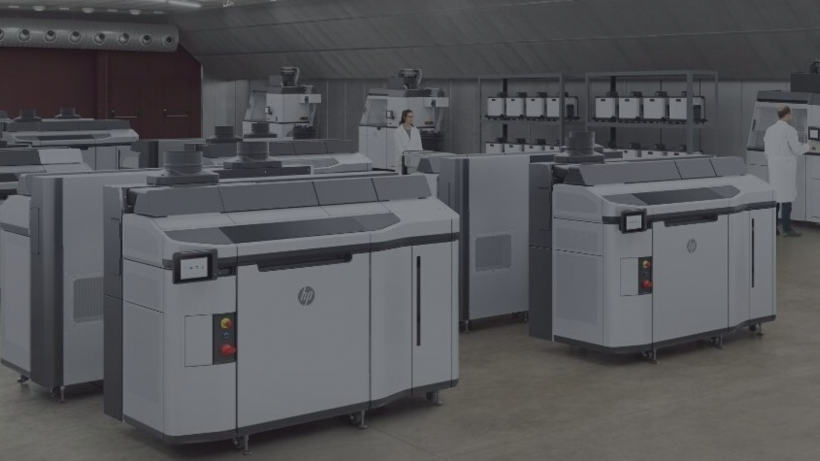
HP has been pushing the limits of additive manufacturing (AM) since 2016, launching a suite of polymer printers and, more recently, the Metal Jet line.
From the outset, HP’s goal has been to democratize 3D printing by delivering faster build speeds, superior part quality, and breakthrough economics.
Dipping Its Toe in 3D Printing
Industrial 3D printing still faces significant hurdles—economic, technological, and skill‑based. Traditional manufacturing often outpaces AM in speed and efficiency, and the upfront investment required to adopt AM can be daunting. HP addressed these challenges with Multi‑Jet Fusion (MJF), a powder‑bed fusion (PBF) technology that uses plastic powder to build parts layer by layer.
MJF starts by spreading a thin layer of powder. A fusing agent, engineered to absorb infrared energy, is jetted across the bed, tracing the part’s contours. Infrared light then heats the fusing agent, melting and bonding the powder in those areas. Repeating the cycle builds the part.
With MJF, HP set a new benchmark for polymer PBF: consistent mechanical properties, faster process times, and higher accuracy than comparable systems such as Selective Laser Sintering (SLS). A study by Xometry found MJF parts cost 30 % less to print than SLS, a gap that widens with volume because HP printers can produce multiple parts simultaneously.
On Its Way Toward Industrialised Polymer 3D Printing
From the beginning, HP’s MJF line targeted functional prototyping and medium‑volume production. The Jet Fusion 3D 4200, released late 2016, quickly earned a reputation as one of the best low‑volume production machines in the PBF family.
The 4200 system comprises a printer, a cooling station, and two interchangeable build units that allow continuous printing and immediate post‑processing—critical for production workflows. The Digital Manufacturing Trends Q2/2018 report by 3D Hubs ranked the Jet Fusion 3D 4200 as the second‑best in printer quality and the top performer for parts produced that year.
The 4200’s versatility spans functional prototypes, tooling, and short‑run end‑use parts. A recent partnership with SmileDirectClub, which produces clear aligners, illustrates its impact: 49 Jet Fusion 3D printers produce over 50,000 unique moulds daily, accelerating SmileDirectClub’s growth and meeting rising demand.
Entering the Full‑Colour 3D Printing Arena
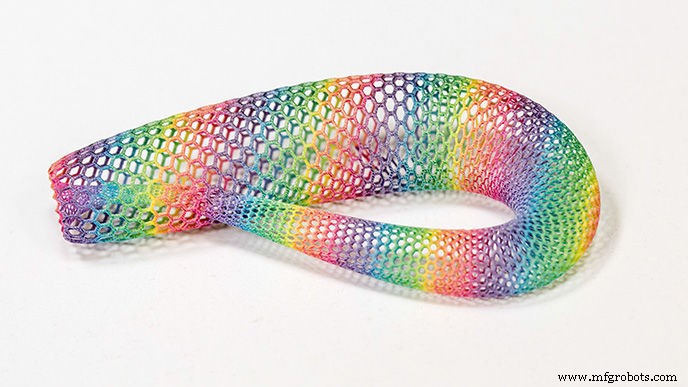
In 2018 HP launched the Jet Fusion 300/500 series—its first full‑colour 3D printers. Accurate, affordable colour printing has long been a goal for manufacturers, who otherwise spend hours dyeing post‑printed parts. The new series offers a cost‑effective alternative for small to medium‑size developers and competes directly with Stratasys and 3D Systems.
The Next Level: Volume Additive Manufacturing
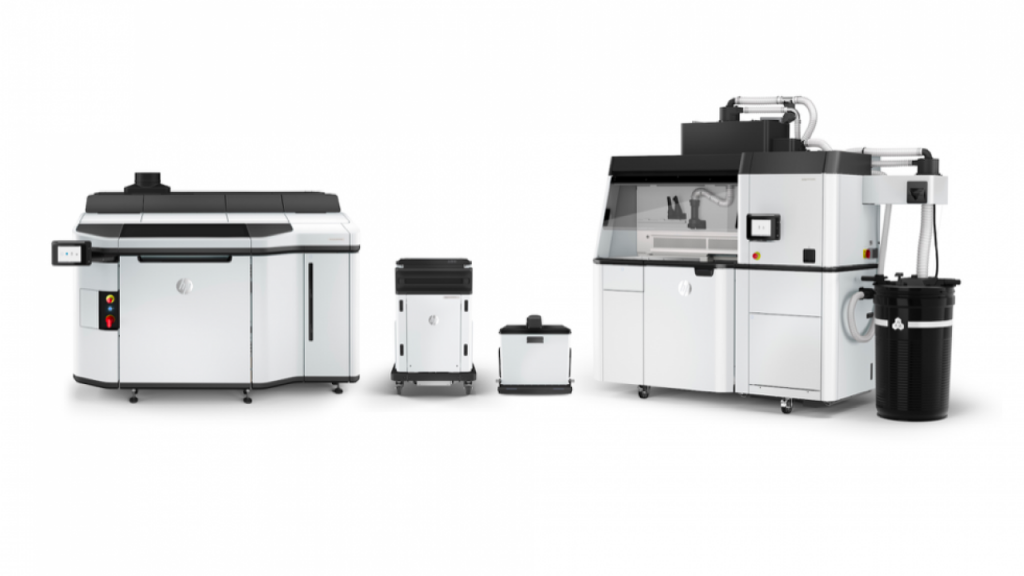
By 2018 HP had already produced 10 million parts with its printers, but the company’s ambition didn’t stop there. In 2019 HP unveiled the Jet Fusion 5200 series, engineered for high‑volume production with the accuracy and repeatability of injection moulding.
Key upgrades include a powerful lamp array that fuses powder in a single pass—boosting productivity by 40 % and enabling high‑temperature materials. The 5200 series is already in production with clients such as Vestas, which uses TPU to print protective components for wind‑turbine blades, and Kupol, which 3D prints safer, more comfortable helmets.
HP’s 3D Printing Materials Roadmap
HP’s journey from prototyping to serial production is driven by continuous material innovation. Early MJF printers could only print Polyamide 12 (PA12). Today the 4200 and 5200 series support a growing range of thermoplastics: PA11, PA12 Glass Beads (40 % glass‑filled nylon), flexible TPU, and, in partnership with BASF, polypropylene (PP) with the same durability and chemical resistance as injection‑molded PP.
Reusability is a cornerstone of HP’s material strategy. While SLS powders recycle only 30–50 %, HP’s MJF powders can be reused up to 80 % thanks to low‑reactive materials such as 3D High Reusability PA 122, which resists molecular growth during heating. HP continues to expand its palette—flame‑retardant plastics, elastomers, high‑performance polyamides—and invites chemical companies to collaborate on the Multi‑Jet Fusion Open Platform.
The New Frontier: Metal 3D Printing
Building on its polymer success, HP launched Metal Jet in 2018—an additive solution based on binder jetting. By combining a custom printhead with 5,280 nozzles across six heads, HP achieves unprecedented speed and reliability.
HP’s binder chemistry is a game‑changer: the system uses less than 1 % binder, an order of magnitude lower than traditional metal injection moulding. This reduces sintering time, cost, and complexity, positioning Metal Jet to match the economies of conventional manufacturing.
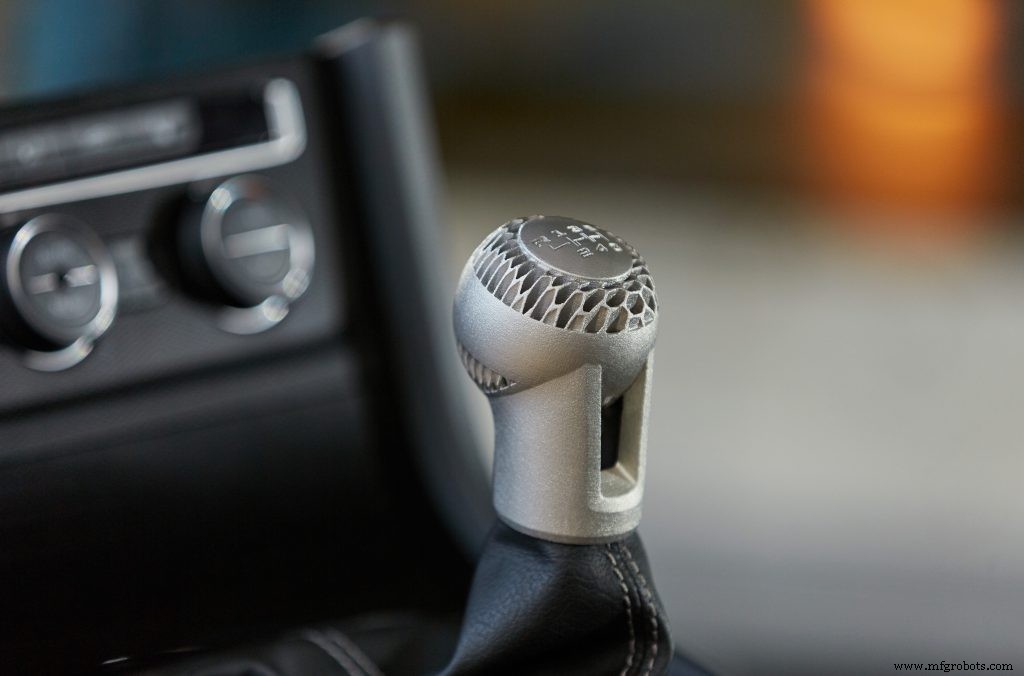
While the machine is not yet sold, HP offers a production service and aims for commercial availability in 2021. Early adopters include Volkswagen, which has partnered with HP to incorporate Metal Jet‑printed gearshift knobs and mirror mounts into its next‑generation vehicles.
Driving Digital Manufacturing
HP’s relentless focus on additive manufacturing—from polymer to metal—positions it as a future leader in the industry. The company’s confidence in its technology is evident: HP uses 3D printing to produce parts for its own printers, streamlining supply chains and demonstrating the scalability of its solutions. As HP accelerates its roadmap, the impact on both the company and the broader manufacturing sector will only grow.
3D printing
- Stereolithography (SLA): The Foundational 3D Printing Technology
- 3D Printing Plastic in Space – Made in Space’s Archinaut Breakthrough
- Rapid Prototyping: The Evolution of 3D Printing and Its Impact on Product Development
- Metal 3D Printing Today: From Prototype to Production
- Interview with VELO3D’s VP of Technology Partnerships: Advancing Metal 3D Printing Capabilities
- Polymer 3D Printing: 6 Cutting‑Edge Innovations Driving Industry Transformation
- Maximizing Efficiency: How Nesting Boosts Polymer 3D Printing Performance
- 3D Printing: Empowering Communities in the Developing World
- How 3D Printing Is Transforming Toy Design, Safety, and Production
- How 3D Printing Revolutionized Manufacturing: A Journey Through Its Evolution