



5 Essential Pillars for Transitioning 3D Printing to Production

3D printing is reshaping manufacturing, but realizing its full production potential requires a solid infrastructure. Discover the five core pillars that enable reliable end‑part production and the solutions that make the transition seamless.
1. Traceability
Traceability is a top priority for companies moving 3D printing into production. In manufacturing, it means tracking every part from raw material intake to final shipment. Regulatory demands—especially in aerospace and medical sectors—make transparent, end‑to‑end visibility essential.
Reused material presents a unique challenge. For instance, in metal PBF, residual powder is sieved and blended with fresh powder in defined ratios. The reuse process must be fully documented so end users can trust the quality of critical components.
Batch traceability ensures each group of parts meets safety and quality standards. Digital solutions, such as Manufacturing Execution Systems (MES), provide the most effective way to capture this data. MES platforms manage every step of the AM workflow and empower manufacturers with data analytics and business intelligence.
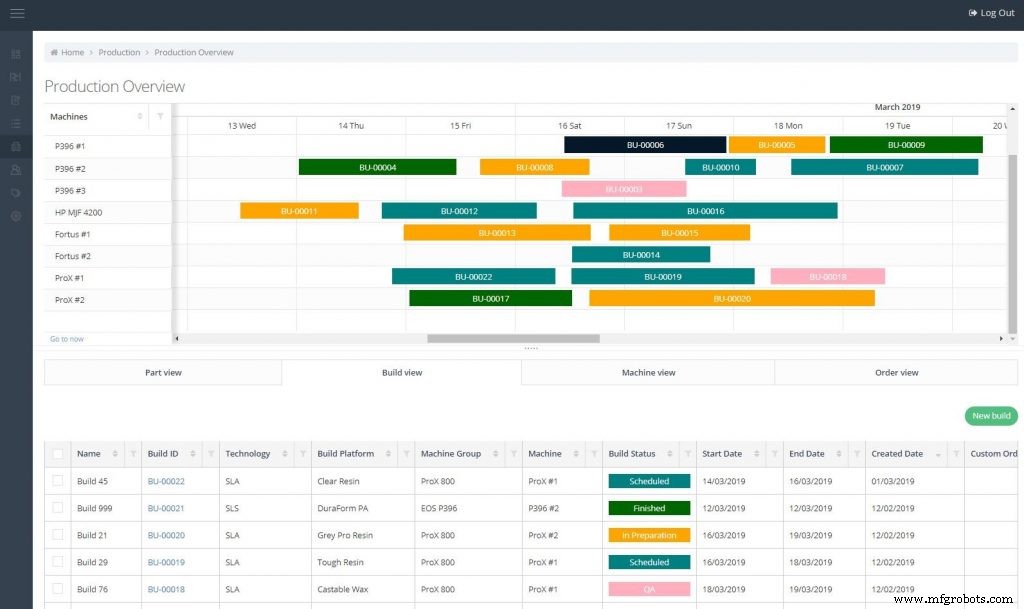
By embedding traceability into every stage, companies gain transparency, accountability, and the ability to audit compliance—key ingredients for mass‑production readiness.
2. Repeatability
Repeatability—the consistency of part geometry across builds—is vital for production. AM processes often suffer from part‑to‑part and machine‑to‑machine variations. Addressing this requires data‑rich workflows and closed‑loop control systems.
A closed‑loop system follows three steps: (1) build planning via simulation, (2) real‑time monitoring, and (3) data‑driven adjustments to correct deviations during printing. Integrating hardware and software tightly, and mastering equipment calibration, elevates repeatability to production‑grade levels.
3. Part Accuracy
As AM expands beyond prototypes, dimensional accuracy becomes critical. Accuracy refers to how closely a part meets its specified tolerances. Today’s AM systems must match the precision of traditional methods like machining or injection moulding.
Functional components—fixtures, end‑use parts, or tooling—require repeatable tolerance to perform reliably. Evaluating a printer’s capability to consistently produce within tolerance is a prerequisite for production deployment.
4. Automation
Automation drives scalability in AM production. By combining robotics, sensors, and networked software, manufacturers can streamline design, build, and post‑processing.
In design, tools for automated support generation and topology optimisation reduce manual effort and improve part performance. MES software consolidates order handling, project management, and production planning into a single digital platform.
Post‑processing, traditionally manual, is now being automated with systems that clean, depowder, remove supports, and apply finishes. Automated post‑processing not only boosts throughput but also enhances repeatability and reduces cost.
5. Verification & Regulatory Compliance
Verification ensures that printed parts meet chemical, mechanical, and metallurgical specifications. It relies on established standards from ISO, ASTM, and other bodies. Currently, 22 ASTM and 15 ISO standards address AM processes, but many critical ones remain under development.
Effective verification requires real‑time quality control rather than end‑of‑line testing. Developing comprehensive part certification frameworks will accelerate compliance and reduce resource demands.
Collaboration with industry experts and proven service providers is essential to stay current on evolving regulations and best practices, ensuring that AM can be safely integrated into production environments.
Successfully Transitioning to Production
Production readiness emerges when all five pillars converge. These elements overlap and reinforce one another, creating a holistic foundation for AM integration. Start by evaluating available technologies, prioritize those that align with your needs, and gradually weave the pieces together.
Although the transition takes time, the resulting benefits—new markets, innovative business models, and a robust digital manufacturing future—make it a strategic investment.
3D printing
- Designing for Binder Jetting: 5 Essential Tips for Reliable 3D Prints
- Alternator Rewinding: Why It Matters & When to Schedule Repairs
- 5 Key Factors to Decide Between Motor Rewind and Replacement
- Top 4 Criteria for Choosing the Right Electric Transformer
- Custom Machining Explained: When and Why You Need It
- When to Upgrade to an Oil‑Free Compressor: Key Considerations
- Process Cooling Explained: Benefits, Methods, and Industrial Applications
- Key Factors for Safe and Efficient Heavy Equipment Transport
- Key Factors for Selecting the Ideal Warehouse Location
- Top 5 Key Considerations When Purchasing a Fiber Laser Machine