



Maximizing Efficiency: How Nesting Boosts Polymer 3D Printing Performance
For a 3D‑printing operation, cost control is paramount. One proven strategy to trim expenses and enhance fleet utilization is nesting—a critical step in data preparation that arranges parts to fit the build volume most efficiently.
In this guide we explain what nesting is, the tangible benefits it delivers, and practical tips to implement it more effectively.
What Is Nesting in 3D Printing?
Nesting is the process of arranging 3D models within the build chamber so that the printer’s capacity is maximized while respecting no‑build zones. Think of it as a 3‑D Tetris game: you pack as many parts as possible into a single build, saving material and time.
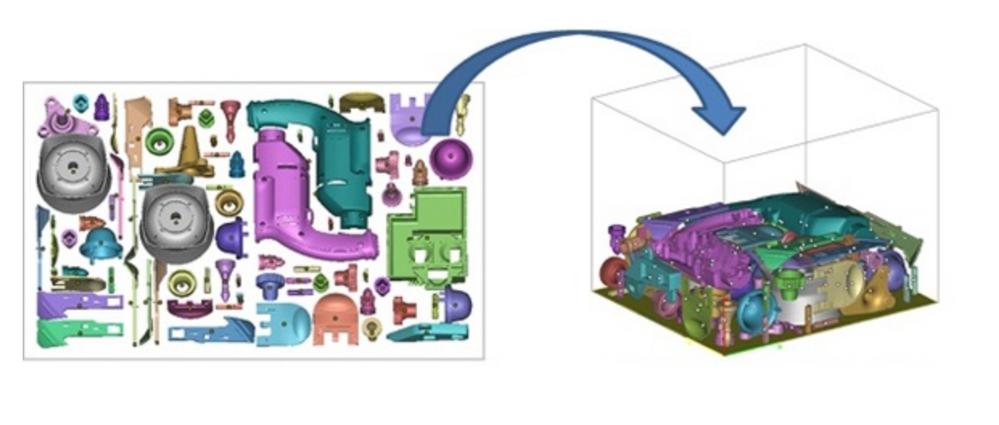
While nesting can be applied to any additive process, it is most common with Powder Bed Fusion (PBF) technologies such as Selective Laser Sintering (SLS) and HP’s Multi‑Jet Fusion (MJF). Whether you use automated or manual methods, nesting arranges, orients, and positions parts to maximize usable space without colliding with the machine’s constraints.
Why Nesting Matters
1. Optimize Machine Capacity
PBF uses powdered polymer and a heat source to fuse layers. After printing, parts remain surrounded by loose powder, which can be partially recycled. Because powder is a major cost driver, squeezing more parts into a single build directly translates to higher throughput and lower per‑part cost.
By packing the build volume densely, you can produce the same quantity in less time—or produce more parts within the same chamber.
2. Save Material
Every PBF build requires more powder than the final part occupies. Typical waste ranges from 20–30 % of the total powder load, while the remainder is reused. For instance, one service provider estimates that of 500 kg of powder purchased monthly, 25 % becomes finished parts, 25 % is discarded, and 50 % is recycled.
Effective nesting reduces the build height and the amount of powder needed, cutting waste and accelerating production.
3. Reduce Costs
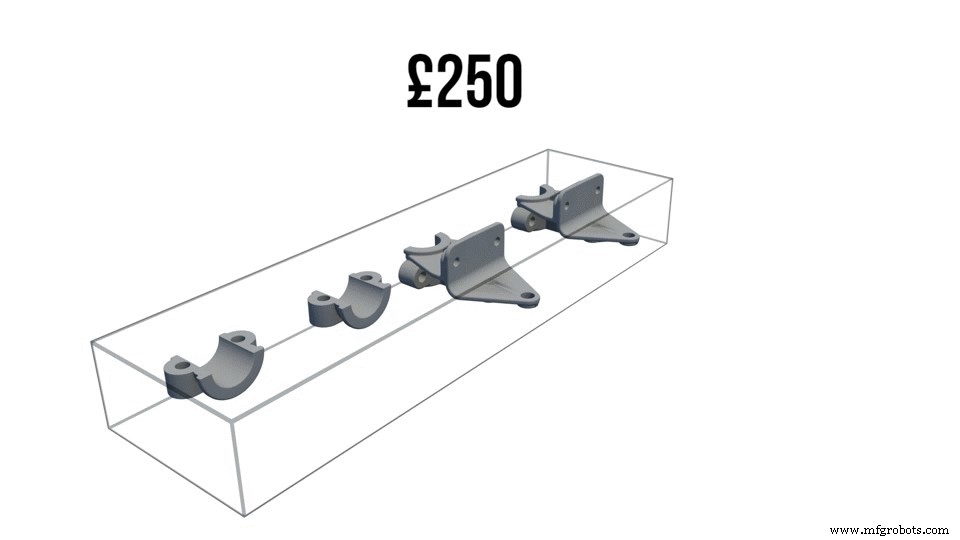
The cost of a 3‑D printed part is largely determined by its bounding box—the minimal rectangular space that encloses the model. Optimally nested parts fit more tightly into a single bounding box, enabling higher batch sizes and lower energy and powder consumption.
Studies show that nesting can yield 30 % cost savings; when designs are nesting‑friendly from the start, savings can reach up to 60 %. However, some parts may perform better in separate builds if they are irregularly shaped or have critical alignment requirements.
Manual vs. Automated Nesting
Most modern data‑preparation tools include nesting features. Manual nesting is labor‑intensive but offers fine control—start with the largest part and nest smaller ones around or inside it.
Automated solutions like Materialise Magics and Netfabb employ algorithms that either use bounding‑box or geometry‑based nesting. Bounding‑box nesting creates a box around a part’s X, Y, Z extents, while geometry‑based nesting considers the actual surface geometry for tighter packing.
Because bounding‑box nesting can limit achievable density, a hybrid approach—pre‑nest manually before running the auto‑nest algorithm—often delivers the best results.
Regardless of method, maintain a minimum gap: 1.5 mm for SLS and 5 mm for MJF to prevent unintended fusion between parts.
Boosting Productivity Through Nesting
Nesting is essential for maximizing printer productivity, cutting costs, and shortening lead times. While it remains a largely manual activity, evolving software is making nesting faster and more reliable, allowing designers to embed nesting considerations early in the design phase.
By integrating nesting into your workflow, you position your business for higher profitability and competitive advantage.
3D printing
- The Crucial Role of Slicing in 3D Printing
- How Extrusion Drives Precision in 3D Printing
- How Computer‑Aided Design (CAD) Powers Modern 3D Printing
- Polymer 3D Printing: 6 Cutting‑Edge Innovations Driving Industry Transformation
- HP’s 3D Printing Journey: From Polymer Innovation to Metal Additive Manufacturing
- Debunking 3D Printing Myths: What the Technology Truly Can Do
- The ABCs of 3D Printing: How Additive Manufacturing is Shaping Modern Industry
- How 3D Printing Revolutionized Manufacturing: A Journey Through Its Evolution
- Unlocking Innovation: The Key Advantages of 3D Printing in Modern Manufacturing
- 4D Printing: Revolutionizing Additive Manufacturing for Adaptive Solutions