



12 Strategic Takeaways from AMFG’s 2020 Additive Manufacturing Landscape Digital Conference – Part 2
In April, AMFG hosted its inaugural Additive Manufacturing Landscape Digital Conference, bringing together 3D printing experts and industry leaders to discuss the current state of additive manufacturing. This article continues the conversation with Part 2, where we distill the most impactful insights shared at the event. You can read Part 1 here.
7. Digitising supply chains with 3D printing to build resilience
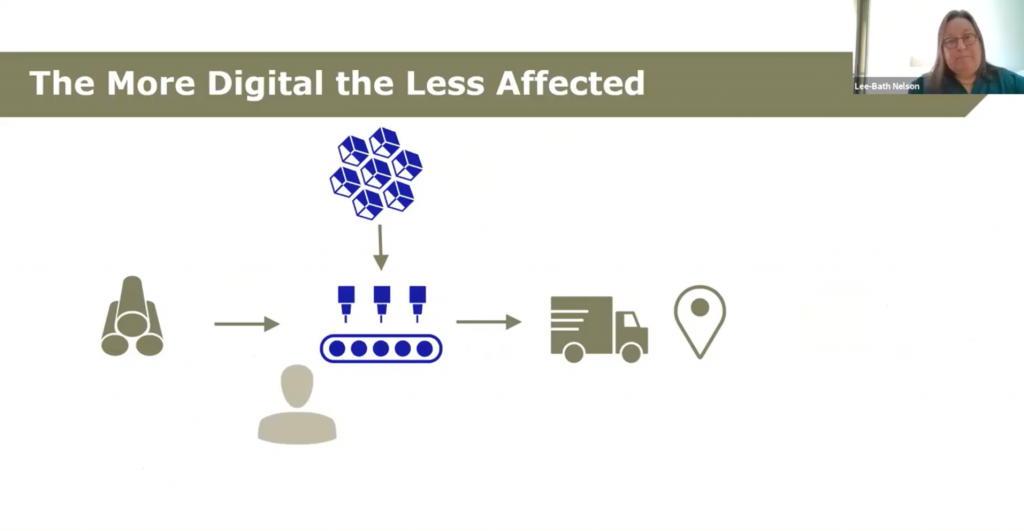
Lee‑Bath Nelson, Co‑Founder and VP Business at LEO Lane, highlighted how the pandemic exposed the fragility of traditional supply chains. “Traditional supply chains have failed, making pandemic‑era logistics even harder,” she said. She argued that digitisation—combining local 3D‑printing production with digital inventory—offers a more agile alternative.
In a conventional model, goods move across borders before reaching the end customer. COVID‑19’s border closures disrupted this flow, underscoring the need for on‑site, rapid production. Nelson pointed out that digital inventory still requires rigorous repeatability across multiple production sites and robust IP protection. She emphasized the role of specialised IP‑security software that limits file access and tracks usage, thereby safeguarding designs from duplication.
8. Current adoption rates of industrial 3D printing
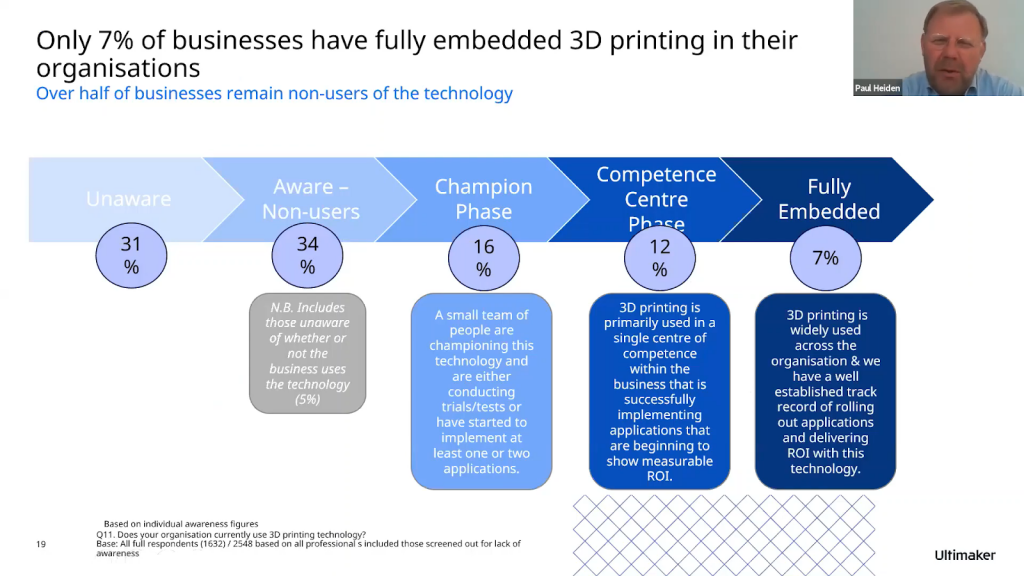
Paul Heiden, SVP Product Management at Ultimaker, shared findings from the company’s recent Sentiment Index survey, which gauges global awareness and adoption barriers. Fused Filament Fabrication (FFF) remains the most widespread technology for plastic parts, driven by the accessibility of professional desktop systems.
Heiden noted that awareness at the corporate level remains the biggest hurdle: the less familiar decision‑makers are with 3D printing, the slower the investment cycle. The survey also revealed a shift toward advanced polymers—TPU, polypropylene, and nylon—as industrial users seek higher performance materials. While prototyping still dominates, the rise of tooling and end‑use parts signals a broader move toward production‑ready applications.
9. Automation is redefining post‑processing
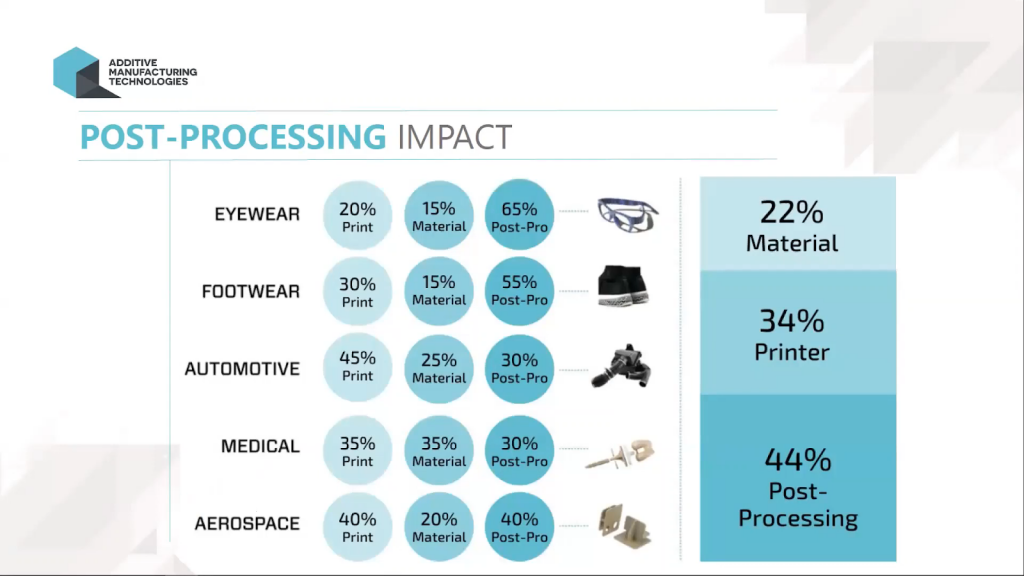
Joseph Crabtree, CEO of Additive Manufacturing Technologies, outlined how automated post‑processing can unlock the true potential of additive manufacturing at scale. He envisions a fully integrated, end‑to‑end system that can retrofit any existing 3D printer, eliminating manual support removal, smoothing, colouring, and inspection.
While no single solution yet covers all AM technologies, companies like AMT are developing tailored automation platforms. Such systems accelerate production, improve repeatability, and are essential for organisations aiming to scale 3D printing into mass production.
10. COVID‑19: a catalyst for additive manufacturing adoption
Speakers at the conference consistently highlighted how 3D printing addressed urgent medical supply shortages during the pandemic. Eric Pallarés, Co‑Founder & CTO of BCN3D, emphasized the agility that 3D printing provides—quickly producing critical components when conventional supply chains falter.
His analysis also pointed out the urgent need for technical medical materials: biocompatible, heat‑resistant polymers are essential for hospital use, yet their market availability remains limited compared to standard thermoplastics. The crisis has underscored the importance of establishing clear regulations and standards to ensure consistent, traceable, and safe parts for life‑critical applications.
11. Powder‑bed fusion leads high‑volume production
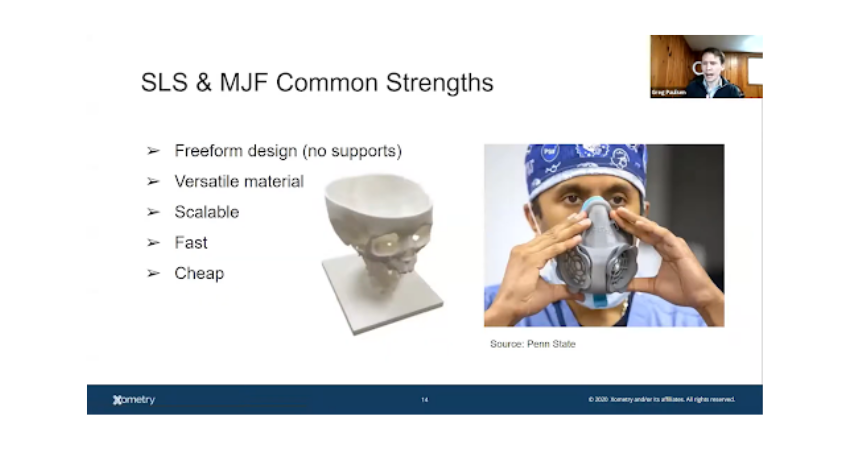
Gregory Paulsen, Director of Application Engineering at Xometry, explained why polymer powder‑bed fusion—specifically Selective Laser Sintering (SLS) and Multi‑Jet Fusion (MJF)—is best suited for high‑volume manufacturing. Xometry typically builds 30 to 300 parts per run, a throughput that aligns well with these technologies’ strengths.
Both SLS and MJF offer support‑free builds, material versatility, and scalability. SLS has a long production track record, while MJF’s factory‑friendly design and speed advantages are rapidly expanding its adoption. Together, they are driving additive manufacturing toward mainstream volume production.
12. Digital manufacturing moves into the mainstream
Avi Reichental, Founder of XponentialWorks and former CEO of 3D Systems, wrapped up the conference by highlighting the acceleration of innovation in the AM sector. He remarked that “more has happened in the last 25 months than in the past 25 years.”
Reichental focused on speed improvements: Nexa3D’s resin printers achieve a six‑fold increase in curing speed, while EOS’s forthcoming LaserProFusion aims to boost SLS throughput by a factor of ten. These gains directly translate into higher productivity and broader industrial adoption.
He also noted that the pandemic’s uncertainty has spurred a shift toward flexible, on‑demand manufacturing—an opportunity that positions additive manufacturing as a key solution for future supply‑chain resilience.
Watch the full speaker sessions on YouTube
3D printing
- How Digitisation Powers the Future of Medical 3D Printing
- 12 Expert Takeaways on 3D Printing’s Future from AMFG’s 2020 Digital Conference – Part 1
- 2020 Additive Manufacturing Landscape: 240 Companies Shaping Digital Manufacturing
- How 3D Printing Is Transforming Manufacturing, Healthcare, Aerospace, and Education
- Four Essential Insights from SAP’s 2019 Sapphire NOW Conference
- Industrial Machinery 2020 & Beyond: The Next Frontier of Industry 4.0
- Top Insights from the 2019 Top Shops Conference: 4 Key Takeaways
- How 3D Printing Will Transform Manufacturing in the Next Decade
- How 3D Printing is Revolutionizing Modern Manufacturing
- 4D Printing: Revolutionizing Additive Manufacturing for Adaptive Solutions