



Digitising Additive Manufacturing: Optimising Post‑Processing & QA for Production Success

This is Part 3 of our series on MES software. Discover the rest of the articles in this series:
- The Beginner’s Guide to Additive Manufacturing Execution Systems (MES)
- How Can MES Software Transform Production Planning for Additive Manufacturing?
- 3 Ways Connectivity Will Enhance Your Additive Manufacturing Operations
Additive manufacturing is accelerating toward industrial scale. A 2023 Deloitte survey shows 46% of companies plan to use AM for serial production within the next two years, making post‑processing and quality management critical for success.
Yet, most firms still struggle to manage post‑processing and QA efficiently. The manual nature of these tasks, combined with the time required to certify parts, demands clear planning and coordination from day one.
In this article we explain why post‑processing and quality management matter, the common hurdles businesses face, and how digitisation can eliminate bottlenecks.
Why Post‑Processing and QA Are Integral to Additive Manufacturing
Discussions about AM for production often focus on the printing step alone. However, the process ends only when the part has met all functional and aesthetic requirements.
Post‑processing—such as support removal, surface finishing, or material post‑treatment—is essential for achieving the final mechanical and visual properties. It also provides the data needed for rigorous QA checks that confirm compliance with industry standards.
For end‑part applications, these steps become non‑negotiable as AM transitions from prototyping to serial production.
Key post‑production activities include:
- Identifying and inspecting finished parts
- Planning and coordinating tasks (sanding, beadblasting, etc.)
- Conducting QA checks to ensure specification adherence
Common Challenges in Managing Post‑Processing and QA
Coordinating Workflow Across Diverse 3D‑Printing Technologies
Different AM technologies demand distinct post‑processing steps. SLA parts require support removal, SLS parts may need dyeing or metal plating, and metal AM demands extensive surface treatment. Some processes, like bead blasting, operate best in batches, adding further complexity.
The more technologies a production line incorporates, the higher the workflow complexity, which can slow down turnaround times if not managed centrally.
Time‑Consuming Manual Processes
While hardware solutions exist for automating physical post‑processing, the orchestration of tasks and QA documentation remains largely manual in most operations. Coordinating multiple staff, steps, and paperwork is labor‑intensive and error‑prone, especially as production scales.
Paper‑based systems become unsustainable when multiple printers and technologies are involved, leading to lost productivity and increased risk of non‑compliance.
Effective Supplier Communication
Many post‑processing tasks are outsourced. This necessitates transparent visibility across the supply chain. Without a digital system to track job status, communication can break down, causing delays and quality inconsistencies.
How Digitisation Streamlines Post‑Processing and QA Management
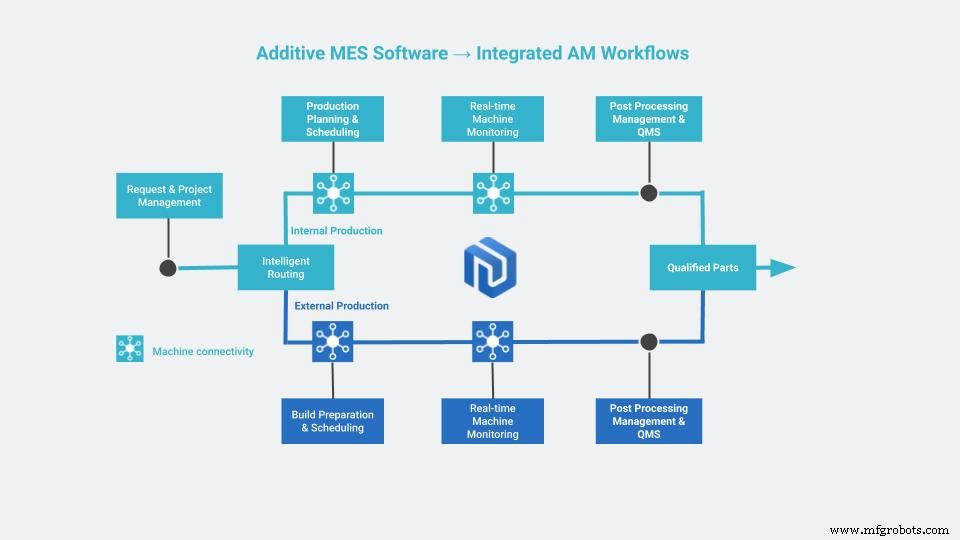
Integrating Post‑Processing into the AM Workflow
Digital transformation, via MES software, embeds post‑processing and QA as a seamless extension of the production workflow. It captures every step—task assignment, timing, responsible party—and links it to the original build data.
The result is real‑time visibility and the ability to re‑route work orders, including post‑processing tasks, to the appropriate supplier instantly.
Automated Quality Control Documentation
Quality control must evolve from a series of checkbox forms to a data‑rich process. MES platforms provide interactive 3D viewers, automated sensor integration, and barcode scanning, enabling instant capture of surface roughness, dimensional tolerances, and material composition.
AMFG’s MES software supports import of external reports, so every part’s QA history is stored centrally and ready for audit or re‑work.
Centralised Data Management and Analytics
A single print build can generate tens or even hundreds of terabytes of data—from slicer files to sensor logs. Manual handling of such volumes is impossible.
MES solutions provide secure, scalable storage and turn raw data into actionable insights. Rich historical records for each part enable trend analysis, root‑cause investigations, and continuous improvement across the AM chain.
Future‑Proofing Your AM Operations Through Digitisation
For firms moving AM into production, post‑processing and QA cannot be an afterthought. A comprehensive digital strategy—anchored by MES—ensures these critical stages are fully integrated, scalable, and auditable.
Discover how to build a robust post‑processing and QMS plan in our white paper, Additive Manufacturing MES Software: The Essential Guide.

3D printing
- Revolutionizing Additive Manufacturing: How MES & Workflow Software Optimize Production Planning
- How IoT Empowers Children with ASD to Learn, Play, and Thrive
- Unlock Global Growth: How Exporting Drives Sales & Innovation for Manufacturers
- Blockchain for Manufacturers: Unlocking Transparency, Trust, and Efficiency
- Maximize Project Success with Comprehensive Equipment Training
- Boost IT Performance: Leveraging AIOps & Observability to Reduce Downtime & Enhance User Satisfaction
- Leveraging IoT for Smart Water Management: Enhancing Efficiency and Sustainability
- How Proper Emergency Equipment Management Saves Lives
- How SDKs Accelerate Innovation in Additive Manufacturing
- Unlock Precision: How a Rotary Table Indexer Enhances Metalworking Accuracy