



Three Ways Connectivity Drives Efficiency in Additive Manufacturing
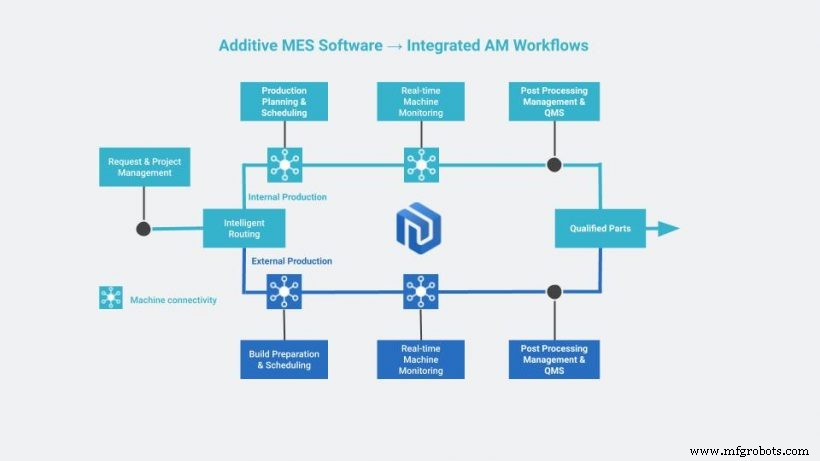
This is Part 4 of our series on MES software. Discover the rest of the articles in this series:
- The Beginner’s Guide to Additive Manufacturing Execution Systems (MES)
- How Can MES Software Transform Production Planning for Additive Manufacturing?
- How Digitisation Can Help Transform AM Post-Processing and QA Management
Connectivity has become essential for additive manufacturing (AM) facilities, breaking down silos between equipment and software to deliver traceable, data‑rich workflows.
Effective connectivity requires a dedicated platform that channels data securely and efficiently. At the heart of this ecosystem lies the Additive Manufacturing Execution System (MES), a software that orchestrates and monitors in‑progress work on the shop floor. An Additive MES centralises operations, linking every AM process and capturing real‑time data.
In this article we examine how connectivity‑enabled Additive MES software boosts efficiency across processes and supply chains.
Why Connectivity Is Essential for Your AM Facility
Every stage of AM production generates continuous streams of data that drive decision‑making. This data comes from machines, materials, ERP, PLM, and other enterprise systems.
The biggest hurdle is the persistence of disconnected systems and manual processes that prevent real‑time data access. Many AM facilities still rely on spreadsheets to organize projects and schedule production. However, spreadsheets foster duplication, errors, and slow consolidation.
Connectivity‑driven software replaces spreadsheets, linking machines, ERP, PLM, and other systems to ensure a continuous, real‑time transfer of data at every stage of production. When operations span multiple locations or involve outsourced post‑processing, connectivity becomes even more critical to coordinate suppliers and maintain quality.
Connected AM workflows deliver real‑time data, enabling full traceability and agile decision‑making.
How Additive MES Drives Connectivity
Connectivity is one of the most critical capabilities of Additive MES platforms. It allows production and operation systems to communicate, creating maximum efficiency. Connectivity in the AM workflow spans three key areas: machines, processes, and supply chains.
Connecting Machines
Machine connectivity enables seamless data transfer between hardware and the MES platform, allowing better decision‑making and process optimisation. Benefits include:
- Improved machine control and real‑time visibility of build status, material levels, uptime, and utilisation.
- Data‑driven identification of bottlenecks and continuous process optimisation.
- Proactive maintenance through real‑time monitoring of sensor data.
- Enhanced quality control by feeding sensor data into the MES.
Challenges persist, as many 3D printer manufacturers still restrict third‑party integrations. However, the industry is shifting toward openness. A recent partnership between EOS and AMFG demonstrates how an Additive MES can be integrated directly with EOS machines, enabling direct data transfer and improved machine control.
Connecting Processes
With connectivity, Additive MES software links all internal AM workflows—and, if you operate in multiple locations, all production centres. Advanced integration with ERP and PLM eliminates manual re‑entry and creates a streamlined digital workflow.
Connected processes provide:
- Full visibility across all AM operations, essential for multi‑site management.
- Consistency and uniformity of procedures, reducing miscommunication.
- Real‑time tracking of progress from any location.
“As manufacturers look to scale their AM operations, they will need to manage and execute these operations across their supply chains and, very often, across multiple production centres. This requires integrated processes that can respond to real‑time demands — in other words, connectivity,” says our CEO, Keyvan Karimi, in an interview with 3D Printing Industry.
Connecting and digitising AM processes simplifies scaling—whether adding new hardware or increasing part volumes.
Connecting Supply Chains
According to EY, 26 % of OEMs outsource at least part of their 3D printing production to suppliers. Connectivity, powered by Additive MES software, offers a centralised platform to:
- Communicate specifications and delivery schedules with suppliers.
- Maintain end‑to‑end traceability across the supply chain.
- Integrate supplier data for a holistic view of upstream and downstream activities.
- Improve overall supply‑network efficiency.
Establishing a Connected Workflow with Additive MES
Connectivity is now a prerequisite for any AM operation. A connectivity‑enabled Additive MES platform delivers:
- Greater machine control and real‑time monitoring.
- Integrated internal processes and supplier collaboration.
- Ready‑to‑use data that fuels informed decision‑making.
By establishing a fully connected workflow, your AM facility will thrive in an integrated ecosystem.
Learn More About Connectivity for Additive Manufacturing
To dive deeper into connectivity‑powered software, read our white paper, Additive Manufacturing MES Software: The Essential Guide. It covers the importance of connectivity for AM workflows, how to develop a comprehensive AM strategy, and how MES software can scale your operations.

3D printing
- 5 Proven Strategies to Drive Success with Additive Manufacturing
- How Digital Inventory Enhances Additive Manufacturing: 4 Key Advantages
- 5 Proven Ways Real‑Time Production Visibility Elevates Additive Manufacturing Operations
- How Manufacturing Brings Warmth and Joy to Your Holidays
- 10 Proven Ways Cloud Computing Boosts Business Efficiency
- 4 Proven Strategies to Accelerate Growth in Manufacturing Operations
- How AI Drives Efficiency and Innovation in Modern Manufacturing
- How IIoT Transforms Warehouse and Factory Operations for Efficiency and Insight
- VoxelDance Transforms Additive Manufacturing Data into Seamless Production
- 11 Proven Ways to Transform Manufacturing with Data