



Choosing Between SLA and SLS for Rapid Prototyping: Which Is Right for Your Project?
Posted on: July 20, 2018, | By Candy, WayKen Marketing Manager
There are roughly 10 major rapid prototyping technologies, depends on how you group them, together. Which one should you choose for the medical device you’ve designed? Or maybe you’ve created something for cars, or airplanes, or maybe a kitchen appliance. Each of the industries and products has its own needs in regards to prototypes. And you have some of your own thoughts about that too, right? Should it just look good to be shown to investors? Or do you want to check, whether it works, so you can forgo surface finish and just settle for something cheaper, or, perhaps, you are going to do tests. You’ll bash and smash the thing or heat it or submerge it in water.
Each of those products and uses has a technology that will best fit to create its prototype. Now, if I started comparing all the methods in one article, the article would become an hour read. And no one has time for those nowadays. So, let’s stick with two techniques, that cover about 30% of the prototyping market. SLA prototyping and SLS prototyping for plastics. So, SLA 3D printing vs SLS 3D printing here goes.
Development of SLA-Printing
SLA or stereolithography is one of the oldest technologies in the 3D-printing world. It was discovered in the early 1980s in Japan. Dr. Kodama thought up a device that used a liquid polymer tank and a single UV laser.
The laser cured the surface layer of the polymer making it hard and submerged the layer into the tank a little bit. That way the hardened plastic would serve as the base for the next layer. Dr. Kodama, however, didn’t have enough financing for his research, so he missed his patent.
In 1884, a group of French scientists were thinking how to create a fractal part ( a very complex intricate geometry part) for their project and thought of the laser that could harden polymers. They filed for a prototype but hey didn’t pay enough attention to commercialization and their idea was not taken seriously.
So, in 1884 as well, Chuck Bell, an American inventor, the third to think up of such a method, filed the patent for the stereolithography process. He thought everything through and founded a company called 3D Systems to sell his idea. Right now, 3D Sytems is one of the largest companies who make 3D-printers.
SLA Printing Technology
There are actually two methods of SLA printing. Let’s call it direct and reverse SLA.
The direct process is the way SLA was originally invented. The printer has a liquid polymer tank and a base plate that is one curing layer lower than the surface of the polymer. A UV laser traces the current cross-section of the part ( the program is written in a way that the part is sliced into layers and the laser path is generated for each slice) and you get the first hardened layer. Then, the plate goes down one layer height and a specialized knife moves across the surface of the tank to ensure that the polymer fills the area above the plate completely. Then, the next layer is cured.
The reverse method is different in regards to part orientation and movement. Here, the base plate is transparent and is upside down compared to the direct method. The laser cures the polymer through the plate and then the plate goes up, instead of going down. So, you may compare this process with slowly retrieving an object out of the water. The only difference that in the latter process, the object was originally in the water. With SLA printing you create it out of the liquid in your tank.
Description and History of SLS
SLS is a similar 3D-printing process. It was developed by a Texas Professor Carl Deckard. He was an engineer and looked to lower the amount of casting required for the serial production. He later sold his patent to the 3D Systems. 3D Systems later managed to use SLS for metal powders as well, which led to a revolution in metal parts production as well. Now, this technology is the most widespread method for printing metal parts. In the course of its development, it turned out that the powder is really dangerous. It is very fine and easy to inhale. So, SLS technology is not really good for desktop hobby versions, unlike SLA.
The process uses plastic powder as its main material. This powder is spread out over the base plate with a special knife. After that, like in SLA, the laser traces the cross-section of the part. After that, the base plate is lowered by one layer and the powder is spread out again. Quite similar to SLA, wouldn’t you agree?
Materials
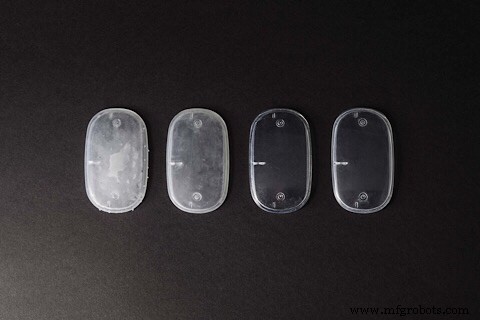
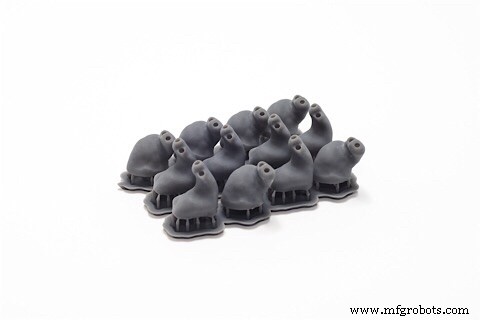
SLA.This process uses polymers that get harder from UV light, or photopolymers as they are called. There is a lot of different resin composition, so they are mostly separated by their use:
- Standard resins. Those are the cheapest and have the worst mechanical properties, however, their quality is really good, can be compared to injection molding even. Among those, some are transparent so you can make clear prototypes, for car lights, for example.
- Engineering resins. Those can be used for actual prototypes and can come either in an ABS-like form, heat-resistant form, stiff or flexible form. They still retain good surface finish and their strength is somewhat better.
- Medical resins. Among the photopolymers, discovered for SLA printing, you can find some class I and II biocompatible ones. It means, that you can keep them in contact with human tissue for a long time. It is a grand advantage.
SLS.This technology was initially used with Nylon. As the years went by, some other materials were adapted for the technology.
- Nylon. This one is by far the most widespread plastic in SLS. It is much more durable, heat resistant and tough, than all SLA materials.
- Urethane. It’s a simple flexible plastic that is good for casting simple polymer parts.
- Wax. The wax to be used is ideal for making casting models. You just cover the model with the forming mixture and heat it till it melts.
Post-Processing
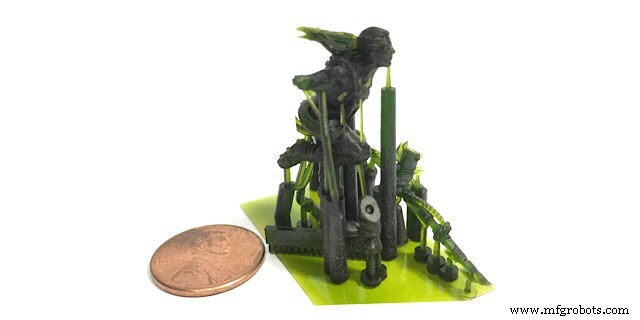
SLA.The main disadvantage of SLA printing is that it has a lot of support, which are made of the same material. This makes it necessary to conduct cutting operations to delete supports. You must also clean the cut-off region from any trace of the support. The whole process is quite time-consuming.
In addition, the cured part is not actually completely cured. Some areas between layers have reacted only halfway through. This is why using some UV light chambers for curing the printed parts will increase their strength. This is not absolutely necessary, though.
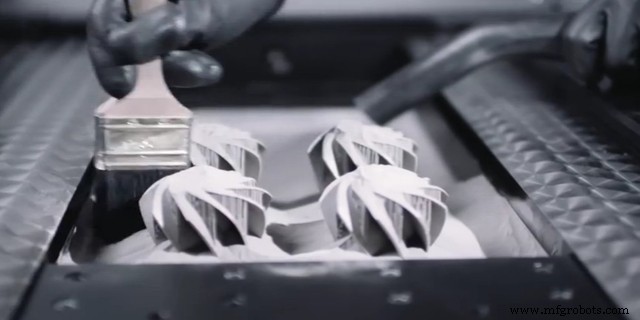
SLS.The part usually has a worse surface finish after SLS than after SLA. This is why SLS parts are sanded and mechanically post-processed if a good surface finish is required. This takes a lot of time.
In Conclusion: What to use when?
Overall, this process yields great quality parts, but it is much more expensive than SLS ( in case of direct SLA, you cannot reuse the leftover liquid plastic from the tank, it cannot be kept for a long time, so it is better to keep the printer loaded) and requires the process of removing the supports. Its advantage is an abundance of materials that can be implemented.
Use SLA for medical equipment, transparent parts with a good surface finish and for some injection molding or casting models. Use it to show off your product, the parts are very good.
SLS yields much better strength and other properties than SLA. However, its surface finish is much worse (about 2-3 classes lower). The process is much cheaper than SLA. You do not need support structures at all (previous powder layers support the higher layers) and you can reuse the powder that was left from previous use.
Use SLS in cases where the part must withstand greater loads, corrosion or vibration. Use SLS when surface finish is not an issue and the budget is low. Use it for yourself or for tests.
3D printing
- Why a SaaS CMMS is the Smart Choice for Modern Maintenance Management
- SLA vs. PolyJet: Choosing the Right 3D Printing Technology for Your Project
- Key Factors to Evaluate in a Pre‑Engineered Robotic Workcell
- Key Factors to Evaluate When Buying a Used CNC Machine
- Choosing the Right CNC Milling Material: A Comprehensive Guide to Metals, Plastics & Wood
- Choosing Between 6061 and 7075 Aluminum: A Professional Guide to the Best Alloy for Your Project
- Choosing Between Resin and Filament 3D Printers: A Practical Guide
- PETG vs ABS: Choosing the Best 3D Printing Filament
- EDM vs CNC Milling: Choosing the Right Machining Solution
- Selecting the Right CNC Manufacturer for Your Prototype Design