



3D Printing Risks: Safety Precautions Every User Should Know
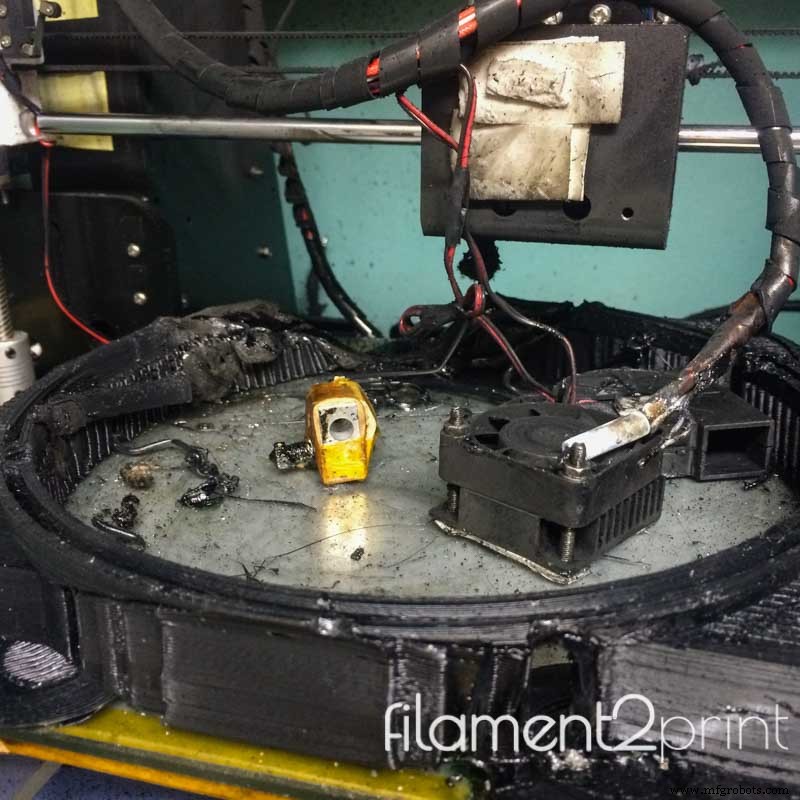
Every day 3D printing is more widespread both at the industrial level and at the domestic level, something that enhances the development of many applications in a large number of fields. At the media level only the benefits of technology stand out, but there are certain precautions that must be taken into account when it comes to starting in the world of 3D printing.
But every user must take into account certain risks that may occur during 3D printing. The two main sources of risk and more common are on the one hand the gases released during the fusion of the material, and on the other the possible sources of fire by misuse of the 3D printer or the poor condition of the electronics of the same.
Below, we detail the main sources of risk, as well as the precautions to be taken to avoid major problems:
Gases and odors released
All materials used in 3D FDM / FFF printing are plastic or contain some of this material. At this point we will focus on the three most common: PLA, ABS and HIPS.
ABS and HIPS are two very widespread materials in 3D printing and also, it is very common to use them in combination, HIPS as a support material (it's dissolved in D-Limonene) and ABS as the base material. These two materials have a drawback which is that during their fusion a quantity of styrene 20 times higher than that which exists in the atmosphere is released, becoming carcinogenic in case of prolonged respiration of these emitted gases.
The PLA is an easy-to-print material on any 3D printer and therefore, the most versatile of all existing materials for 3D printing. Regarding the waste generated, it releases lactide, an element that does not present the aforementioned problem of ABS, nor does it affect the health of people.
In addition, industrial 3D printers sincorporate the HEPA filter, which is a type of high efficiency air filter that meets high standards. Therefore, if you don't have a closed 3D printer with a HEPA filter, the main recommendation is to keep the place of printing well ventilated (care must be taken with drafts since they cause the dreaded warping and cracking effect in open 3D printers).
Therefore, in domestic environments, it's advisable to print filaments that don't emit odors as long as they comply with the mechanical properties.
Possible fire sources
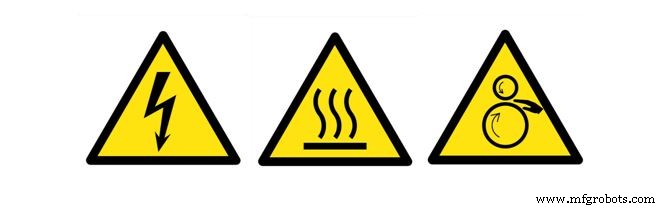
Image 1: Possible fire sources
At this point we must take into account first of all that 3D printers that don't have the CE mark (European Certificate) don't pass any quality control, something that can become very dangerous in the event of a failure.
Electricity
It must be taken into account that the characteristics of the electrical network to which the 3D printer is connected must be exactly those indicated on the machine: 230 Vac, 50Hz. In addition, attention should be paid to where the 3D printer connects. If it's fed from a terminal strip with more consumers, it can cause fuses to blow or the protections of the installation to skip. Therefore, the characteristics of the line must be checked before connection. When cleaning the 3D printer, always disconnect the 3D printer from the electrical outlets to avoid accidental contacts.
Electronics
The use of quality electronic components, as well as cables with the appropriate section is crucial to avoid excess temperatures that can lead to the fire of the 3D printer itself and this, in turn, of everything that is around it. Another possible problem that can also cause a fire is that the temperature sensor comes out of its housing and the heating cartridge raises its temperature to the maximum, melting the elements that are around it and can cause fire.
Hot parts
Sometimes by inertia or forgetfulness you tend to put your hand inside the 3D printer while it's still hot, which can cause severe burns to the skin. We mustn't forget that the operation of a 3D printer is based on the principle of polymer melting, which implies a high temperature in the heating elements.
In addition, the fact that the 3D printer is switched off or unplugged after finishing an impression doesn't imply that the heating elements are cold, so it shouldn't be touched until enough time has passed.
Mobile parts
For the movement of the 3 axes, as well as that of the 2 extruders, electrical motors are used step by step with high torque. When you put your fingers or your hand in the areas of the shafts, spindles and belts, it can cause entrapments, bruises and wounds, as well as burns due to the heat dissipated by the motors. Therefore, we must be very careful when entering the hand inside the 3D printer, and should only be done if strictly necessary, and to be able to be with security measures to prevent further damage in the event of an accident.
Fixing spray
When applying the base fixative spray (3DLac, DimaFix or PrintaFix) it must be done outside the 3D printer since they are highly inflammable products that in contact with high temperatures or residual electric currents can cause a flame. Although it seems incredible, there have already been more than one case where a house is burned or something worse because of the wrong process.
Our particular recommendation is that at all times you have proof (especially when you have a 3D printer in a domestic environment), that this isn't a "toy", and that its operation carries associated risks. It's always better to have 3D printers with CE marking that have a closed housing and HEPA filter, and if possible in ventilated places.
3D printing
- Top 5 Essential Safety Practices for 3D Printing in Manufacturing
- Beyond Prototypes: Real‑World Innovations Made with 3D Printing
- Top 10 3D Printer Kits of 2022 – Expert Review & Comparison
- UV 3D Printing: How SLA Resins Deliver Faster, Higher‑Quality Prints
- Fix 3D Printing Ghosting: Simple Steps to Eliminate Vibrations & Improve Print Quality
- Fixing a 3D Printer That Prints Off-Center: Quick Troubleshooting Guide
- How Quickly Can a 3D Printer Produce Parts? Understanding Print Speed Factors
- Role of a 3D Printer Operator: Skills, Responsibilities, and Career Opportunities
- Understanding and Managing Odors from 3D Printing: Health and Safety Tips
- Essential In-Process 3D Printing Tips to Prevent Failures