



Variable Width Fill Explained: 4 Key Benefits for 3D Printing Success

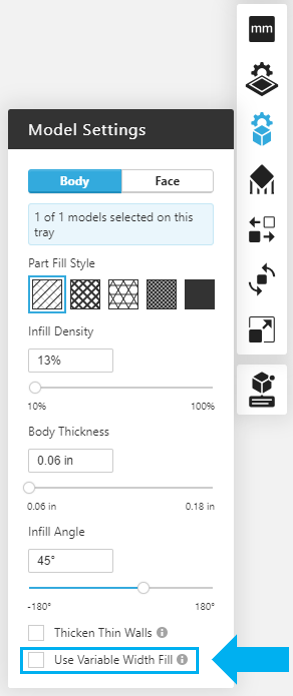
Hidden in the Model Settings of GrabCAD Print, the Variable Width Fill option is a powerful feature for Stratasys F123, Fortus 380 mc, 450 mc, and 900 mc printers. Hover over the info icon beside the checkbox and you’ll read: “Fill small gaps in the infill using a variable bead width of model material.”
What Does Variable Width Fill Do?
Variable Width Fill allows the slicer to adjust the width of each bead within a single layer. Instead of a fixed bead width, the printer varies the width to perfectly match the geometry of thin walls, eliminating the intentional air gaps that standard slicers insert to preserve dimensional accuracy.
Test Model
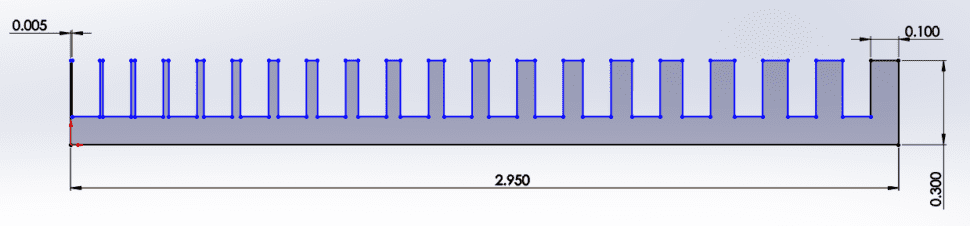
The example model has wall thicknesses ranging from 0.005″ to 0.100″ in 5‑thousandth increments. When printed without Variable Width Fill, the slicer inserts gaps wherever the wall thickness isn’t an exact multiple of the default bead width, weakening the part and compromising watertightness.

Variable Width Fill Off
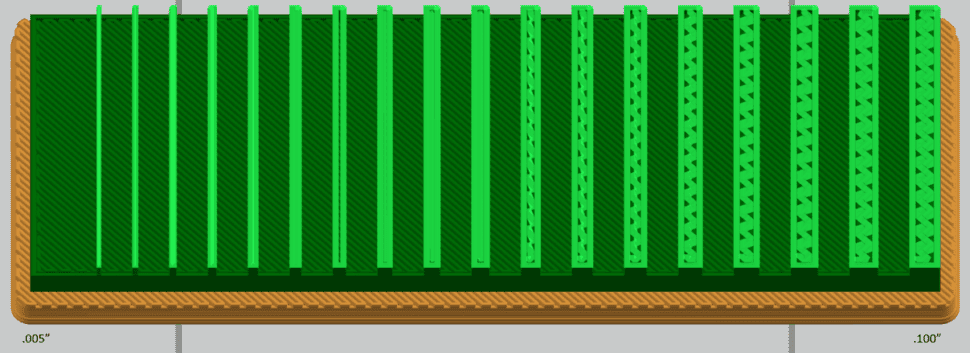
Below is a top‑down sliced view of the model on a Stratasys F370 with ABS at a 0.010″ layer height, Variable Width Fill disabled. Notice the disappearance of the 0.005″ and 0.010″ walls—the slicer omits features it considers too small for the chosen bead width. A residual gap appears at the 0.045″ wall, and solid fill ends near 0.060″, after which crosshatching resumes.
Variable Width Fill On
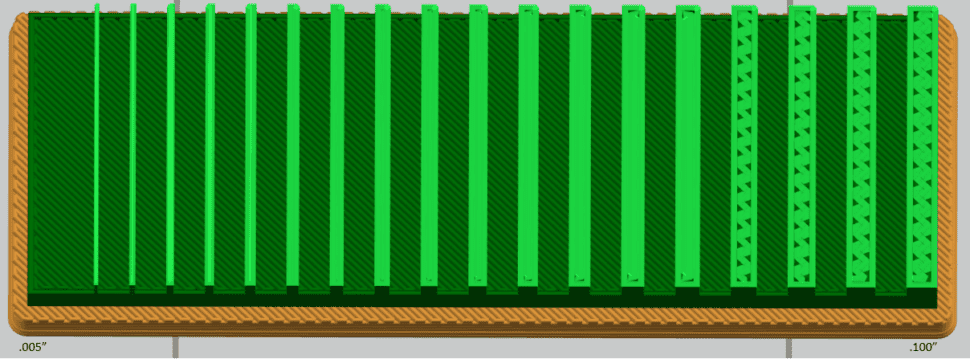
With Variable Width Fill enabled, the slicer adapts bead width to match the wall thickness exactly. The top‑down view shows solid, continuous fills for walls up to 0.080″, eliminating gaps and enhancing structural integrity.
Applications
1. Thin Walls
Single tool paths or gaps drastically reduce the strength of thin walls. Variable Width Fill deposits a continuous bead, giving the wall a solid, cross‑sectional area that resists failure and increases print reliability.
2. Cylindrical Towers
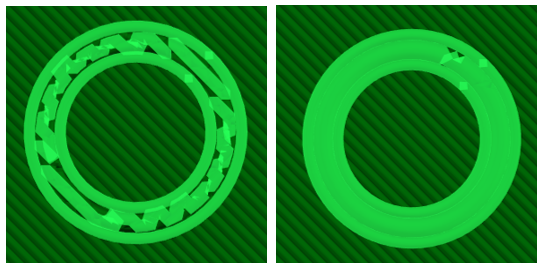
Fast back‑and‑forth movements in cross‑hatch infill can cause tall, slender towers to wobble. By applying Variable Width Fill, the tower’s core receives a continuous bead that stabilizes the structure and reduces the risk of collapse.
3. Watertight Parts
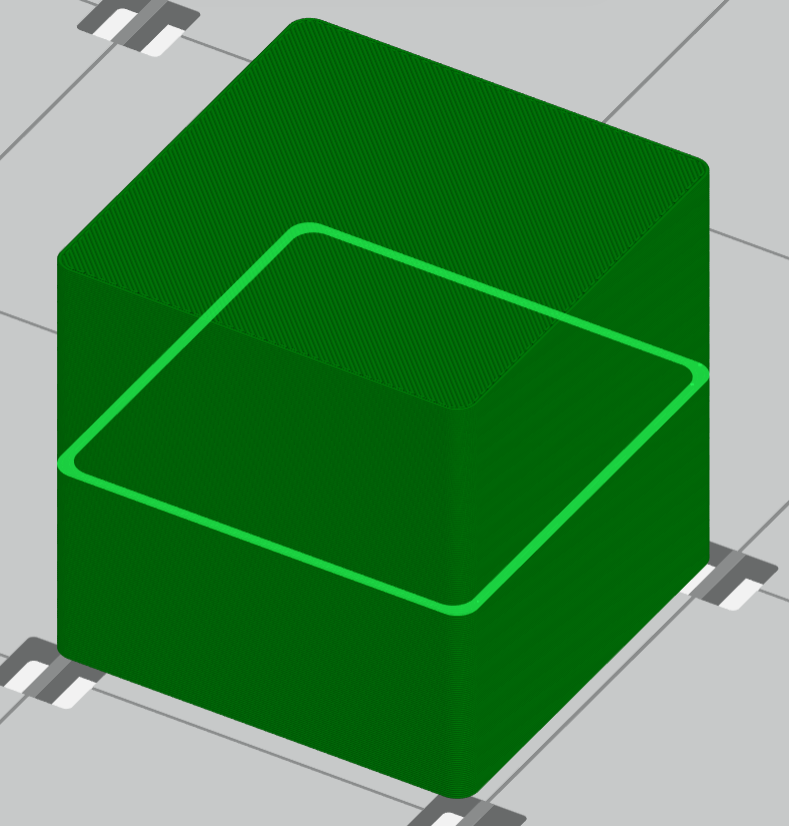
FDM parts are rarely truly watertight. Minimizing air gaps reduces leakage paths, allowing printed containers to hold liquids or pressurized gases more effectively.
4. Threaded Inserts
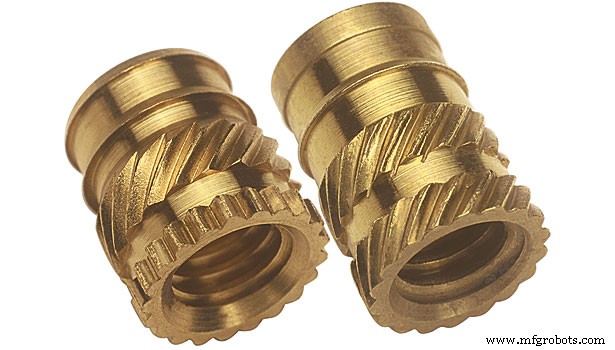
Threaded inserts and directly threaded screws require solid material to bite into. Variable Width Fill ensures that cylindrical holes have sufficient fill, preventing stripped threads and ensuring secure fastening.
In Review
Variable Width Fill is a straightforward yet powerful tool in GrabCAD Print that fortifies thin walls, improves watertightness, and supports threaded inserts. Try it on your next print to see a noticeable difference in strength and reliability.
Need 3D Printing or CAD Support?
Check Out Our Services Page
3D printing
- Understanding Equipment Depreciation: Calculating Asset Useful Life & Optimizing Maintenance
- Carbon Fiber 101: How the Ultra‑Light Material Is Revolutionizing 5 Key Industries
- Pointers in C: A Comprehensive Guide to Types, Usage, and Best Practices
- Java Static Explained: Variables, Methods, and Blocks – Hands‑On Examples
- Which Solvents Effectively Dissolve PETG? A Practical Guide
- TPU Filament Explained: A Comprehensive Guide to 3D Printing's Flexible Material
- Demystifying 3D Printing: A Clear Guide for Innovators
- Variable Resistors Explained: Types, Applications, and Current Control
- Understanding Cut and Fill: Efficient Earthwork for Construction Projects
- Anodized Aluminum Explained: Benefits, Process, and Answers to 5 Common Questions