



How Two Universities Leverage Markforged Additive Manufacturing to Empower Students
When we talk about the tools, fixtures, and production parts that companies worldwide use Markforged technology to fabricate, we often overlook the transformative impact on higher education. Universities are now turning 3D printers into laboratories where students can experience every phase of manufacturing—from concept to design to production—demonstrating the full value of additive manufacturing. “Additive manufacturing lets us create parts that subtractive methods cannot. It accelerates student learning from idea to prototype,” explains Dr. Brad Rowland, ENDEAVOR Manager of Operations. He stresses that OSU’s curriculum teaches both additive and subtractive techniques, emphasizing their complementary strengths. The College of Engineering, Architecture, and Technology’s ENDEAVOR facility spans 72,000 sq ft and houses 12 laboratories, five makerspaces, and five design labs. Each year, 1,500–2,000 students—across eight engineering departments—tap into the space to complete 38 courses. Key to this experience are two Onyx Pro, two Mark Two, an X7, and a Metal X printer. Rowland says, “Markforged’s Onyx and continuous‑fiber printers drew us in; they give students the ability to produce complex composites with ease.” He adds that the Metal X will distinguish OSU’s graduates, providing a hands‑on advantage in metal fabrication. Students already utilize the composite printers for projects ranging from remote‑controlled carts to unmanned aerial vehicle components. Rowland notes, “We have two student‑designed products in patent consideration, one of which will rely on the Mark Two.” ENDEAVOR’s environment empowers students to move swiftly from concept to tangible part—often creating geometries that traditional manufacturing cannot achieve or that blend additive, subtractive, and casting methods. “We’re a gym for fabrication—students bring the effort and determination; we provide the equipment,” says David McMillin, Assistant Director of the Bechtel Innovation Design Center. Purdue’s 400,000‑student campus hosts the Bechtel Innovation Design Center, an advanced prototyping hub founded by students for students. The center offers 20 cloud‑enabled 3D printers—two Markforged Metal X and two Mark Two—alongside CNC mills, lathes, and a full wood shop. McMillin highlights the low barrier to entry that 3D printing provides: “It introduces students to fabrication with minimal risk and effort.” The Mark Two’s carbon infill control, for instance, delivers high resolution, fit, and finish straight from the machine, a feature that students particularly enjoy. The Metal X has already produced race‑car knuckle brackets and a Mach 2 wind‑tunnel test target using 17‑4 stainless steel and H13 tool steel. McMillin observes, “The industry is rapidly advancing metal 3D printing, and our students, faculty, and the broader community are eager to participate.” Both universities demonstrate how integrating Markforged technology into curricula can cultivate a generation of engineers equipped with practical skills in additive manufacturing.Oklahoma State University
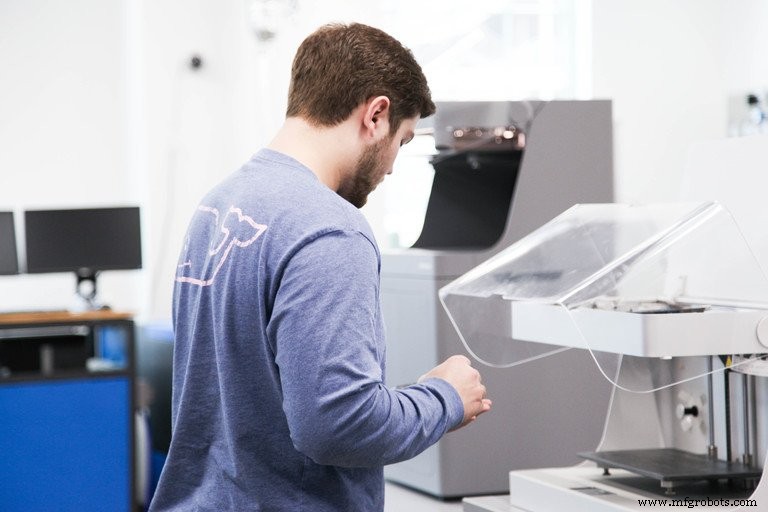
Purdue University
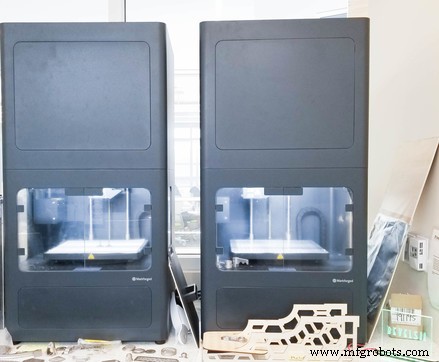
3D printing
- Hybrid Manufacturing: Merging Additive and Subtractive Technologies for the Future of Production
- Revolutionizing Aerospace: How Additive Manufacturing Enhances Performance and Efficiency
- Mastering Additive Manufacturing: Technologies, Processes, and Applications
- How Kuka Robots and Laser Technology Transform Additive Manufacturing
- How Technology is Transforming Tomorrow's Manufacturing
- Revolutionizing Auto Production: The Role of Additive Manufacturing
- Maximizing CAD Efficiency in Additive Manufacturing
- Additive Manufacturing: Driving Innovation and Cost Efficiency in Aerospace
- How SDKs Accelerate Innovation in Additive Manufacturing
- Additive vs. Subtractive Manufacturing: Unlocking the Future of Production