



Hybrid Manufacturing: Merging Additive and Subtractive Technologies for the Future of Production
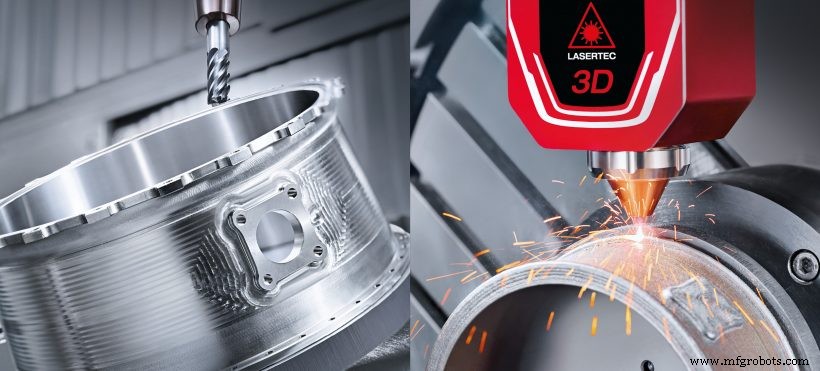
[Image credit: DMG Mori]
For decades additive manufacturing (AM) and traditional subtractive manufacturing have been viewed as separate ends of a spectrum. In reality, the most advanced factories are blending the two to create parts that are both geometrically complex and dimensionally precise. Hybrid manufacturing—where AM and CNC machining coexist in a single machine—offers a one‑stop solution that can drastically reduce lead times and costs.
What Is Hybrid Manufacturing?
Hybrid manufacturing is the integration of additive and subtractive processes within a single piece of equipment. Rather than printing a part and then machining it on a separate machine, the two operations are performed sequentially on the same platform. This allows designers to take advantage of the design freedom of AM while ensuring the tight tolerances and surface finish that only CNC machining can deliver.
Combining the Best of Both Worlds
Low‑volume production of metal parts is a prime use case. Machines are typically built around a CNC milling head and then fitted with 3D‑printing nozzles, such as DED or laser sintering units. The result is a streamlined workflow: a complex geometry is printed, then finished in the same session. Companies like Imperial Machine & Tool Co. have already deployed this approach to produce end‑use parts that would otherwise require multiple manufacturing steps.
Hybrid Technologies on the Market
Direct Energy Deposition (DED) melts metal with a laser or electron beam as it deposits the material, enabling rapid build of large parts. After deposition, the same machine can mill the surface to achieve sub‑millimetre tolerances. DED is especially effective for repair and rebuild operations.
US‑based Hybrid Manufacturing Technologies pioneered the first hybrid deposition‑milling system, the AMBIT™, introduced in 2013. Its patented deposition heads can be added to any CNC machine, offering automated changeover and seamless integration.
DMG MORI’s LASERTEC 65 3D hybrid machine features a 5‑axis material‑deposition nozzle that can produce highly complex metal parts without the need for support structures. Optomec’s LENS 850‑R and integrated machine‑tool lines further demonstrate the versatility of hybrid solutions across a range of metals and part sizes.
The Benefits of Hybrid Manufacturing
Hybrid systems deliver multiple advantages:
- Reduced lead times—DED’s high deposition rates combined with immediate machining accelerate production.
- Increased part size and density—hybrid builds can exceed the volume limits of powder‑bed fusion.
- Multi‑metal capability—start with one alloy and switch to another in the same build, ideal for cladding and repair.
- No support structures—multi‑axis arms build parts in any direction, eliminating waste.
- Cost savings—molds and dies can be produced at half the cost compared to conventional methods, and injection‑mold runs can be 50 % faster with improved tool life.
For instance, Matsuura Machinery’s LUMEX series combines laser sintering with a 20‑tool machining spindle, enabling parts to be finished in‑process and eliminating post‑manufacturing machining.
Applications
While aerospace and automotive leaders already employ hybrid manufacturing for one‑off, high‑complexity parts, the technology is poised to transform other sectors:
- Medical—patient‑specific prosthetics and dental implants can be produced faster and more precisely.
- Repair & Maintenance—GE used a hybrid system to rebuild turbine blades, adding material to worn features and machining to exact tolerances, thus avoiding a full replacement.
- General manufacturing—any industry that requires small batch production of complex components can benefit.
The Road Ahead
Hybrid manufacturing is still evolving, but its potential to shorten lead times, reduce waste, and enable previously impossible designs is clear. Universities such as Loughborough are pushing the boundaries with multi‑system AM research, suggesting that hybrid technology could soon become a standard manufacturing paradigm. The promise of an all‑in‑one, sustainable production platform is within reach.
More like this:
Hybrid and multi‑systems AM, AM automation and more: an interview with Professor Ian Campbell of Loughborough University
3D printing
- Advancing Hybrid Manufacturing: Merging Additive and Subtractive Techniques
- Additive Manufacturing Technologies Revolutionizes Post‑Processing with the First‑Ever Automated Machine
- Jabil’s Rush LaSelle Explains How Additive Manufacturing is Revolutionizing Global Production
- 5 Key Additive Manufacturing Trends Driving 2021 Innovation
- How 3D Printing Is Transforming Manufacturing, Healthcare, Aerospace, and Education
- Additive Manufacturing Explained: From Design to Finished Part
- How Technology is Transforming Tomorrow's Manufacturing
- Metal Additive Manufacturing: Transforming Production for Aerospace and Beyond
- How 3D Printing Will Transform Manufacturing in the Next Decade
- How 3D Printing is Revolutionizing Modern Manufacturing