



ULTEM & PEEK: Mastering High‑Performance 3D Printing Materials
 \n
\n
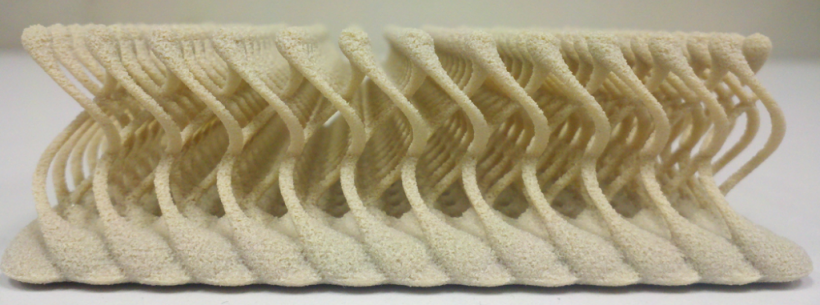
High‑performance thermoplastics, such as PEI, PAEK and PPSU, are increasingly in demand for industrial‑grade manufacturing applications.
\nWithin the field of additive manufacturing, Fused Deposition Modelling (FDM) is the most common technology for printing with these filaments.
\nIn this tutorial, we explore 3D printing with high‑performance thermoplastics, covering pros, cons, applications, and key printing requirements.
\nWhy Use High‑Performance Thermoplastics?
\nUnlike PLA or ABS, high‑performance thermoplastics offer superior mechanical properties—strength, durability, heat and chemical resistance—making them ideal for engineering applications.
\nThe Materials
\nPEI (ULTEM)
\nPolyetherimide (PEI), known commercially as ULTEM, is a high‑performance engineering thermoplastic available in amber or transparent colors. ULTEM 9085 and ULTEM 1010 are the most widely used grades; Sabic has recently introduced two new ULTEM‑1010‑based variants.
\n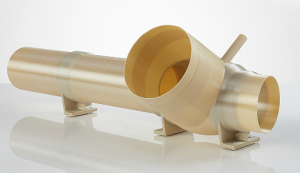
ULTEM 9085: Key Benefits
\n- \n
- Inherently flame‑retardant (FST‑compliant, certified for aircraft components) \n
- High strength‑to‑weight ratio—lighter than aluminum yet comparable impact strength \n
- Heat deflection temperature of 167 °C \n
- Excellent chemical resistance to automotive fluids, aqueous solutions, and alcohols \n
Applications
\nIdeal for aerospace and automotive parts: interior components, ductwork, electrical enclosures, and customized tools. Latécoère uses ULTEM 9085 to create 50 % lighter aircraft tooling.
\nRecommended printer settings
\n- \n
- Extruder temperature: 350 – 380 °C (all‑metal extruder) \n
- Print bed temperature: 140 – 160 °C \n
- Bed cover: Kapton tape, lightly sanded FR4, or perf board \n
- Heated enclosure: required (warm to hot build environment) \n
- Printing speed: 20 – 30 mm/s \n
ULTEM 1010: Key Benefits
\n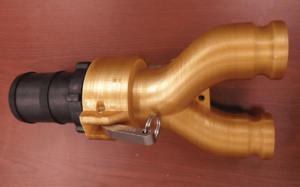
- \n
- Highest tensile strength among FDM filaments \n
- Excellent thermal stability—tolerates steam sterilization \n
- Biocompatible (ISO 10993/USP Class VI) \n
- NSF 51 food‑contact certification \n
Applications
\nUsed in out‑of‑cabin aerospace components, automotive parts, food‑production tools, and custom medical devices such as surgical guides and trays.
\nRecommended printer settings
\n- \n
- Extruder temperature: 370 – 390 °C (all‑metal extruder) \n
- Print bed temperature: 120 – 160 °C \n
- Bed cover: Kapton tape, lightly sanded FR4, or perf board \n
- Heated enclosure: required \n
- Printing speed: 20 – 30 mm/s \n
PAEK Family (PEEK & PEKK)
\nPolyaryletherketone (PAEK) includes PEEK and PEKK—both high‑temperature, high‑strength thermoplastics.
\nPEEK: Key Benefits
\n- \n
- Heat resistance up to 260 °C \n
- Excellent strength‑to‑weight ratio and abrasion resistance \n
- Strong chemical resistance to solvents, acids, and bases \n
- Compatible with autoclave sterilization \n
Applications
\n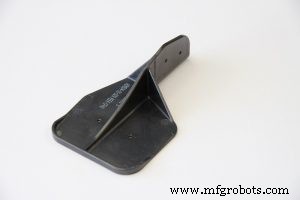
Airbus Helicopters replaced aluminum door fittings on the A350 XWB with PEEK, cutting weight by 40 % and improving functionality. PEEK also suits automotive bearings, piston parts, and custom prosthetics.
\nRecommended printer settings
\n- \n
- Extruder temperature: 360 – 450 °C (all‑metal extruder) \n
- Print bed temperature: ≥120 °C \n
- Bed cover: Kapton tape \n
- Heated enclosure: 70 – 150 °C \n
- Printing speed: 10 – 50 mm/s (0.2 mm layer) \n
PEKK: Key Benefits
\n- \n
- High strength, toughness, and wear resistance \n
- Superior heat and chemical resistance \n
Applications
\nSuitable for components exposed to jet fuel, oil, and hydraulics; used in spacecraft parts with low outgassing. Boeing’s Starliner incorporates over 500 PEKK parts, offering ~60 % cost savings.
\nRecommended printer settings
\n- \n
- Extruder temperature: 345 – 375 °C (all‑metal extruder) \n
- Print bed temperature: 120 – 140 °C \n
- Bed cover: Kapton tape \n
- Heated enclosure: 70 – 150 °C \n
- Printing speed: 20 – 50 mm/s (0.2 mm layer) \n
PPSU (PPSF)
\nPolyphenylsulfone (PPSU) ranks among the strongest 3D‑printing thermoplastics for engineering.
\nPPSU: Key Benefits
\n- \n
- Heat deflection temperature of 205 °C and high chemical resistance \n
- Strong and durable \n
- High resistance to gamma radiation; sterilization‑capable (EtO, steam, plasma, dry heat, cold) \n
Applications
\nVersatile across automotive, medical, and low‑volume injection molding. Its steam‑sterilization resistance makes it ideal for medical tools; automotive under‑hood parts and electronic enclosures also benefit.
\nRecommended printer settings
\n- \n
- Extruder temperature: 360 – 390 °C (all‑metal extruder) \n
- Print bed temperature: 140 – 160 °C \n
- Bed cover: Kapton tape \n
- Heated enclosure: required \n
- Printing speed: 1000 mm/min \n
The Limitations of High‑Performance Thermoplastics
\nPrimary challenges include high material cost and the need for advanced printing expertise. Limited availability of FDM printers capable of handling these temperatures and the requirement for post‑processing (e.g., annealing for PEEK/PEKK) also constrain adoption.
\nConclusion
\nHigh‑performance thermoplastics are rapidly evolving. Their unique properties often provide cost‑effective, lightweight alternatives to metal alloys, opening new opportunities for engineering design. As manufacturers expand the material portfolio, prices are expected to decline, broadening their application scope and strengthening the future of high‑performance 3D printing.
\nMore like this:
\n3D Printing with ABS: All You Need to Know
\nPLA 3D Printing: The Definitive Guide
3D printing
- Choosing Between In‑House and Outsourced 3D Printing: A Practical Guide
- 5 Key Trends Driving the 3D Printing Materials Market in 2019
- Stratasys Unveils Antero800na & Nylon12‑CF, New High‑Performance 3D Polymers for Aerospace, Automotive, and Industrial Parts
- High‑Performance 3D‑Printed Fixtures: Solving Skilled Labor Shortages and Boosting Quality
- Your Definitive Guide to 3D Printing: From Basics to Advanced Techniques
- The Ultimate 3D Printing Glossary: All Key Terms Explained
- Mastering 3D Printing Supports: A Comprehensive Guide to Quality & Efficiency
- Master 3D Printing Infill: Expert Guide to Optimal Percentage Selection
- Expert Guide to Choosing 3D Printing Materials for SLS, MJF, FDM, SLA & DLS™
- Top Flexible Materials for 3D Printing: Performance & Applications