



Building and Sustaining a Consistent Pipeline of High-ROI RPA Opportunities
 As RPA initiatives advance in an organisation, it moves from automating a simple task to large and complex processes.
Robotic process automation (RPA) has become a very common name amongst digital service providers (DSPs) and all of them have seen its benefits in one way or the other. But, scaling RPA across the organisation is a different ball game and is proving to be a highly challenging task for organisations. Deloitte’s Global Robotics Report 2018 says that 80% of organisations implementing RPA were happy with the results, but only 1% of them were able to scale considerably in past 1 year (50+ bots in a year).
One of the major reasons for this challenge is the inability to identify the right use cases for automation after initial few successful implementations. Lack of end-to-end visibility in complex and large processes further adds to this problem.
Mentioned below are a series of techniques which can help to create and maintain a steady pipeline of processes ready for RPA as per DSP’s maturity level:
Demand generation techniques as per DSPs’ RPA implementation maturity
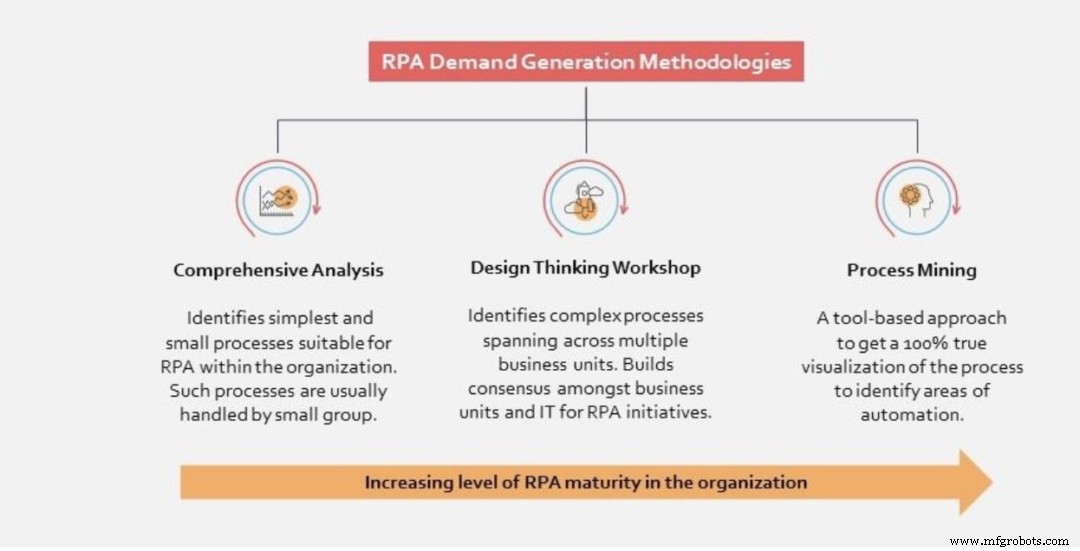
Let’s understand each one of them in detail:
Comprehensive Analysis
Comprehensive analysis helps in identifying high-value RPA opportunities for the DSPs who are just adopting RPA and are in the early stages of their journey. It takes into consideration the level of maturity, the proportion of processes done in-house vs. outsourced, and any or all the process details available. It has two approaches:
| Top-down Approach | Bottom-up Approach |
|---|---|
| It is based on full-time equivalent (FTE) allocation and analyses following operational metrics: *FTE strength in operations *Cost of these FTEs *Cost allocation across functions *FTE allocation across functions *Level of manual intervention required in various functions | It focuses on getting into details of processes and improving them using Lean Six Sigma methodologies. It analyses: *Process complexity and standardisation *Volume and repeatability of processes *Identifies non-value-added tasks in the processes and analyses how to remove them *It involves both organisational as well as process improvement |
Based on the combined results of these approaches, joint solution workshops are conducted. This is where both IT and business leadership teams are involved to narrow down on prospective processes and to create ROI projection and roadmap of automation. The aim of this technique is to deliver process documents (As-Is and To-Be), process improvement opportunities, automation opportunities and automation architecture and cost projection.
Design thinking workshops
As RPA initiatives advance in an organisation, it moves from automating a simple task to large and complex processes. Such processes traverse through multiple teams and business units. For example; quote and invoice validation, service work-order status, promotion notifications service, etc. This causes a lack of end-to-end visibility of the process across business units, leading to incomplete analysis. Also, in such processes, a lot of inefficiencies occur at the hand-off stage rather than at the siloed team stage.
Design thinking workshop brings together a diverse set of stakeholders, from IT and business units, and gets their support and consensus for RPA initiatives. It enables them to gain a holistic bird’s-eye view of organisational operations and ideate automation strategy while collaborating with each other. The techniques used are:
- Affinity cluster – use cases suggested during the focus interviews are visually mapped out on the walls in clusters of similar functional areas
- Experience diagramming – teams to develop process maps capturing key personas, waypoints, & systems. Rose/Thorn/Bud terminology is used to highlight issues and opportunities
Process Mining
Any process improvement starts by creating process models of that process. These are usually based on either incomplete/outdated process documentation or flawed perceptions of the stakeholders. Also, multiple stakeholders may have multiple ways of doing the same process and all of them can be inefficient.
Process mining tools help to visualise all the possible paths of doing a process using event logs created by information systems. It builds the exact As-Is flow of the current state and aids in a detailed analysis of the process.
These tools observe how the process is executed, how much time it takes to complete, which steps are repeated, and what can be automated. It also helps to build an automation roadmap based on empirical data.
All these insights help in qualifying processes for automation, which are not obvious choices otherwise. These tools also help in measuring the benefits of ongoing automation, as it can breakdown any process and identify the magnitude of automation for individual sub-processes. This technique is suitable for organisations that are already matured in their RPA journey.
Benefits
- Lean Six Sigma techniques used in the comprehensive analysis can help in increasing the automation potential of a process by 20%
- Process redesign happening as a result of the comprehensive analysis can lead to an increase in savings by up to 50%
- On average, a two-day design thinking workshop can help in identifying 150+ automation opportunities, out of which minimum 20% can be high value
Automation Control System
- Building a Seamless Partnership Between Maintenance Planning and Storeroom Operations
- Mastering High‑Quality STL Export Settings for Precise 3D Printing
- Robotic Deburring: Boosting Productivity & Delivering Tangible ROI for Manufacturers
- 2021 Outlook: 6 Key Predictions for RPA, AI, and Automation
- Recession-Proofing Businesses: How RPA & Process Mining Drive Growth
- Future of Automation: 4 Key Predictions for 2017 and Beyond
- Enhancing Customer Experience with RPA and Digital Process Automation
- Tech Leaders Summit: Mastering Your RPA & AI Journey – Expert Insights
- Robotic Process Automation: Top Use Cases, Common Pitfalls, and Future Outlook
- Winter-Ready Heavy Equipment: Expert Prep & Maintenance Guide