



Revolutionizing Stream Document Processing with UiPath IXP
The vision of a paperless office surfaced in the 1970s, yet a decade later most enterprises were still wrestling with PDFs, scanned forms, email attachments, and the infamous Invoice_FINAL_v2_ACTUALLY_USE_THIS_ONE.pdf. Documents haven’t disappeared; they’re simply taking on new roles within enterprise workflows, demanding a higher‑grade, production‑ready stream processing solution.
In our previous discussion we highlighted that intelligent document processing (IDP) is evolving rather than being replaced. Here we dive into the technical backbone that powers that evolution.
Why documents remain the bottleneck
Traditional IDP treated each document as an isolated island: a PDF arrives, a model pulls out fields, the output moves downstream, and the document’s life ends. Modern agentic processes, however, treat a loan package, an insurance claim, or a medical record as a continuous evidence pipeline. Each new extraction becomes part of an organization’s working knowledge.
Meeting this demand requires continuous ingestion, classification, and extraction from high‑volume, varied sources in real or near‑real time. Sources shift, schemas drift, and the system must adapt without compromising the governance that makes IDP deployable: reliable accuracy, auditable evidence, and lifecycle control. Customers want higher straight‑through processing (STP) at lower cost, faster integration, and a defensible path through local and global compliance regimes.
UiPath IXP (Intelligent Xtraction & Processing) is the framework we use to meet that bar.
The two dimensions of document complexity
Enterprise document complexity can be split into two dimensions:
1️⃣ Document entropy – variability in field structures and relationships (e.g., how 20 vendors encode the same invoice) and semantic ambiguity (the same phrase meaning different things in different contexts).
2️⃣ Operational constraints – jurisdictional rules on where a document can be processed, data residency requirements, acceptable error rates per field, and cost profiles that must hold across millions of pages a month.
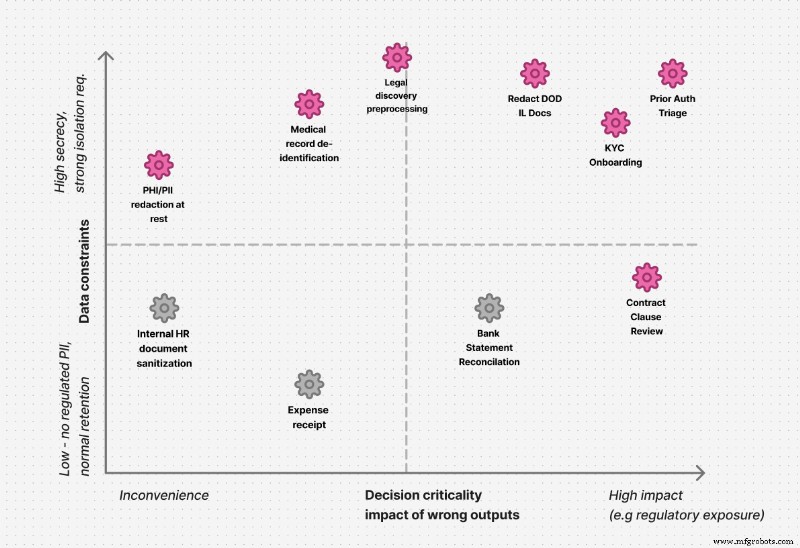
Most IDP programs fail on the second dimension. They optimize extraction accuracy but neglect the hard work of making the pipeline operable in context. A high‑accuracy model that can’t run in the required region, produce an audit record, or absorb schema drift is a non‑starter.
Taxonomy as a contract
UiPath IXP reduces entropy through taxonomy. A taxonomy defines the fields, types, relationships, and validation rules a document class is expected to produce, serving as a contract between extraction and downstream systems.
This contract is the governance spine. Schemas change under version control; when a new vendor variant appears, the taxonomy is extended—not rebuilt. Workflows, agents, and systems of record bind to stable field names and types, not to the model’s raw output.
IXP can auto‑generate taxonomies from sample documents, compressing weeks of schema discovery into hours. Production reliability still requires schema validation, evidence capture, and fallbacks, regardless of how capable the underlying model is. “The model said so” is not a governance strategy.
Risk‑stratified processing
A fifty‑page medical record and a ten‑dollar coffee receipt should not travel the same pipeline. Critical facts like medications, allergies, and lab values run through strictly verified extraction with evidence capture and field‑level traceability. Lower‑risk narrative content can use OCR plus lighter LLM cleanup.
Compliance sets the floor: the minimum verification, isolation, redaction, and retention controls a document class must meet. Cost and downstream use determine the ceiling. The result is a portfolio of pipelines, each tuned to a risk class, each producing the same shape of auditable record so reviewers see consistent evidence regardless of the path a document took.
From clerk to judge
The most compelling shift is in the human role.
In traditional IDP operations, people performed clerical work—retyping values, correcting misreads, resolving exceptions manually. In IXP, a pre‑validation agent acts as a digital senior clerk: it reasons through ambiguity, consults external tools (ERP, CRM, system of record), proposes corrections, and captures its reasoning as evidence. By the time a person reviews the document, the hard work is already done: a candidate answer, a second‑opinion check against policy, and a trace of how both were produced.
The human becomes a judge, adjudicating proposed fixes against evidence and policy rather than rebuilding records from scratch. This amplifies STP gains and strengthens auditability, because every decision carries its reasoning trail.
Validation as composable primitives, governable by design
A monolithic validation UI hampers how agentic processes actually run across ERPs, case management, email, chat, and internal tools.
UiPath IXP’s Validation Station is delivered as embeddable primitives—a lightweight SDK and modular components that let teams integrate validation into the surfaces where users already work, including MCP apps and elicitation patterns. Policy enforcement, evidence capture, and audit behavior remain consistent everywhere, because they are properties of the primitive, not the host application.
UiPath Maestro orchestrates long‑running processes without fragmenting the audit record. The same policy, evidence schema, and audit format follow the document wherever validation occurs.
What this unlocks
Documents are no longer islands. They are inputs to policy‑bound, auditable, composable pipelines that feed agents, systems of record, and ultimately decisions. UiPath IXP, working alongside orchestration layers like UiPath Maestro™, turns those pipelines into deployable, compliance‑ready solutions that move beyond proof‑of‑concept.
The next wave of automation value lies in document‑to‑decision workflows that are fast enough to compete, accurate enough to trust, and disciplined enough to survive an audit. That’s the benchmark IXP is built to meet. If your current document stack can’t deliver all three simultaneously, it’s time for a conversation.
Automation Control System
- AMRs Adapt and Thrive During the Pandemic and Beyond
- TrustPortal Launches Enterprise-Scale Hyperautomation Platform for Superior Employee and Customer Experiences
- Boosting UK Manufacturing: 2018 Outlook for Industry 4.0 Success
- Smaller, Faster, & Smarter Remote I/O: The Future of Industrial Automation
- How UiPath Boosted Capacity by 21% Using In-House Automation
- Leverage Modern Technology for Business Growth and Efficiency
- Anca AIMS Delivers Modular Automation to Boost Tool Production
- Top Hyperautomation Trends Reshaping Finance: Boost Efficiency, Cut Costs, Reduce Fraud
- Automating Job Shops: Boost Productivity & Cut Costs
- Industry 4.0 in Process Industries: Proven Steps to Boost Efficiency and Innovation