



Key Mathematical Constants: Euler's Number (e) & Pi (π) – Applications and Definitions
Euler’s Number (e)
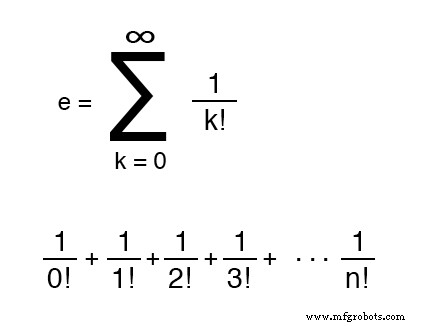
Euler’s number is the base of natural logarithms, essential in modeling continuous growth or decay, such as radioactive decay or compound interest.
Its unique self‑similarity makes it the sole constant whose derivative equals itself, simplifying differential equations and integral calculus.
Pi (π)
Pi is the invariant ratio of a circle’s circumference to its diameter, appearing in geometry, trigonometry, and physics.
Below are the first 100 digits of each constant, grouped in five‑digit blocks for ease of manual copying.
e approximately equals:
2.71828 18284 59045 23536 02874 71352 66249 77572 47093 69996
Pi approximately equals:
3.14159 26535 89793 23846 26433 83279 50288 41971 69399 37511
Note:
The spaces between each set of five digits have no mathematical significance; they simply aid readability.
RELATED WORKSHEETS:
- Time Constant Calculations Worksheet
- Phasor Mathematics Worksheet
- Algebraic Equation Manipulation for Electric Circuits Worksheet
Understanding Radicals: Definitions, Properties, and Practical Tips
Understanding Logarithms: Definition, Properties, and Practical Applications
Industrial Technology
- Understanding C Constants and Literals: Types, Usage, and Best Practices
- C++ Constants & Literals Explained: Types, Syntax, and Best Practices
- Mastering C# Constants & Literals: Types, Rules, and Best Practices
- Key Insights About Gold: What You Need to Know
- Warehouse Optimization: Definition, Benefits, and Key Strategies
- Why Traceability Matters: Boosting Quality, Safety, and Brand Trust
- Why the Automation Industry Matters in Industry 4.0
- Why Uniform Wall Thickness Matters in Injection Molding
- The Critical Role of Heavy Equipment Maintenance in Industrial Success
- Why ISO Certification Matters: Boosting Quality, Compliance, and Global Credibility