



Understanding Logarithms: Definition, Properties, and Practical Applications
Definition of a Logarithm
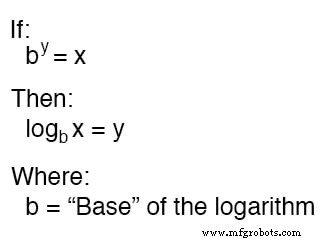
A logarithm answers the question: to what power must a base be raised to produce a given number? In this context, log refers to the common logarithm with base 10, while ln denotes the natural logarithm with base e (≈ 2.71828).
Key Properties of Logarithms
Logarithm of a Product
logb(MN) = logbM + logbN
Logarithm of a Quotient
logb(M/N) = logbM – logbN
Logarithm of a Power
logbMn = n · logbM
These identities transform multiplication, division, and exponentiation into simpler addition, subtraction, and scaling operations, which is especially valuable in manual calculations and early computing.
Historically, tables of logarithms were used to perform multiplication and division by turning the operation into addition or subtraction of logarithmic values. The resulting sum or difference is then referenced back to the table to find the product or quotient.
Slide rules embody this principle: they employ logarithmic scales so that moving the cursor a linear distance corresponds to a logarithmic change in value. Adding or subtracting these distances on the scale yields the product or quotient of the numbers represented.
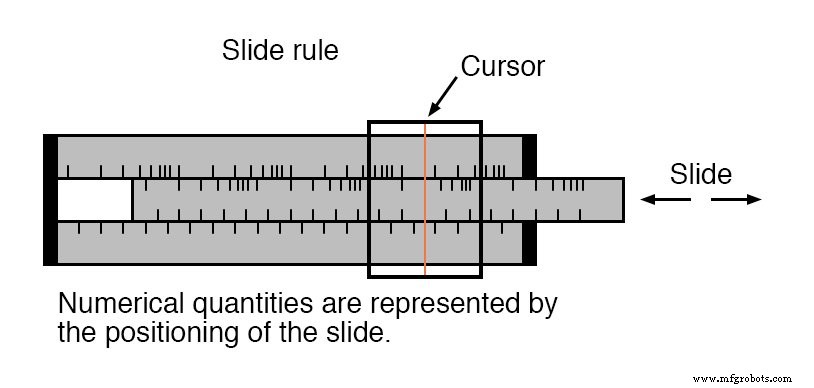
Because the marks on a slide rule’s scales follow a logarithmic progression, a straight‑line measurement of distance translates into a non‑linear relationship on the printed scale. This feature makes slide rules a powerful analog tool for engineers and scientists before the digital era.
Most slide rules also incorporated specialized scales for trigonometric functions, exponentiation, root extraction, and other frequently used mathematical operations.
RELATED WORKSHEETS:
- Logarithms for Analog Circuits Worksheet
Industrial Technology
- Mastering Java Logging: Fundamentals & Best Practices
- Log & Graph 24‑V Thermostat Events with an Optocoupler and Raspberry Pi
- Raspberry Pi Photocell Logging & Alert System – Build a Low‑Power Light Sensor with Python
- 32‑Band Arduino Audio Spectrum Analyzer – Linear & Pseudo‑Log Display
- How to Log GPS Data to a MicroSD Card Using Visuino on Arduino Nano
- 7 Key Benefits of Maintaining an Equipment Maintenance Log
- Log Amplifier: Key Features & Applications for Signal Processing
- Choosing the Right Hydraulic Pump Size for Your Log Splitter
- Boost Your Log Splitter’s Power: Proven Strategies for Heavy‑Duty Performance
- Choosing the Right Hydraulic Pump Size for Your Log Splitter: A Practical Guide