



Measuring Power Dissipation in Resistors: A Hands‑On Experiment with Joule’s Law
PARTS AND MATERIALS
- Calculator (or pencil and paper for arithmetic)
- 6 V battery
- Two ¼‑watt resistors: 10 Ω and 330 Ω (±5 % tolerance)
- Small thermometer (medical or infrared)
Exact resistor values are not critical; keep them within ±5 % (±0.5 Ω for the 10 Ω, ±16.5 Ω for the 330 Ω). The color codes are Brown‑Black‑Black‑Gold (10 Ω) and Orange‑Orange‑Brown‑Gold (330 Ω).
Only a 6 V battery should be used. The thermometer must be compact to detect rapid heating.
CROSS‑REFERENCES
Lessons In Electric Circuits, Volume 1, Chapter 2: Ohm’s Law
LEARNING OBJECTIVES
- Using a voltmeter, ammeter, and ohmmeter
- Applying Joule’s Law to calculate power
- Understanding component power ratings
- Recognizing electrically common points in a circuit
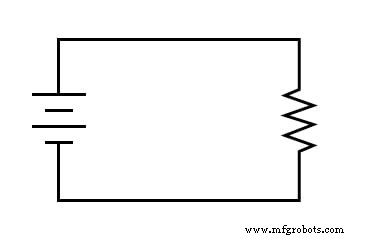
SCHEMATIC DIAGRAM
ILLUSTRATION
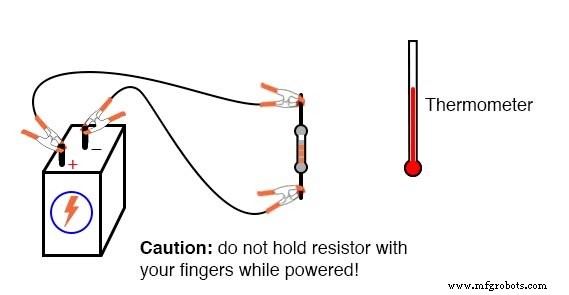
INSTRUCTIONS
1. Measure the resistance of each resistor with an ohmmeter; record the exact values.
2. Connect the 330 Ω resistor to the 6 V battery using jumper wires, attaching the wires to the resistor terminals first to avoid touching a live component.
3. With the circuit powered, use a voltmeter to confirm the battery voltage across the resistor. Because the resistor and battery share the same two nodes, the voltage across the resistor equals the battery voltage.
4. Measure the current with an ammeter inserted in the circuit’s path. Create a break in the wire, place the ammeter between the open ends, and reconnect the circuit.
5. Record voltage, current, and resistance. Then calculate power using any of the following forms of Joule’s Law:

With a 6.0 V source and a 330 Ω resistor, the expected power is 0.109 W (109 mW), comfortably below the resistor’s 0.25 W rating. The resistor should warm noticeably but not overheat.
6. Touch the thermometer to the resistor’s center to observe the temperature rise.
SAFE PRACTICE
When swapping resistors, disconnect the circuit before installing a new resistor. Replace the 330 Ω with the 10 Ω resistor and reconnect. The 10 Ω resistor dissipates ~3.6 W—over 14 times its 0.25 W rating—so it will heat rapidly. Keep it away from flammable materials.
If the resistor begins to smoke, immediately break the circuit, allow it to cool, then re‑measure resistance. A damaged resistor often shows a higher resistance, which can reduce current and power, providing a self‑protective effect.
RELATED WORKSHEETS
- Energy, Work, and Power Worksheet
Industrial Technology
- Voltage Divider Lab: Design, Measurement, and Kirchhoff’s Voltage Law Verification
- Build a Potato Battery: A Step‑by‑Step Guide to DIY Electrochemical Power
- Understanding AC Circuits: A Beginner's Guide
- Power Sources: AC and DC Explained
- Protective Relays: Safeguarding Industrial Power Systems
- Amplifiers: Harnessing Active Devices to Boost Power
- Understanding Bels and Decibels: From Power Gain to Voltage Conversion
- Optimized Power Solutions for Arduino Projects
- UPS Circuit Design: Build Reliable Emergency Battery Backup Systems
- Fixed Resistor Explained: Purpose, Types, and Key Applications