



Understanding Radicals: Definitions, Properties, and Practical Tips
Understanding Radicals: Definitions, Properties, and Practical Tips
What is a radical?
In mathematics, a radical is an expression of the form √[x]{a}, where x is a positive integer greater than one (the index) and a is a real number (the radicand). The radical can also be written as a power:
$$\sqrt[x]{a} = a^{1/x}$$
Here, x is the index and a is the radicand. The symbol √ denotes the radical.
When people refer to a square root, they are describing a radical with an index of 2. This is mathematically equivalent to raising a number to the 1/2 power. Knowing this equivalence is handy when working with scientific calculators that might not have a dedicated “fourth‑root” button. Simply compute the root by raising the number to the reciprocal of the desired index—for example, the fourth root of y is y0.25.
Important Note:
For any even root (square root, fourth root, etc.), two solutions exist. While most people immediately think of the positive root—√9 = 3—the negative root is also valid because (-3)2 = 9.
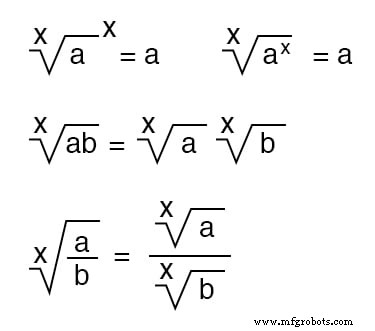
Key Properties of Radicals
Industrial Technology
- Root Cause Failure Analysis: A Proven Approach for Manufacturing Excellence
- Root Cause Assessment Methods: A Professional Guide to Reliability Improvement
- Root Cause Analysis: Strengthening Plant Reliability
- Avoiding Common Pitfalls in Root Cause Analysis: A Practical Guide
- Mastering Root Cause Analysis with the 5 Whys Technique
- Why Organic Turmeric Root Powder Is a Powerful Antioxidant: Health Benefits & Practical Uses
- How to Use Dried Ginger Root: Tips, Health Benefits, and Culinary Ideas
- Java 10 Introduces Built‑In Root Certificates for Secure TLS
- Root Cause Analysis for Manufacturers: The Definitive, Actionable Guide
- Unlocking Solutions: How Root Cause Analysis Drives Sustainable Success