



Mastering Root Cause Analysis with the 5 Whys Technique
As a recent Fiix blogger highlighted, "Equipment failure is not a single event—it is a process." In practice, maintenance issues rarely stem from one isolated fault; they are the culmination of a chain of technical glitches and procedural lapses. The 5 Whys method shines precisely because it peels back those layers to reveal the underlying cause, forming a cornerstone of comprehensive root cause analysis (RCA).
What is Root Cause Analysis (RCA)?
RCA encompasses a spectrum of approaches, tools, and techniques designed to identify the origins of problems. As outlined by Asq.org, it is a "collective term that describes a wide range of approaches, tools, and techniques used to uncover causes of problems." While broad, the practical aim is simple: prevent recurrence by addressing root causes rather than surface symptoms.
Every defect or failure presents an obvious, visible symptom—perhaps a machine producing off‑spec parts. Yet that symptom is merely the tip of the iceberg. Behind it lie multiple contributing factors that, if ignored, will lead to repeated breakdowns. RCA forces teams to investigate those hidden layers.
How to Master Troubleshooting in Maintenance
Beyond the 5 Whys, lean manufacturing explores the eight causes of production waste to pinpoint improvement opportunities, while Six Sigma’s DMAIC framework applies statistical analysis for process optimization. Successful RCA typically involves a cross‑functional team, ensuring diverse perspectives uncover every angle of the problem.
What is the 5 Whys Analysis?
The 5 Whys is a systematic questioning loop: "Why did this happen?"—repeated until the root cause emerges. By repeatedly probing, you filter out symptoms and reveal the core issue.
Consider a scenario where a critical product order is missed because a key machine failed. To find the root cause, we ask:
- Why did the equipment fail? It overheated.
- Why did it overheat? The cooling fan failed.
- Why did the cooling fan fail? Regular servicing was missed.
- Why was its service missed? We used a paper tracking system that fell through the cracks.
- Why don’t we have an automated preventive maintenance system? We’ve resisted adopting new technology.
Simply replacing the fan would not stop recurrence. The key is to keep asking "Why" until the root cause—often a process failure—becomes clear. The method can require six or seven iterations; the goal is to avoid turning the exercise into a series of “5 Whos.”
After each "Why," ask:
- Is there measurable evidence supporting this root cause?
- Could another "Why" reveal a more plausible cause?
- Could something else have produced this problem?
Download a 5 Whys root cause analysis template here
How to Avoid the Wrong "Whys" in Your Analysis
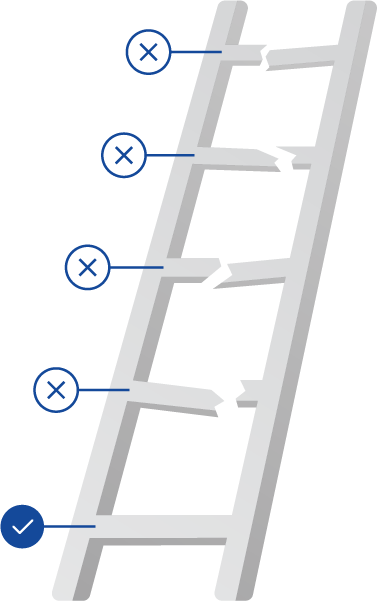
While a 5 Whys exercise uncovers the root cause, focusing solely on the lowest rung can leave the broader system flawed. Think of it as fixing the base of a broken ladder; the ladder remains unusable unless each rung is addressed. Invest at every level of the "why" hierarchy—technical training, automated preventive maintenance alerts, adherence to manufacturer‑recommended service schedules, or predictive sensors like vibration monitors.
Incremental, continuous improvements compound over time, boosting maintenance productivity and freeing personnel from firefighting breakdowns.
Root Cause Analysis for Maintenance
In maintenance, the 5 Whys framework offers a straightforward, systematic problem‑solving path that leads to sustainable corrective actions.
It is an excellent entry point for shifting from reactive to preventive maintenance, introducing systematic reasoning without requiring advanced statistics. Whether tackling simple faults or complex failures, the method keeps teams focused on real causes, preventing the recurrence of breakdowns and ending the symptom‑driven cycle.
Equipment Maintenance and Repair
- Root Cause Failure Analysis: A Proven Approach for Manufacturing Excellence
- Root Cause Analysis: Strengthening Plant Reliability
- Avoiding Common Pitfalls in Root Cause Analysis: A Practical Guide
- Master Root Cause Analysis with the 5 Whys: A Lean Tool Explained
- Root Cause Analysis & Prevention: A Reliable Approach
- Choosing the Ideal Root Cause Analysis Tool for Operators
- Former Intel Engineer Shares Proven Root Cause Analysis Techniques
- Vibration Analysis Fundamentals: A Practical Guide for Predictive Maintenance
- Root Cause Analysis for Manufacturers: The Definitive, Actionable Guide
- Unlocking Solutions: How Root Cause Analysis Drives Sustainable Success