



Vibration Analysis Fundamentals: A Practical Guide for Predictive Maintenance

Non‑destructive testing (NDT) offers a range of methods to assess machine health without shutting down equipment. Among them, vibration analysis stands out as a reliable, real‑time diagnostic tool used across industries—from manufacturing to infrastructure.
In this article, we dissect the vibration analysis workflow, key parameters, essential tools, and real‑world applications to help you integrate it into your maintenance strategy.
Why Measure Vibration?
All moving machinery generates vibration. Each component has a unique vibrational signature under specific operating conditions. By recording and analyzing changes in these signatures, engineers can detect underlying mechanical issues before they become catastrophic.
What Is Vibration Analysis?
Vibration analysis leverages recorded vibration signals to spot deviations from a component’s baseline behavior. A change in the pattern typically signals a shift in the physical state of the asset—such as wear, imbalance, or misalignment.
When an anomaly is detected, root‑cause analysis pinpoints the failure mode, enabling timely corrective actions that prevent downtime.
Applications and Scope
Vibration analysis is ideal for any equipment that undergoes rotary motion—bearing torsional forces. Typical targets include:
- Bearings, gears, shafts, rotors
- Motors, fans, drive‑trains, gearboxes
- Pumps, piston engines, compressors, and other reciprocating machines
Beyond rotating machinery, vibration data can monitor structural health in bridges, pipelines, and other critical infrastructure, detecting corrosion or material fatigue.
Gearbox Inspection
Gearbox wear is often silent until failure. Vibration analysis detects broken or pitted gear teeth early, allowing a work order to be issued before a catastrophic breakdown.
Bearing Defect Detection
Excessive vibration is a hallmark of bearing wear. Vibration monitoring can isolate specific fault types, such as:
- Reverse loading
- False brinelling
- Overheating
- Fatigue
- Corrosion
- Installation problems
- Misalignment
- Imbalance
Pipeline Condition Monitoring
Corrosion inside pipelines alters vibration signatures, especially at constant flow rates. Analyzing these patterns can reveal leaks or structural weaknesses before they pose safety risks.
The Vibration Analysis Process
- Establish a Baseline: Record a healthy machine’s vibration to serve as a reference.
- Develop a Routine: Schedule regular checks based on equipment criticality and operating conditions. Real‑time streaming can replace periodic sampling.
- Standardize the Process: Use consistent sensors, software, and SOPs to ensure comparable data.
- Maintain Records: Store all historical data for trend analysis and future reference.
- Analyze and Act: Compare new data against the baseline; when anomalies appear, trigger maintenance actions.
Key Measurement Parameters
Vibration signals are defined by:
- Frequency (Hz): Vibrations per second.
- Amplitude (RMS): Maximum displacement from equilibrium.
- Period (s): Time between successive peaks; the inverse of frequency.
In practice, amplitude is expressed through three physical metrics:
- Displacement (mm or μm)
- Velocity (mm/s or μm/s)
- Acceleration (mm/s² or μm/s²)
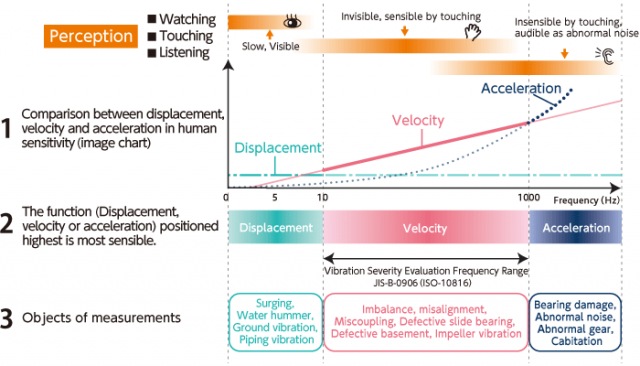
Vibration perception categories – visual, tactile, auditory (Source: IMV Corporation)
Essential Equipment for Vibration Analysis
Vibration Sensors
Different parameters require specific sensors:
- Displacement sensors
- Velocity sensors
- Accelerometers (Piezoelectric, MEMS, proximity probes, laser Doppler vibrometers)
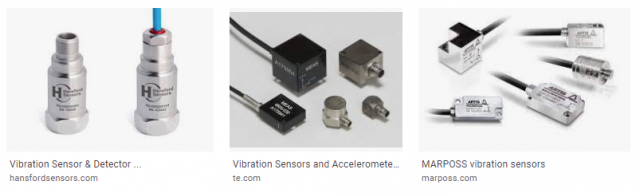
Common vibration sensor types
When selecting a sensor, evaluate:
- Amplitude range
- Sensitivity
- Bandwidth
- Noise level
- Mounting options
- Axis coverage
- Sampling frequency
For deeper insights, consult the guide Choosing the Right Sensor for Vibration Analysis.
Analysis Software
Key software options include:
- EI Analytic
- Vibinspect (ReVibe Energy)
- Dplot
- Control Software (Vibration Research)
- ProAnalyst (Xcitex)
- Lab Software (enDAQ)
- FEMtools
Verify compatibility and licensing before purchase.
Online Monitoring Systems
Deploy sensors that stream data to cloud‑based platforms. The software analyzes the influx in real time, issuing alerts and maintenance recommendations.
Portable Handheld Devices
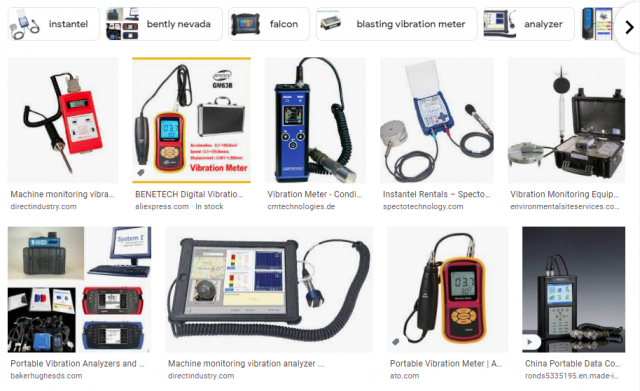
Handheld vibration meters for on‑site diagnostics
These devices support CMMS integration, enabling scheduled measurements and streamlined work‑order creation.
From Data to Diagnosis
Vibration data is captured in two primary formats:
- Time‑Domain Waveform: Raw amplitude vs. time data; useful for immediate defect detection.
- Fast Fourier Transform (FFT): Converts time data into frequency spectra, pinpointing the source of vibration.
While time‑domain analysis flags anomalies, FFT identifies the exact fault source—be it a motor, belt, or shaft—enabling targeted repairs.
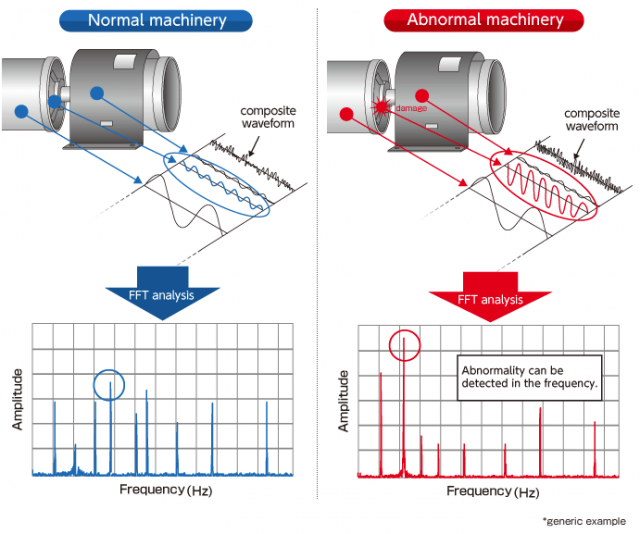
FFT spectrum analysis for precise fault localization (Source: IMV Corporation)
Professional Training and Certification
Qualified analysts typically hold credentials from recognized bodies:
- ASNT – offers NDT certifications, including vibration analysis modules.
- The Vibration Institute – provides Category I‑IV analyst training, accredited by ANSI.
- Mobius Institute – delivers ISO‑accredited courses on condition monitoring and reliability engineering.
National labor departments also recognize NDT specialists, and many countries maintain their own accreditation schemes.
Vibration Analysis in Maintenance Strategies
Predictive Maintenance
Integrate vibration data into predictive models to forecast failures. Pairing sensors with CMMS platforms like Limble triggers automated work orders when thresholds are exceeded.
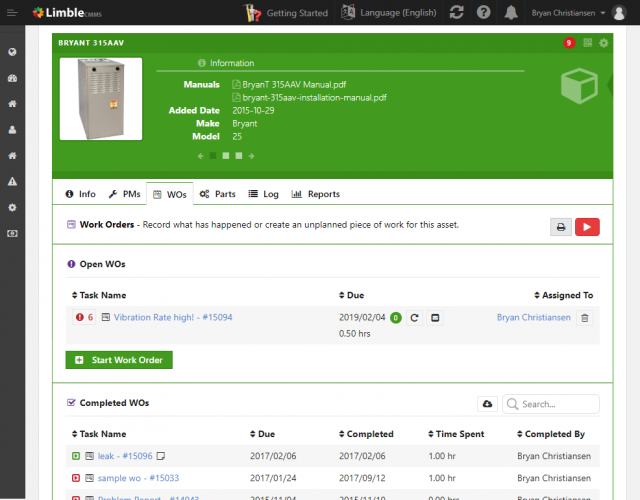
Automated work order in Limble CMMS triggered by vibration alerts
Corrective and Breakdown Analysis
Post‑failure vibration reviews help isolate root causes, reduce recurrence, and inform future maintenance planning.
- Implement corrective actions.
- Update maintenance schedules to prevent repeat incidents.
Technicians can log observations directly into CMMS, providing a rich dataset for reliability engineers and managers.
Benefits and Considerations
**Advantages**:
- Non‑intrusive monitoring of hard‑to‑reach components.
- Remote data collection for dispersed assets.
- Real‑time insights into critical equipment health.
- Established SOPs and mature software ecosystems.
- Commercially available sensors tailored to specific conditions.
**Limitations**:
- Requires skilled analysts and certifications.
- Not effective for ultra‑fast defect propagation.
- Initial investment in sensors and software.
- Fault localization can be complex in multi‑component systems.
Implementing vibration monitoring should follow a cost‑benefit analysis to ensure ROI.
Early Detection Saves Costs
Proactive identification of deterioration gives maintenance teams ample time to procure parts, coordinate downtime, and align with production schedules.
When combined with CMMS, vibration analysis transforms condition‑based maintenance into a data‑driven, efficient process.
Equipment Maintenance and Repair
- High Vibration in New Centrifugal Pump Traced to Faulty Motor Mounts
- Predictive Vibration Analysis Saves Machines—and Money
- Harnessing Pareto Analysis to Optimize Maintenance Efficiency
- Polyester Resins: Essential Guide for Composite Applications
- Milling Machines 101: A Comprehensive Guide to Their Function, Components, and Uses
- Ladder Logic 101: Mastering the Fundamentals for Automation Success
- Mastering Asphalt Compaction: Key Techniques for Durable Pavement
- Your Complete Guide to Buying a Lathe: Tips & Insights
- Unlocking Solutions: How Root Cause Analysis Drives Sustainable Success
- Structural Foam Molding: Streamlining Complex Part Production