



Continuous Manufacturing: Setting Up and Sustaining a 24/7 Production System
Manufacturers adopt diverse production models to maximize efficiency. A continuous production system—also known as mass production—is a powerful approach for high-volume, low‑variation output, but it demands careful design, ongoing monitoring, and disciplined maintenance.
What is Continuous Production?
Continuous production is one of the three core manufacturing paradigms—batch, job, and continuous. It is engineered for large‑scale output of standardized products, using tightly integrated processes, fixed tooling, and constant material flow. Operations run around the clock in rotating shifts, ensuring minimal downtime and consistent quality.
Industry Applications
Below are notable sectors that leverage continuous flow for maximum benefit.
Automotive
Toyota’s Indonesian complex exemplifies continuous manufacturing. Three integrated plants—casting, stamping, engine building, vehicle assembly, and packing—operate in a single, unbroken chain, delivering high volumes with stringent quality controls.
Pharmaceuticals
While traditionally batch‑oriented, many pharma firms are transitioning to continuous processes. GSK’s new facilities in Singapore, funded with a $95 million investment, illustrate the shift to continuous coating, roll compaction, and wet granulation streams that meet evolving therapeutic needs.
Mining & Metals
Rio Tinto’s aluminum supply chain—from bauxite mining to alumina refining and smelting—illustrates continuous flow in material transformation. The alumina refining process, shown in the image below, demonstrates the energy‑intensive, high‑volume nature of this sector.
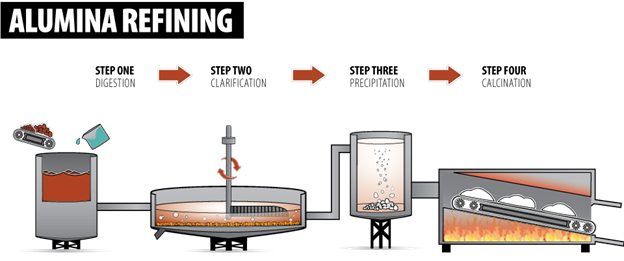
Alumina refining process – Source: Aluminimum.org.au
Biotechnology
In 2019, Sanofi launched the world’s first digital biopharmaceutical facility, employing intensified continuous biologics production to deliver therapeutic proteins more efficiently.
Continuous vs. Batch Manufacturing
Manufacturers often evolve from job shops to more efficient models as demand grows. The core decision typically pits batch against continuous processes, each suited to different market and operational realities.
Batch Manufacturing
- Demand‑driven: Small runs for niche or seasonal products.
- Quality‑driven: Frequent checks and the ability to adjust specifications between batches.
Batch mode offers flexibility and lower upfront equipment costs but can suffer from lower machine utilization and higher per‑unit capital expense.
Continuous Manufacturing
Continuous systems keep raw material and work‑in‑progress in constant motion. Conveyor belts and pipelines act as “moving warehouses,” drastically reducing storage footprints. Because stopping the line incurs significant penalties—thermal cycling, crystallization, and downtime costs—continuous plants favor high equipment utilization and large batch sizes.
Maintenance intervals are typically annual or less, with some high‑temperature units (e.g., blast furnaces) operating for 5–10 years without shutdown.
Pros & Cons of Continuous Manufacturing
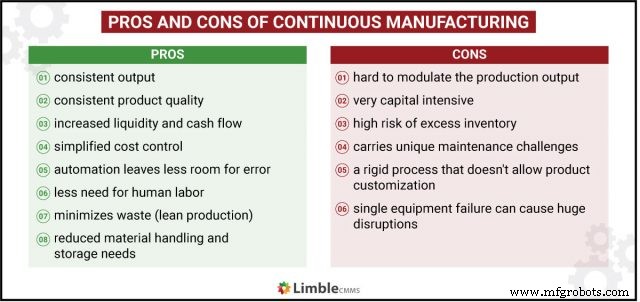
Advantages
- Unmatched process control ensures consistent quality.
- Just‑in‑time raw material delivery and streamlined sequences cut work‑in‑progress, boosting liquidity and cash flow.
- Reduced material handling lowers construction and handling capital.
- Capital amortized over high throughput lowers per‑unit cost.
Disadvantages
- High product standardization limits customization.
- Single‑point failures can halt the entire line.
- Demand fluctuations are difficult to absorb; production cannot be scaled down easily.
- High upfront investment and equipment obsolescence risk.
- Potential for excess inventory if downstream processes stall.
Maintenance Requirements for Continuous Plants
Continuous plants demand a proactive, data‑driven maintenance culture. Failure to plan can lead to costly, high‑pressure shutdowns.
Design Considerations
Maintainability should be baked into the design phase. Perform FMECA analyses to guide equipment layout, redundancy, and spares strategy, ensuring the total cost of ownership reflects in‑service reliability.
Maintenance Philosophy
Reliability‑centered maintenance (RCM) should underpin your strategy, supplemented by total productive maintenance (TPM) or business‑centered approaches as needed. In continuous settings, preventive work occurs during parallel processes; condition‑based tactics dominate due to infrequent shutdowns, while predictive analytics focus on high‑impact assets.
Technology Stack
Deploy a robust CMMS, coupled with predictive and prescriptive analytics. Retrofit assets with sensors for real‑time condition monitoring. This reduces reactive interventions and allows precise scheduling of the rare but critical maintenance windows.
Operational and Safety Planning
Shutdowns are high‑stakes events requiring meticulous scheduling, skilled staffing (in‑house vs. outsourced), and comprehensive safety protocols. Lock‑out/tag‑out (LOTO) procedures, coordinated testing, and adherence to safety guidelines are essential to prevent incidents during the short shutdown window.
Implementing a Continuous Production System
Even for small to medium‑sized manufacturers, the transition demands rigorous planning. Adopt a project‑based mindset and involve cross‑functional teams.
1. Feasibility Phase
Led by production experts, this phase gathers cross‑functional input—engineering, maintenance, finance, quality, safety—to evaluate technical and economic viability.
2. Planning Phase
- Define manufacturing philosophy: high volume of standardized products favors single‑task or multi‑role equipment.
- Assess flexibility: anticipate changes in specifications or client needs.
- Balance CAPEX against potential OPEX savings.
- Design control & monitoring: decide on sampling methods, PAT integration, and sensor placement.
3. Implementation Phase
Execute the plan, ensuring tight integration of production, data, and maintenance systems. Link CMMS to asset condition data, inventory, and planning tools to enable pre‑shutdown readiness, resource allocation, and accurate scheduling.
Conclusion
Continuous manufacturing delivers high‑volume, low‑variation output with superior quality and lower per‑unit costs. However, it requires a disciplined design, robust maintenance strategy, and a data‑centric operational framework to thrive. By investing in the right tools, processes, and safety practices, manufacturers can unlock the full potential of continuous flow while safeguarding workforce safety and system reliability.
Equipment Maintenance and Repair
- How COVID‑19 is Reshaping Manufacturing: Production, Demand, and Supply Chain Impacts
- Mastering Cable and Harness Manufacturing: Setting Accurate Lengths in E3.series
- Boost Manufacturing Efficiency & Cut Costs with Strategic Batch Production
- Proven Strategies for Maintaining Industrial Manufacturing Equipment
- Maximizing Manufacturing Efficiency: Proven Production & Process Optimization Techniques
- Kanban Explained: Boost Lean Manufacturing Efficiency
- Eliminate Errors & Boost Production Quality with an Effective QMS
- Maximizing Manufacturing Productivity Through Continuous Improvement
- Streamline Your Manufacturing & Shipping: Proven Strategies to Cut Costs & Boost Efficiency
- Boost Industrial Productivity & Quality: Proven Strategies for Manufacturing Success