



Mastering Right‑Triangle Trigonometry: Key Concepts & Formulas
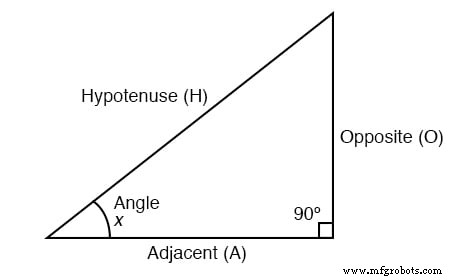
A right triangle contains exactly one right angle (90°).
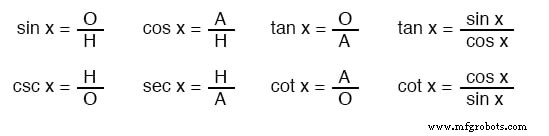
Trigonometric Identities
In the standard notation, the hypotenuse (H) is always opposite the right angle. For a given acute angle x, the side opposite x is denoted O, and the side adjacent to x is A.
Inverse trigonometric functions—arcsin, arccos, and arctan—return an angle from a ratio input. For instance, since tan 45° = 1, arctan 1 equals 45°.
These “arc” functions are indispensable for determining angles in a right triangle when side lengths are known.
The Pythagorean Theorem
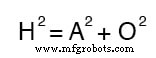
According to standard geometry textbooks, the Pythagorean theorem states that in a right triangle, the square of the hypotenuse equals the sum of the squares of the other two sides: H² = O² + A².
RELATED WORKSHEETS:
- Trigonometry for AC Circuits Worksheet
Industrial Technology
- Mastering Trigonometry: The Law of Sines & Cosines for Any Triangle
- Hire the Right ISO Consultant: Boost Your Manufacturing Quality and Competitive Edge
- Arduino HC‑SR04 Ultrasonic Radar: Build a Real‑Time Visual Display with Servo and Processing
- Understanding the Angle of Contraflexure: Definition, Significance, and Impact on Vessel Stability
- Understanding Angle Valves: Function, Types, and Uses in Plumbing and Industry
- Angle Blocks: Essential Tools for Precise Material Cutting
- Understanding Right-Angle Speed Reducers: Function, Applications, and Benefits
- Right Angle Planetary Gearbox: Compact, Efficient Speed Reduction Solutions
- Right-Angle Servo Gearboxes: Lightweight, Flexible, Reliable Drive Solutions
- Mastering Controlled Impedance: Essential Techniques for Reliable PCB Design