



Mastering Trigonometry: The Law of Sines & Cosines for Any Triangle
Welcome to a concise guide on two cornerstone trigonometric identities that empower you to solve any triangle—whether it’s right‑angled or not. These laws are the backbone of geometric problem‑solving and are used in fields ranging from engineering to navigation.
The Law of Sines
The Law of Sines states that for any triangle ABC, the ratio of a side’s length to the sine of its opposite angle is constant:
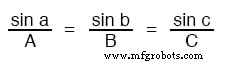
Use it when you know two angles and one side (AAS or ASA), or two sides and a non‑included angle (SSA). It also helps determine the ambiguous case in real‑world applications.
The Law of Cosines
When two sides and the included angle are known (SAS) or all three sides (SSS), the Law of Cosines provides the missing side or angle. The formula is:
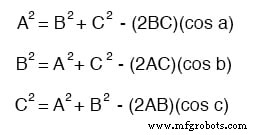
It reduces to the familiar Pythagorean theorem when the angle is 90°, underscoring its generality.
These laws are widely taught in high‑school mathematics and university courses alike. They provide a systematic way to find unknowns in triangles, ensuring accuracy in both academic and professional settings.
For a deeper dive, refer to the Wolfram MathWorld or Stewart’s “Mathematics: A Comprehensive Course” (2022 edition).
Industrial Technology
- Practical Ohm’s Law Experiment: Measuring Voltage, Current, and Resistance
- Detecting AC Electric Fields: A Hands‑On Guide to Electrostatic Coupling and Shielding
- Mastering Right‑Triangle Trigonometry: Key Concepts & Formulas
- Understanding Ohm’s Law and the Real Risks of Electrical Shock
- Calculating Power Dissipation in Resistive Circuits
- Mastering Ohm’s Law: Correct Application and the Table Method for Accurate Circuit Analysis
- Kirchhoff’s Voltage Law (KVL): A Practical Guide to Voltage Circuits
- Kirchhoff’s Current Law (KCL): Fundamentals and Practical Application
- Foundations of Network Theorems: Simplifying Circuit Analysis
- Celebrate Manufacturing Excellence—Choose Your Own Day for Manufacturing Day