



Understanding Don’t-Care Cells in Karnaugh Maps
Up to now, we’ve tackled logic‑reduction problems where every input combination is fully specified. A 3‑variable truth table, for example, contains 2^3 = 8 entries and the corresponding Karnaugh map is fully populated.
In many real‑world applications, however, we do not need to define every possible input. Some combinations will never occur, and the output for those “impossible” states is irrelevant. These are called don’t‑care conditions.
For instance, when working with Binary Coded Decimal (BCD) numbers encoded in four bits, the valid codes are 0000 to 1001 (decimal 0–9). The six binary patterns 1010 to 1111 correspond to the hexadecimal digits A through F and are never used. Consequently, we can mark those six patterns as don’t‑cares and leave them blank in a truth table or Karnaugh map.
Don’t‑Care Cells
In a Karnaugh map, don’t‑care cells are represented by an asterisk (*) and can be treated as either a 0 or a 1 when grouping, or simply ignored. Using them can enable larger groupings, which often lead to a simpler Boolean expression.
Only include a don’t‑care in a group if it reduces the overall complexity of the logic. There’s no obligation to use every don’t‑care cell.
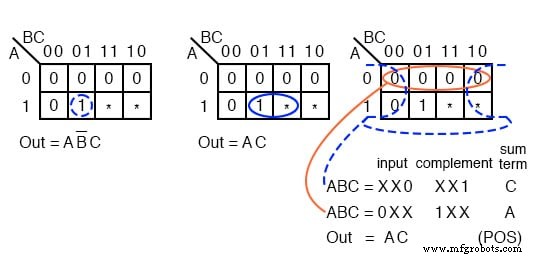
Consider a function that should output 1 for the input ABC = 101 while all other inputs between 000 and 101 are irrelevant. The two combinations 110 and 111 are marked as don’t‑cares. We can derive three different simplified expressions:
- Without using don’t‑cares: Out = AB′C.
- Including a don’t‑care to form a pair: Out = AC.
- Using a don’t‑care to form a four‑cell group of zeros: also Out = AC.
These examples illustrate that don’t‑care cells can be treated as 1s or 0s, depending on which choice yields the simplest expression.
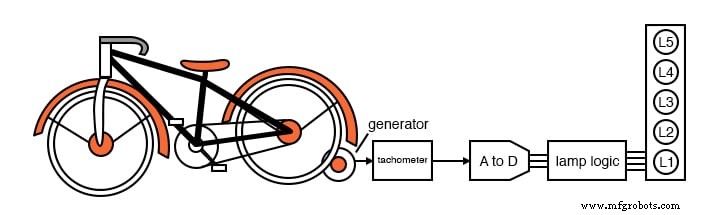
We now turn to a practical application: designing lamp logic for a stationary bicycle exhibit at a local science museum.
As the rider pedals faster, a small DC generator produces a voltage proportional to speed. This voltage is fed into a tachometer board that caps the signal so that the downstream Analog‑to‑Digital (A/D) converter never outputs the two highest 3‑bit codes (110 and 111). The converter therefore produces one of the following codes: 000 (no motion), 001, 010, 011, 100, or 101.
Five lamps (L1 through L5) form a bar‑graph display. The lighting pattern is as follows:
- 000 – no lamps light.
- 001 – L1 lights.
- 010 – L1 and L2 light.
- 011 – L1, L2, and L3 light.
- 100 – L1, L2, L3, and L4 light.
- 101 – all five lamps light.
Since the codes 110 and 111 can never occur, we treat them as don’t‑cares. The following Karnaugh maps are built for each lamp, with 0s for the 000 state, 1s for the appropriate lit states, and *s for 110 and 111.
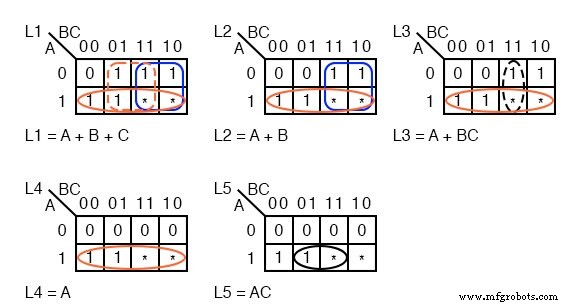
For example, lamp L5 is only on for ABC = 101. Its map contains a single 1 at that cell and zeros elsewhere. Lamp L4 is on for ABC = 100 and 101, so its map has 1s in those two cells. Lamp L3 lights for 011, 100, and 101; lamp L2 lights for 010, 011, 100, and 101; lamp L1 lights for every code except 000.
By grouping the 1s and exploiting don’t‑cares where beneficial, each lamp’s Boolean expression simplifies dramatically. In particular, lamp L4’s expression reduces to simply A (the most significant bit), eliminating the need for any logic gate. The other lamps also benefit from reduced complexity.
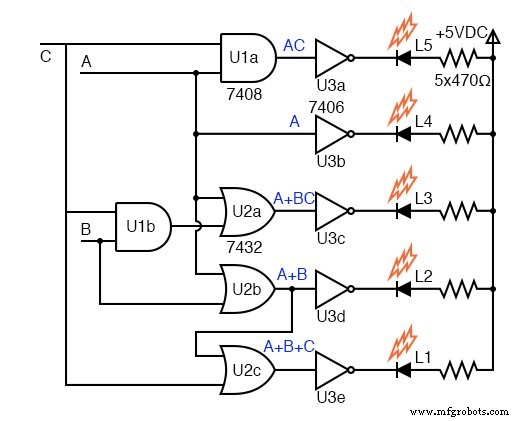
The resulting gate diagram (shown above) connects the five minimized expressions to open‑collector inverters (74‑series 7406) that drive the LEDs. The L1 output uses a 2‑input OR gate combining (A + B) with C, yielding the logical sum A + B + C.
Open‑collector outputs are ideal for LED drivers because they allow current to flow through an external load. An active high at any inverter pulls its output low, sinking current through the LED and its current‑limiting resistor. Although the LEDs in this exhibit might be part of a solid‑state relay driving 120 VAC lamps, that circuitry is beyond the scope of this logic design.
Related Worksheets
- Digital Display Circuits Worksheet
- Karnaugh Mapping Worksheet
Industrial Technology
- Transforming a Venn Diagram into a Karnaugh Map: A Step-by-Step Guide
- Mastering 5‑ and 6‑Variable Karnaugh Maps for Efficient Logic Design
- AI Now Maps Global Informal Settlements from Low-Resolution Satellites
- Climate Change Threatens Solar Panel Efficiency: MIT Study Reveals Impact
- CNC Machines: The Definitive Guide to Best Practices
- Revolutionizing Patient Care: How IoT is Transforming Health Care Delivery
- Maximize Your High-Performance Machining Success: Why Tool Holders Matter
- Smart Manufacturing: Stay Ahead in the Industrial Revolution
- Hydrogen Fuel Cells: The Next Frontier in Sustainable Transportation
- HHO Fuel Cell Explained: A Comprehensive Beginner’s Guide