



Ensuring Safety in Commercial Buildings: The Role of Tensile Sample Preparation Equipment
As things slowly go back to normal, many are thrilled to visit their favorite restaurants and shopping centers again. With commercial establishments becoming more packed than ever, how can the building industry guarantee their safety?
One way is by using tensile sample preparation equipment. How? Read on.
What is tensile strength and why is it important?
Tensile strength refers to the ability of a material to withstand a pulling force before it uncontrollably stretches and breaks. It also refers to its breaking strength when exerting a force that can otherwise simultaneously break many strands of the same material at a constant rate of load or extension. The unit of measure for tensile strength is units of force per cross-sectional area, such as pounds per square inch or psi.
Tensile strength is a widely used metric system for materials used in structural applications. With tensile testing, how a material responds under different types of forces can be easily determined – which is an especially important process in metallurgy since brittle metals are more prone to rupture.
How metals are tested in construction
With a simple tensile testing process, a material is usually pulled up to its breaking point to identify its tensile strength. The material to be tested is usually held by top and bottom grips securely attached to the Universal Testing or Tensile Machine (UTS).
During the test, the two grips are pulled apart at a constant rate to stretch the material to its breaking point. It involves the application of an ever-increasing and recorded load that eventually produces a stress/strain curve that shows how the material reacts to the test.
After the test, all results are finalized, and the material is assembled back together to measure its ultimate length and cross-section measurements. Its ultimate length and cross-section measurements are then compared to the original before the tensile test.
Aside from tensile strength alone, metals undergoing the tensile testing are also bound to have the following information at hand:
- Tensile strength or the Ultimate Tensile Strength (UTS) – refers to the highest tensile strength produced by the specimen.
- Ductility – can be defined as both the strain and elongation at or after a point of fracture, as well as the reduced area resulting from the fracture.
- Yield Strength – stress at which yielding or time-permanent deformation had begun.
Tensile sample preparation
The preparation of test specimens is determined by the testing objectives as well as the applicable test technique or specification. A standardized sample cross-section is frequently present in a tensile specimen. It is made up of two shoulders and a gauge (section) in the middle. Depending on the standard, a standard specimen is constructed in a round or square segment along the gauge length. Both ends of the specimens should be long enough and have a smooth surface so that they may be held tightly during testing.
Gone are the days of huge testing machines taking over laboratories. Now the way smaller, mightier, and more convenient machines are being used to prepare different tensile specimens for a variety of needs. The perfect example of such machinery is TensileMill CNC MINI. Don’t let the small size deceive you. Apart from its apparent convenience and space-saving elements, this machine is also specially designed to achieve utmost flexibility in tensile sample preparation and CNC machining functionalities.
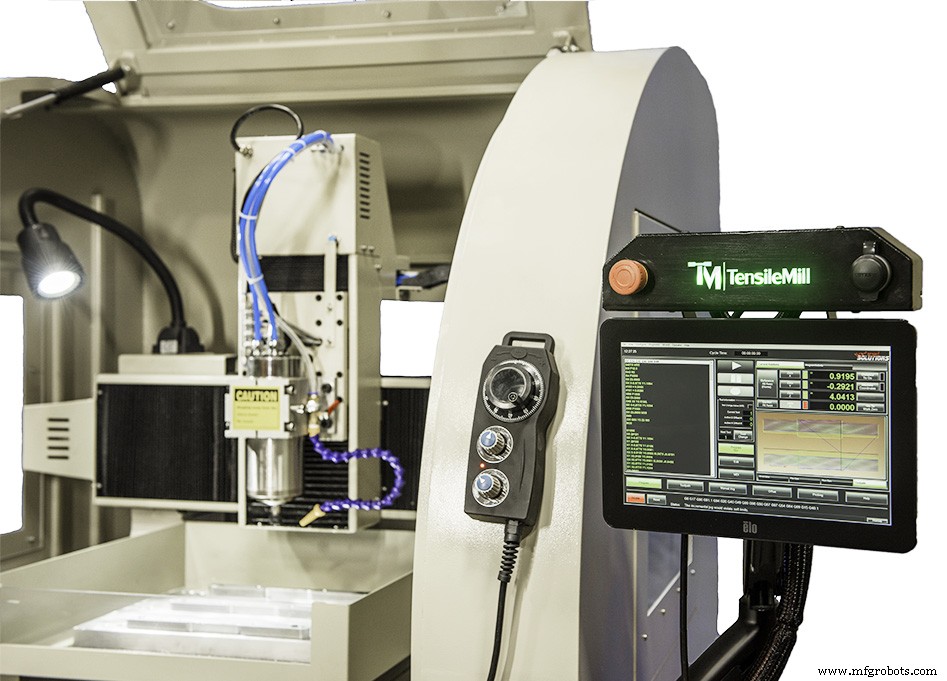
TensileMill MINI CNC
It’s made with a heavy cast iron frame with linear rails that allow for the smooth sliding of all axes. It also comes with a 24,000 RPM ISO20 spindle along with high-powered servos for optimum machining capability. The machine can then be controlled with a convenient touchscreen controller that can also be upgraded into a complete Carbon software.
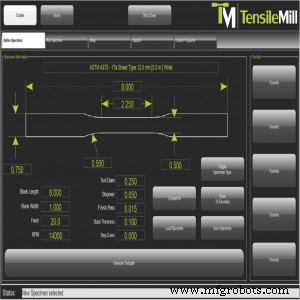
ASTM A370 Flat Specimens on TensileSoft™
The significance of tensile testing in commercial construction
During the design phase, engineers turn to tensile testing to ensure that the materials to be used will not reach stress levels higher than their capacity. Otherwise, these can result in complete breaking, which can be disastrous.
The use of tensile testing in commercial construction allows buildings to go higher than what used to be considered impossible. By using metals and other materials with the recommended tensile strength, buildings are guaranteed to last for a long time while keeping their occupants safe from any form of building hazard. This is especially useful in high-rise construction, wherein steel and/or iron frameworks are mainly used.
Outside commercial construction
Aside from the building industry, did you know that more industries benefit from tensile testing machines? Here are a few of these industries and how tensile testing machines help them:
Aerospace Industry
- Reduction of fuel consumption without compromising strength requirements
- Allows the combination of various materials that result in stronger outputs compared to a singular material
- Testing of tensile strength for miscellaneous materials such as adhesive bonds, cables, hoses, wiring looms, harnesses, carpets, gaskets, seat belts, and more
Automotive Industry
- Identification of the breaking strengths of seat belts, foam rubbers of car seats, and other high-strength and lightweight materials used
- Quality assessments for exterior and interior fittings

Construction Industry
- Secures the safety of metals and other building materials in terms of tensile strength, ductility, bond strength, compliance standards, and more

Electrical and Electronics Industry
- Assess the withdrawal force, electrical and mechanical behavior, and pull-off properties of various materials to meet certain requirements
Medical Device Industry
- Determine the elasticity of dressings, bandages, silicone rubbers, surgical gloves, and other soft, stretchable materials
- Quality assessment of the strength of injectors, needles, IV connector fittings, respiratory masks, lenses, surgical tubes, and more
- Identify the flexibility of catheters to guarantee their ability to change direction

Packaging Industry
- Identify the maximum load that packaging can carry before it breaks
- Assess the difficulty level of opening a packaging

Paper and Board Industry
- Measure the strength and elongation of paper and board
- Determine the capability of paper and board to be inserted in automated machines for printing
Pharmaceuticals Industry
- Identify the hardness and breaking force of tablets

Plastics, Rubber and Elastomers Industry
- Determine the capacity of materials to endure adhesion as well as external and physical stress
- Assessment of elongation, necking, and yield strength of various plastics and rubbers

Safety, Health, Fitness and Leisure Industry
- Quality assessment on the elongation, knot, and tensile strength of strings
- Secure the quality of badminton, squash, and tennis rackets
Textile Industry
- Identify whether a fabric is durable and can withstand regular use
- Determine the breakage strength, elongation, and tear resistance of synthetic textiles
- Assess the pull-off properties of zip fasteners, poppers, press studs, buttons, stitched decorations, hook-and-loop fasteners, and more
Who would’ve thought that a single machine could assist all of these amazing industries all at once?
Industrial Technology
- Prolong Your Equipment's Lifespan: Expert Maintenance Tips
- AI-Driven Roadmaps: A Strategic Guide for Supply Chain Companies
- Accelerate WMS Deployments with SAFe Agile Methodology
- Boost Your Supply Chain Resilience by Bundling 3PL Services
- Leveraging IoT to Empower Heavy Equipment Operators: Boost Efficiency & Safety
- Understanding Polyurethane Tensile Strength for Superior Material Design
- Boosting Sterilization Efficiency: The Role of Medical Vacuums in Equipment Hygiene
- Build Powerful Audience Personas for B2B Manufacturing Success
- Build Your Own Raspberry Pi Robot: A Beginner‑Friendly Guide
- Tensile vs. Yield Strength: How Metal Properties Shape Structural Performance