



Metal Cutting Chips Explained: Types, Formation, and Effects on Machining
In the process of cutting metals in different shapes and sizes, there is a loss of material in the form of chips. Different cutting processes result in the production of different types of chips. Therefore in this article, I will show you the various types of chips that can be found while machining different materials.
What is Chip in the Metal Cutting Process?
In order to give metal to a desired shape and size, extra metal is removed from the metal surface using various machine tools and techniques. This removed and deformed metal is called a Chip.
Before going in-depth into the chip, let’s have a look at basic terminologies used during metal cutting.
Rake face:
It is the face of the cutting tool used.
Rake angle:
- It is the angle between the rake face and the normal to the machining surface.
- A higher rake angle ensures better cutting and reduces cutting force as well.
- But, it can be increased within a limit because it reduces the metal backup available at the tool rake and thus reducing the strength of the tooltip as well as heat dissipation through the tool.
- It should be of the order 15 degrees and can be zero or negative when needed.
Clearance Angle:
- It is the angle between the underside of the tool (flank face) and machined surface.
- Clearance angle is given so that tool doesn't rub or spoil the metal surface.
- It increases the cutting forces and is thus used of the order 5-6 degrees.
- It is also called as relief angle.
Chips Formation:
- When the tool comes in contact with the metal surface, elastic compression and then plastic compression of the metal face in contact with the tool rake face takes place. This develops shear and ultimately yielding or fracture starts.
- Finally, the deformed metal or chip flows over the tool face and get removed.
- The chip will be removed and get further deformed due to friction, depending upon the cutting conditions.
Types of chips in Metal Cutting:
There are three basic types of chips in the metal cutting process:
- Continuous Chips
- Discontinuous Chips
- Continuous Chips with Built-up Edges (BUE).
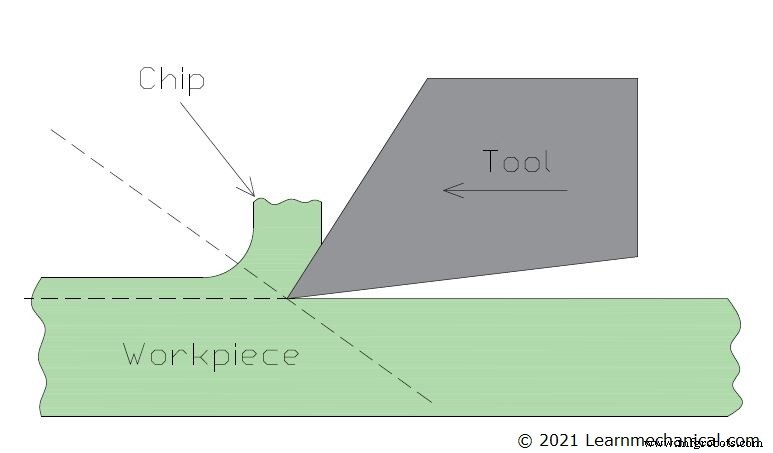
#1 Continuous chips:
When the chips formed during cutting operation is without any intervals such type of chips are called continuous chips. These chips are formed when a ductile material is cut, for example, steel.
Reasons for formation of Continuous chips:
- The velocity of cutting should be high: For the formation of continuous metal chips, it is required that the velocity of cutting or cutting velocity must be high. If the velocity is high enough the new material will get cut off before the breakage of the chip.
- Rake angle must be large: A greater rake angle will help in the smooth flow of metal chips thus creating continuous metal chips.
- The material must be ductile: The ductility of a material is one of the most important factors in the production of continuous chips. The greater the ductility, the more continuous chips will be produced.
- The coefficient of friction must be low as possible: If the coefficient of friction is high there will be a high amount of heat produced which will make the material brittle and not suitable for continuous chips to be produced.
- Depth of cut: The depth of cut for producing continuous chips must be low. If the depth of cut is more it will tend towards breaking of the chips. Effects of continuous chips and better surface finish. Due to the small depth of cut and high cutting velocity the surface finish obtained is excellent in the case of continuous chips.
- Low power consumption: Low coefficient of friction and use of lubricant causes less power to be consumed during the process of metal cutting in case of continuous chips.
- Better tool life: The life of the cutting tool increases as the material is ductile, friction is less, and lubricants are used.
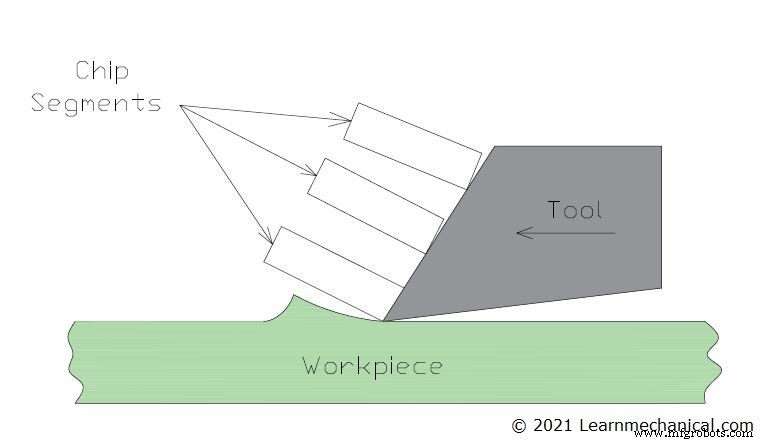
#2 Discontinuous chips:
When there is a breakage or fracture of chips in the process of metal cutting then such types of chips are called discontinuous chips. These chips are formed when brittle materials like cast iron, are cut.
Reasons for the Formation of Discontinuous Chips:
- Low cutting speed: A low cutting speed causes the chip to fracture before the cutting tool advances. This causes the production of discontinuous chips.
- low rake angle: A low rake angle pushes the chip out instead of curving it thereby producing discontinuous chips.
- Brittle materials are used: Unlike ductile materials, brittle materials have the tendency to break because of which there is a formation of discontinuous chips.
- High frictional forces: As discussed earlier high frictional forces causes heat generation which causes the material to become brittle, as a result of which there is a formation of discontinuous chips.
- Greater depth of cut: As the depth of cut increases the thickness of the material removed also increases. Increased thickness of material causes it to break which results in the formation of discontinuous chips.
Effects of Discontinuous Chips:
- Greater material removal: A greater amount of material is removed in the formation of discontinuous chips, this is of help when there is a huge difference of size between the workpiece and required dimension.
- Increased tool life at low speed: low rake angle helps in increasing tool life at low speeds.
- Chips are convenient to dispose of: Discontinuous chips are easy to handle and dispose off, because of small size and can be filled easily in some container to dispose or recycle.
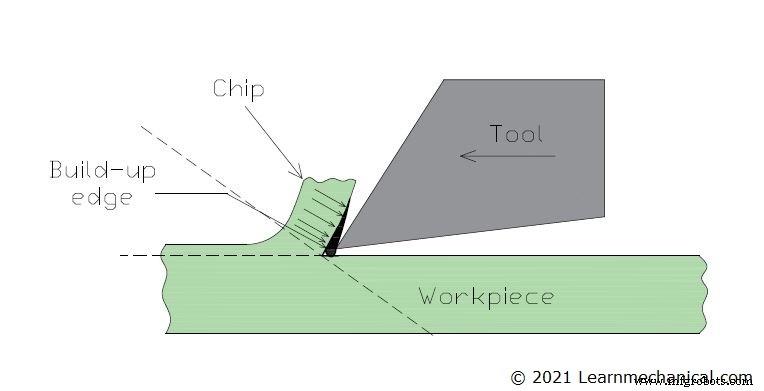
#3 Continuous Chip with Built-up Edge (BUE):
This is the type of continuous chip formed when the friction between the tool and the workpiece is very high. Due to high friction and temperature, a very little amount of material gets welded on the chip.
Reasons for Formation of BUE:
- High temperature: The main reason for the formation of a built-up edge is due to excess temperature. Because of very high temperature (more than the melting point of metal) some amount of metal gets welded up causing built up on the chip. The rest of the reasons are responsible for high temperature.
- Very high friction: The main reason for an increase in the temperature relative to tool and workpiece is due to high friction, which in turn becomes the prime reason responsible for the formation of built-up edge.
- Insufficient coolant: Another factor that is responsible for the increase in temperature is insufficient to use of coolant. The coolant used is generally a mixture of oil and water.
- Type of material: For the formation of a continuous chip it is necessary that the material should be ductile. Hence in ductile material, there is a formation of a built-up edge.
- Small rake angle: Small rake angle is one of the factors due to which there is a formation of built-up edge. This is because it is required for the formation of continuous chips.
Effects of Continuous Chips with Built-up Edges:
- Increased tool life: The tool life is increased because the chip which is formed, protects the tool from high temperature thus increasing the tool life.
- Rough surface finish: There is a formation of the rough surface due to the presence of built-ups on the working surface.
- Increased power consumption: Due to the small rake angle and great depth of cut the power consumption is increased.
Summary:
In the process of metal cutting, three types of chips are formed. The formation of continuous chips gives an excellent surface finish which has a positive impact on the workpiece.
The formation of discontinuous chips has both positive and negative impacts on the workpiece. The formation of the continuous chip with built-up edges has a mainly negative impact on the workpiece.
Industrial Technology
- Lapping Process Explained: Principles, Types, Materials, and Applications (PDF Guide)
- Rake Angle: Types, Importance, and Design Tips for Cutting Tools
- Quick Return Mechanism: Definition, Types, Working Principle & Applications – Advantages, Disadvantages (PDF Guide)
- Extrusion Process: Principles, Types, Applications, and Expert Insights
- Understanding Forming Processes: Types, Applications & Benefits
- Chip Formation Explained: Types of Metal Cutting Chips
- Understanding Chip Formation in Metal Cutting: Types and Significance
- The Essential Types of Welding for Modern Metalwork
- Understanding Chip Formation in Metal Cutting: Types, Processes, and Applications
- Understanding Chip Types in Metal Cutting: Classification, Causes, and Impact