



Rake Angle: Types, Importance, and Design Tips for Cutting Tools
In this article, you will get to know about Rake Angle, its importance and its types. So let's get started.
What is a Rake Angle?
The rake angle (γ) is the angle between the rake surface and the reference plane (πR) or perpendicular surface of the workpiece. Rake angle is the most important factor while designing a cutting tool. It is provided so that chips from the workpiece can flow easily and also it provides a smoother machining operation.
Importance of Rake Angle:
Rake Angle and Clearance Angle is the only two important parameters we need to keep in mind before designing a tool. Here are some of the important significance of Rake Angle:
- Rake Angle decided the cutting resistant between tool and workpiece.
- If we do not set the rack angle properly it can damage the tool as well as damage the workpiece surface.
- The flow of chips depends on the rake angle. If chips do not flow smoothly than a built-up edge may forms.
- Wrong Rake Angle can decrease the life of the cutting tool.
Types of Rake Angle:
For different machining operation, we need different types of rake angle, which is suitable for performing that specific operation. So depending upon those specific criteria (i.e. depth of cut, workpiece material, RPM of the machine, etc.) rake angle can be classified into three types:
- Positive Rake Angle
- Zero Rake Angle
- Negative Rake Angle
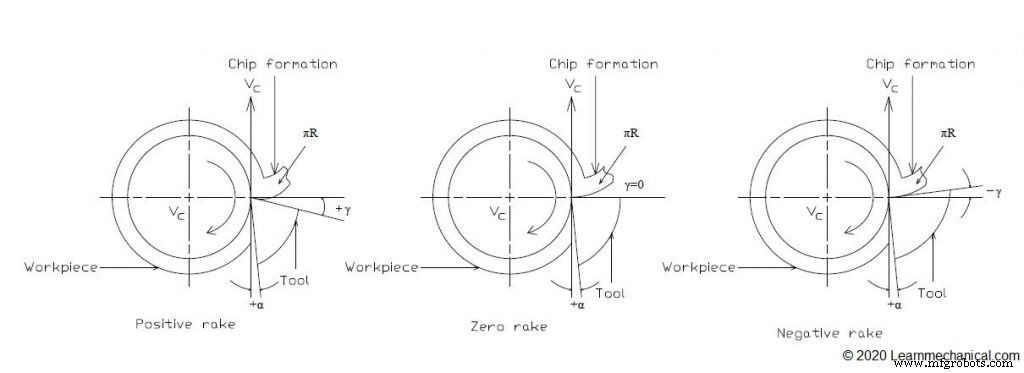
Each of these rake angles has its own advantages I'll discuss those below.
1. Positive Rake Angle:
If the slope of the cutting tool is away from the cutting edge in the opposite direction or at the inner side then this type of rake angle is called the Positive (+) rake angle. Positive Rake Angle tools are generally made up of HSS.
There are sevaral benefits of Positive Rake Angle, some of them are listed below:
- A positive rake angle reduces the cutting force.
- As it reduces the cutting force thus cutting power required for the operation is also less.
- If we use a positive rack angle then there are chances of continuous chips formation.
- It also reduces the chances of forming a built-up edge.
Disadvantages of Positive Rake Angle:
- Although it has sevaral advantages of using a positive rake angle but due to the positive rake angle the cutting tool becomes sharpen thus it reduces the strength of the cutting tool, as well as lower the tool life span.
2. Zero Rake Angle:
As the name denotes zero rake angle that means there will no angle between the rake surface and cutting plane. Here the face of the cutting tool makes a 90-degree angle about the cutting edge at the inner side.
Advantages of using Zero Rake Angle:
- Neutral cutting power consumption happens.
- Design is very simple so that it is easier to manufacture.
- The cost of this type of cutting tool is less.
Disadvantages of using Zero Rake Angle:
- In this type of tool, we can see that the built-up edge is formed.
- Cutting efficiency is low.
3. Negative Rake Angle:
If the slope of the cutting tool is away from the cutting edge in the same direction or on the outer side then this type of rake angle is called a Negative (-) rake angle. We generally provide a negative rack angle to the carbide tools so that it can resist the higher cutting force.
Advantages of using Negative Rake Angle tool:
- Due to the thicker cutting edge, the strength of this type of tool is more.
- Tool life is increased.
Disadvantages of using Negative Rake Angle tool:
- The power required for the cut is more as the negative rake angle makes the tool blunt.
- By using this type of tool the working surface temperature is increased due to friction, so cooling water is must be needed for the operation.
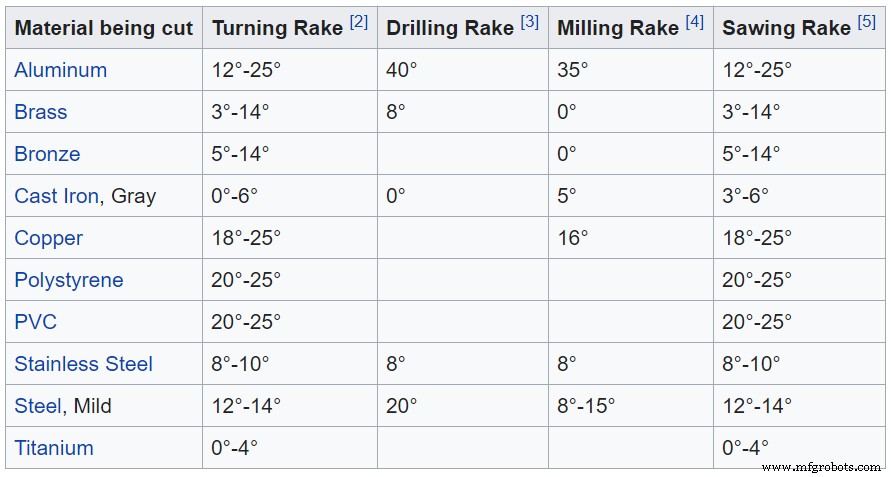
Rake Angle Recommendation:
Conclusion:
I hope this article on Rake Angle helps you to find your answers. If you found this article helpful or not helpful, please let me know by voting below. We also have articles on various other topics as well. Free free to check those out.
Industrial Technology
- Positive vs Negative Rake Angles: How Geometry Affects Cutting Efficiency
- Honing Process Demystified: Definition, Construction, Principles, Benefits, and Industrial Applications
- Lapping Process Explained: Principles, Types, Materials, and Applications (PDF Guide)
- Metal Cutting Chips Explained: Types, Formation, and Effects on Machining
- Quick Return Mechanism: Definition, Types, Working Principle & Applications – Advantages, Disadvantages (PDF Guide)
- Electron Beam Welding: Definition, Process, Applications, Pros & Cons (PDF Notes)
- Extrusion Process: Principles, Types, Applications, and Expert Insights
- Understanding Forming Processes: Types, Applications & Benefits
- Turning in Machining: Definition, Types, and Key Operations
- Comprehensive Guide to Metal Casting: Definitions, Types, and Processes