



Extrusion Process: Principles, Types, Applications, and Expert Insights
In the field of mechanical engineering, the Extrusion Process is widely used by the engineers to form an object which has a fixed cross-sectional area. For making the object, the raw material is pushed into a die to provide it with the desired shape.
The major function of this process is that the brittle materials can easily be turned into the desired product as in the case of extrusion only the shear stress and compressive stress are encountered in the process.
It can be argued that extrusion is a semi-continuous or even a continuous process that can be used to form hot or even cold material.
What is Extrusion?
Extrusion is one type of metal forming operation where dies are used to change the shape of the metal piece with the help of external force which is compressive in nature. By this process, we can make any type of complex shape quite easily.
Working Principle of Extrusion:
The required amount of force in the case of the extrusion process is given by a plunger or piston to produce the compressive force. The following is the working principle of the extrusion process:
- At first of the process ingot or billet of a standard size is developed by the manufacturer.
- Then the billet is heated at a higher amount of temperature in the case of the hot extrusion process and it stored for a long time at room temperature to push it in the press.
- The billet is pushed by the plunger mounted in the press towards the die to provide the compressive force.
- The die is previously manufactured at a required shape for developing the material at the desired shape. High compressive force helps the material to achieve the desired form.
- Lastly, the material is taken out from the press and after that, it needs to pass through the finishing process in order to enhance its mechanical properties.
Types of Extrusion:
Extrusion can be broadly classified into two types, one is Hot Extrusion another one is Cold Extrusion. These aforementioned categories are also subdivided into categories, they are as follows:
Hot Extrusion
- Forward Extrusion
- Backward Extrusion
Cold Extrusion
- Forward Extrusion
- Hydrostatic Extrusion
- Hooker Extrusion
- Backward Extrusion
- Impact Extrusion
- Cold Extrusion Forging
So let's dive into these categories in details.
Hot Extrusion:
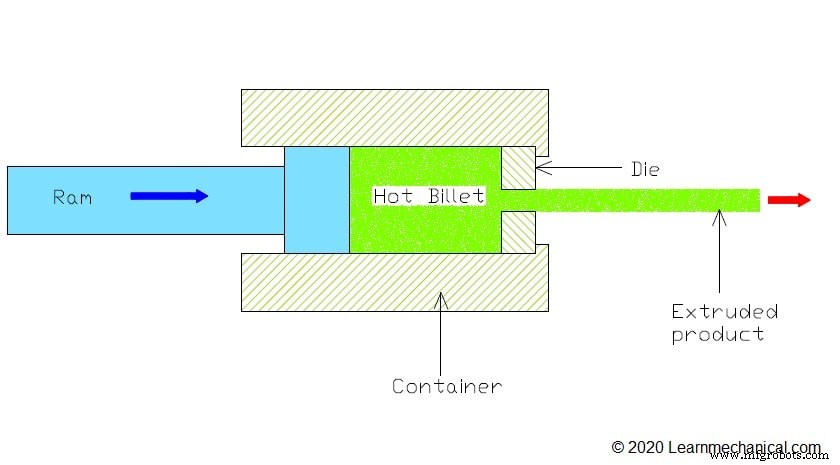
I hope you are already assumed by the name of this type "Hot extrusion". Here in this process workpiece or billet is heated above the recrystallization temperature, then it's loaded to the container and then ram exert force on it.
As the workpiece is already heated above the recrystallization temperature, it quite easily flows through the die, and also very accurately and effectively reshaped.
The common materials used in this type of extrusion are Magnesium, Copper, Steel, Aluminium, Nickel, etc.
Cold Extrusion:
In this process, the workpiece is kept into the normal room temperature, or you can say below the recrystallization temperature. To extrude any product by this process need a huge amount of force.
Indirect Extrusion:
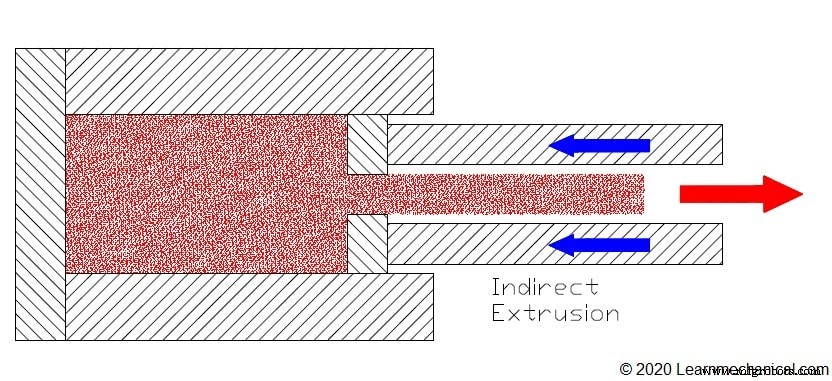
In this process, the direction of the force applied by the ram and the direction of extruded metal is on the opposite side. This type of extrusion is also called backward extrusion.
The main advanatages of this mode of extrusion is, it reduces the friction comparatively. Also by this process, we can extrude metal of relatively less diameter.
Direct extrusion:
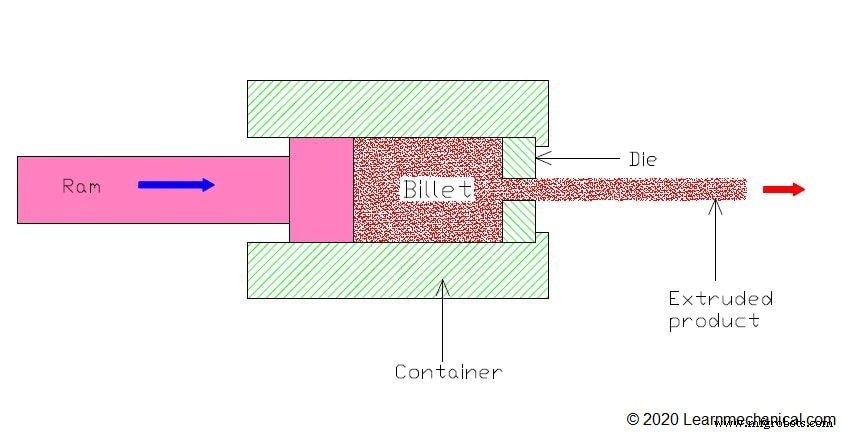
In this extrusion process, the direction of ram and the direction of extruded metal is in the same direction. This mode of extrusion is also called forward extrusion.
The main advantage of this process is, by this type we can extrude longer workpieces.
Hydrostatic extrusion:
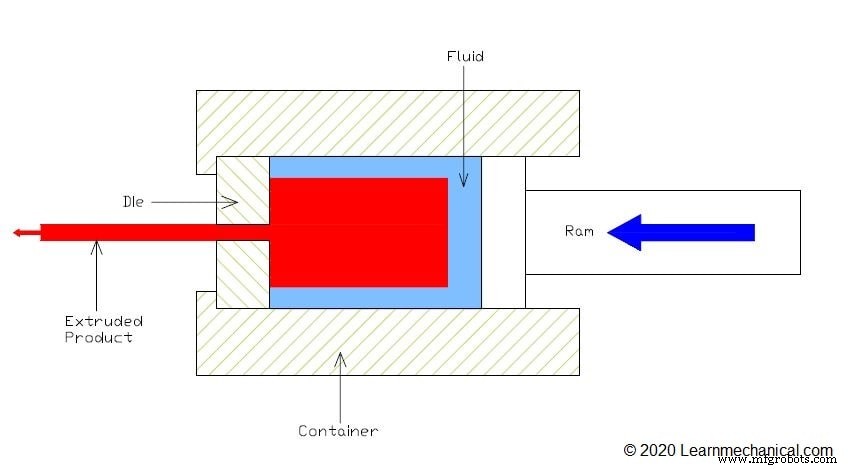
In this type of extrusion, we use fluid to pressurize the billet. At 1st a billet is loaded to the container then we fill the container with fluid generally castor oil, then the container is closed except one side of the container, which contains a ram and piston.
To keep the operation smooth the shape the billet is maintained conical so that it can easily pass through the die.
So when we start the machine, ram exerts a high amount of pressure to the fluid and then it's transferred to the billet. Due to the high pressurize fluid a plastic deformation happens into the billet and it comes out to the other side of the die and gets the shape of the die.
The main advantage of this process is here, very less amount of friction force comes into action as there is no contact between the container wall and the billet.
Hydrostatic extrusion usually conducts in the room temperature.
Hooker Extrusion:
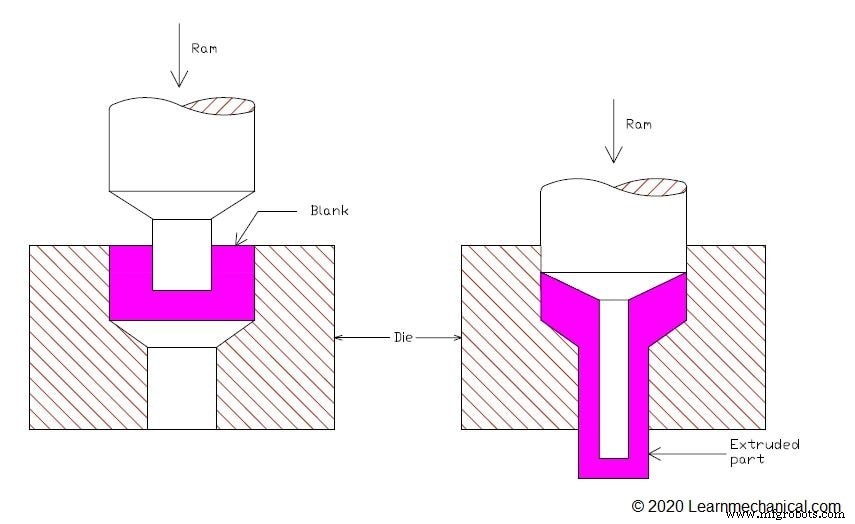
This is quite popular extrusion process, by which thin walled seamless copper or aluminum tubes are produced.
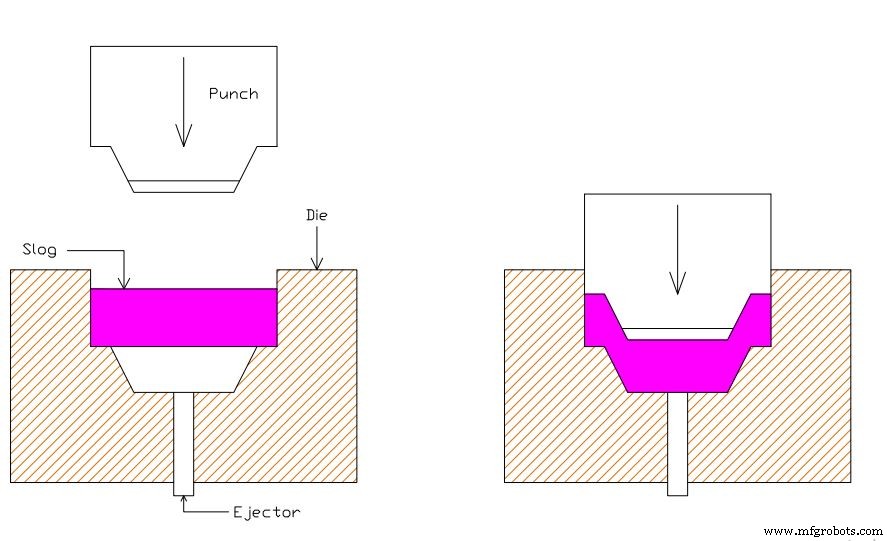
At first, the billet or the blank is placed in the container, a punch is exerted the force on the workpiece and make the workpiece into a cup shape.
In the next step, longer length punch again exerted the force into the cup and make it a long cylinder-shaped product and the thickness, as usual, reduce as well.
Impact Extrusion:
Here in this process, a punch is strike to the workpiece at very high speed to produce impact load. It can be any type like forward, backward, and even both.
It is generally done at room temperature i.e. Cold Extrusion.
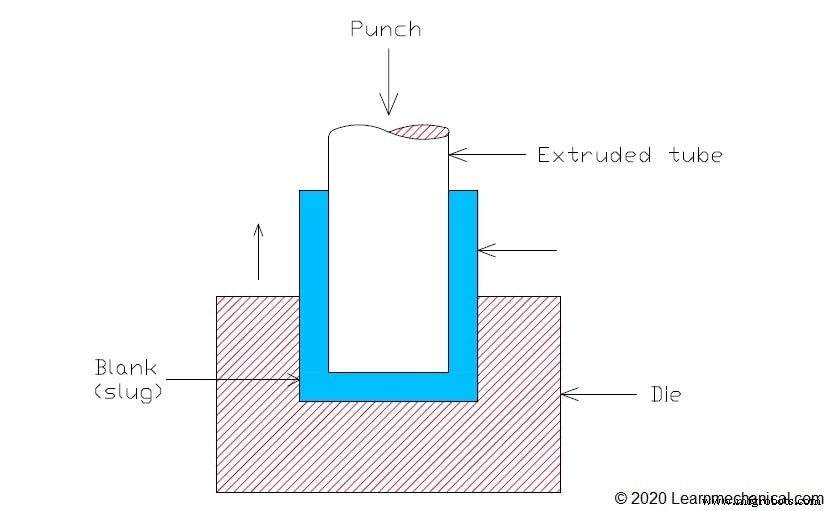
If we need products like a cup, toothpaste cover, or any hollow section we generally do Backward impact extrusion which is quite a popular impact extrusion process.
Cold Extrusion Forging:
Cold Extrusion Forging is a backward extrusion process. The process of Cold Extrusion forging is same as of Impact Extrusion. In this process, the movement of the punch or ram is a little bit slower than Impact Extrusion. As the force applied to the blank is gradually increased, so the length of the extruded product is quite short but the thickness is more.
Applications of Extrusion Process:
- The extrusion process is mainly used in the formation of hollow pipes and it can be used in the production industry. Apart from that, for making instant foods and snacks type products extrusion process is considered by manufacturers. In the case of food processing extrusion process is used to heat the product and develop a liquid stage of the product. Also, in cooking, the extrusion process is used nowadays that includes mixing, shearing, separation, cooling, heating and so on. For removing the moisture from the products and also for encapsulating material, the extrusion process is also taken into account by producers.
- However, to develop ready to eat material cold extrusion process is used. As an example, pasta types of products are manufactured by the help of cold extrusion process. These types of products incorporated with low moisture due to which the life cycle of products is increased and also it is more convenient to serve customers.
- Moreover, pharmaceutical products are also developed through the help of the extrusion process. Polymeric filters, nanoporous goods are formed through the extrusion process. The making process of drugs carries hot as well as cold extrusion process. To increase the solubility of products and bioavailability, the hot extrusion process is used. In this process, a high amount of pressure, heat and agitation is taken into account by manufacturers.
- Apart from that, in structural work, the aluminium extrusion process is used. This process includes doors, windows etc. In the automotive industry, the extrusion process is also used to form the desired type of material by using brittle materials.
- Lastly, it can be said that the extrusion process is widely used to make plastic materials.
Advantages of Extrusion Process:
Extrusion includes several advantages which are as follows;
- The extrusion process is widely used to create a complex profile of materials within the least time as compared to other metal forming process.
- The extrusion process is very useful to work with brittle and ductile materials.
- Mechanical properties which can be developed by the extrusion process is very precise that enhance the life cycle of products.
Disadvantages of Extrusion Process:
Some disadvantages of extrusion is listed below:
- The time consumption of this process is very high.
- Set-up cost at the initial stage is also very high.
- The amount of compressive force that required for the extrusion process is also very high, and due to which the operator needs to ensure that the plunger is fixed in the press appropriately.
Conclusion:
So this is all about Extrusion Process in details.
I hope you find this article interesting.
If so then feel free to share this resource among your friends or your favorite social media groups. Your one share is really appreciable.
Industrial Technology
- Honing Process Demystified: Definition, Construction, Principles, Benefits, and Industrial Applications
- Lapping Process Explained: Principles, Types, Materials, and Applications (PDF Guide)
- Quick Return Mechanism: Definition, Types, Working Principle & Applications – Advantages, Disadvantages (PDF Guide)
- Electron Beam Welding: Definition, Process, Applications, Pros & Cons (PDF Notes)
- Extrusion Process Explained: How It Works, Types, Applications, Pros & Cons
- Hot Extrusion Process Explained: Types, Benefits, and Applications
- Water Jet Machining: Principles, Benefits, Drawbacks, and Applications
- Ultrasonic Machining Explained: Process, Components, Benefits, Drawbacks & Applications
- Chemical Machining Explained: Principles, Types, Applications, and Advantages
- Understanding the Rolling Process: Definition, Mechanics, Types, Benefits, and Applications