



Understanding the Rolling Process: Definition, Mechanics, Types, Benefits, and Applications
Welcome back to The Mechanical post ! Today in this article we will see:
What is Rolling process ? its working, advantages, disadvantages and applications.

What is Rolling process ?
Rolling is a type of manufacturing process in which the metal is passed through pairs of rollers, this results in reduction and uniformity of the cross section of the metal workpiece.
This process mainly deals with the cross-section of the metal which is to be rolled. The main aim of using this process, is to reduce the thickness of the workpiece by increasing its length. However, in this process the breadth or width of the strip/sheet remains the same.
The rolling process makes use of one of the mechanical property of metals which is “plasticity”.
When the metal is passed through the rollers it undergoes compression. This load applied is such that it exceeds the proportionality limit of the metal being compressed. Thus, causing plastic deformation. And hence the workpiece can be given desired shape.
Rolling process is mainly classified into 2 categories on basis of workpiece temperature.
- Hot rolled process
- Cold rolled process
Hot rolling process
The rolling process in which the metal strip/sheet is heated above its re-crystallization temperature before being passed through the rollers is called as hot rolling process.Advantages of hot rolling process
- Due to heating of metal, it becomes soft and thus easier to be rolled.
- Less effort is required to give the metal workpiece the desired form.
- Application of heat reduces the strain in the material.
limitations of hot rolling process
- Due to less force applied the surface finish of the workpiece suffers.
- Heating element is required for heating of metals.
- Cost of operation is high as compared to cold rolling process.
Cold rolling process
The rolling process in which the metal strip/sheet is passed through the rollers at room temperature is called as cold rolling process.Advantages of Cold rolling process
- Superior surface finish.
- Inexpensive as compared to hot rolling process.
limitations of Cold rolling process
- High amount of force is required to push the metal strip through the rollers.
- Cold rolling process can induce internal stresses in the material.
You might also like to read
- What is extrusion process ?
- What is GMAW or Mig welding ?
- Casting process – detailed explanation
Types of Rolling process
Rollers come in various shapes and arrangements depending upon the workpiece and desired output. The types of rollers are:- Transverse rolling
- Continuous rolling
- Section or shape rolling
- Ring rolling
- Thread rolling
Transverse rolling
Transverse rolling is a type of rolling process which is used to make tapered shafts, leaf spring etc.
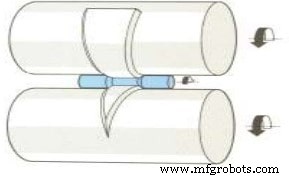
This process consists of rollers which rotate in the same direction while the metal bar is fed in transverse direction, thus the name “Transverse rolling”.
Continuous rolling
Its the simplest form of rolling in which cylindrical rollers are placed at appropriate positions. As the workpiece advances its thickness reduces while the length increase. The width remains almost the same with little changes.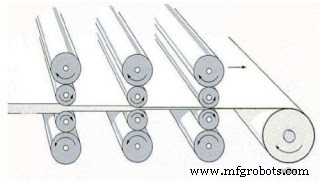
Section or shape
Flat slab is progressively bent into complex shape. Suitable for moulded sections such as irregular shaped channels and trim.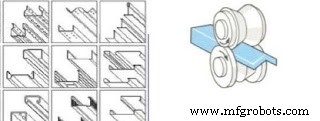
Ring rolling
As the name suggests this rolling process helps turn the metal strips into circular rings by using a special type of rolling arrangement as shown in the figure.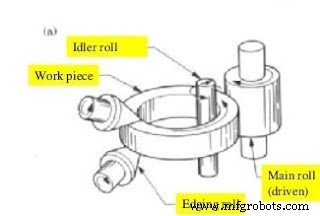
A specialised type of hot rolling that increases the diameter of the ring. The resulting grain structure is circumferential, which gives better mechanical properties.
Thread rolling.
In this process threads are formed over the circumference of a cylindrical workpiece. Rolled threads are produced in a single pass when dies are pressed against the surface of the cylindrical bank as shown in figure.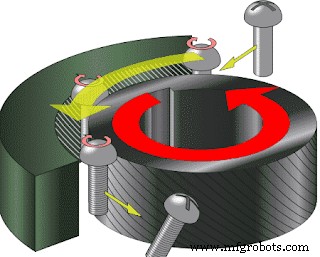 |
| Tosaka / CC BY |
As workpiece rolls against the in the feeding die faces, the material is displaced to form the roots of the thread, and the displaced material flows radially outward to form the thread crest.
Types of defects in rolling
During the rolling process, defects are introduced in the workpiece. Let’s discuss some of them. Types of defects are:- Wavy structure
- Edge cracks
- Alligatoring
Wavy structure
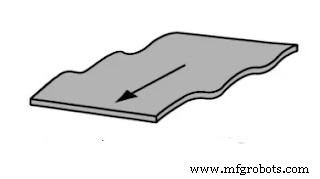
Due to improper force applied or due to improper arrangement of the rollers, the metal sheet or strip isn’t compressed successfully resulting in wavy shaped workpiece instead of a smooth one.
Edge cracks
Edge cracks are formed due to suddenly and excessively quenching the metal during the hot rolling process which results in increased internal stresses.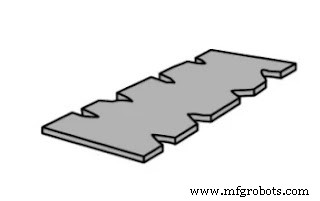
Alligatoring
It is the defect in which a crack causes separation between the layers of the metal which looks like the mouth of the alligator, hence the name alligatoring.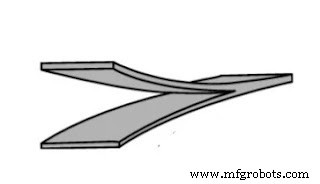
Advantages of rolling process
The advantages of the rolling process is given as follows :- It is a fast and less time consuming manufacturing process.
- Suitable for mass production.
- Has high efficiency.
- Complex cross-section profiles can be produced easily.
- Rolling processes can be designed to produce workpieces with very close tolerances.
Limitations of rolling process
- The initial cost / investment is high.
- The rolled workpiece’s surface finish is not very good, thus it is needed to be subjected to further finishing processes.
- It is ideal for mass production only.
Applications of Rolling process
The rolling process finds many industrial applications like:
- By using rolling process, shafts, rods, tubes, axles, spindle etc can be manufactured.
- Rolling is used to manufacture workpiece with desired cross-section.
- Rolling is used to produce gears on the gear blank.
- By making use of Thread rolling threaded parts, bolts, screws, etc. are manufactured.
- Bearings, Turbines rings are manufactured by ring rolling process.
- The rolling process of manufacturing finds many applications in the automotive industry.
- Metal sheets, plates, panels etc are manufactured by rolling process.
That’s an overview on the rolling process. If you like this post or have any suggestions do let us know in the comments we would love to hear it from you.
Also do consider subscribing by clicking the subscribe button and never miss a post by us!
We’ll be back soon with another interesting article till then Keep learning and read The Mechanical post!
Industrial Technology
- Lapping Process Explained: Principles, Types, Materials, and Applications (PDF Guide)
- Extrusion Process: Principles, Types, Applications, and Expert Insights
- Understanding Rolling: Types, Mechanics, Terminology, and Industrial Applications
- Extrusion Process Explained: How It Works, Types, Applications, Pros & Cons
- Process Planning Explained: Steps, Types & Key Benefits
- Metal Casting Explained: Types, Benefits, Stages & Applications
- Woodruff Keys Explained: Types, Functions, Benefits & Applications
- Chemical Machining Explained: Principles, Types, Applications, and Advantages
- Understanding Milling Machines: Definition, Process & Types
- CNC Machines Explained: How They Work, Types, Benefits & Applications – PDF Guide