



Metal Casting Explained: Types, Benefits, Stages & Applications
In this article, you’ll learn what is metal casting? and how it is done its processes, stages of metal casting, and types of the metal casting process.
Metal Casting Process
The metal casting process is the oldest and popular method of manufacturing means of designing the desired shapes. It is the first step in manufacturing most products.
Casting is made from any metal that can be melted and can have any shape the designer desires. The castings can produce in sizes ranging from a few mm to several meters. Casting can weigh from a few grams to tons.
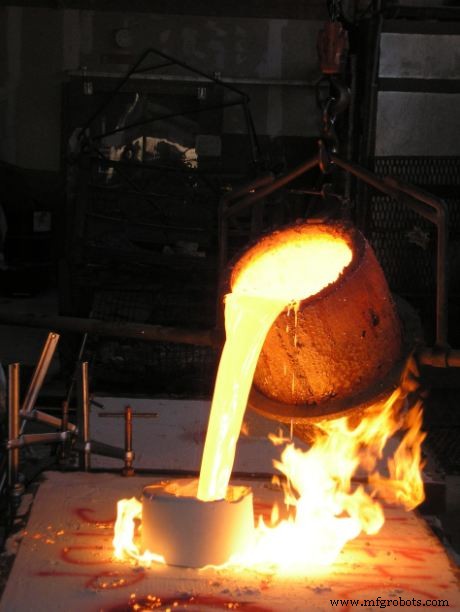
Products with very complex shapes, hollow sections, complex internal cavities, and irregularly curved surfaces made of metals that are difficult to machine can be easily produced by the casting process.
Read also: Heat treatment of steel Why It Is Important Factor In Manufacturing
Many casting processes are available and the choice of a process for producing particular parts depends on such factors as production cost, production rate, size, shape, and surface finish. The casting processes differ from each other basically in the type of material used for the preparation of the mould and the method of pouring the molten material.
The mould material is generally sand or metal and the pouring method may use gravity, vacuum, low or high pressure. Casting is most often used for making complex shapes that would be difficult or uneconomical to make by other methods.
The modern casting process is divided into two main categories:
- Expendable
- Non-expendable casting.
In expendable casting, it includes sand casting, shell casting, plaster mould casting, investment casting, and evaporative-pattern casting.
In non-expendable casting, it includes permanent mould casting, dies casting, semi-solid metal casting, centrifugal casting, continuous casting.
Advantages of Metal Casting Process
- The cost involved in the casting process is very low as compared to the other manufacturing processes.
- Very heavy and bulky parts which are difficult to fabricate from other manufacturing methods can be manufactured by this process.
- Casting can be employed for mass production as well as for batch production.
- A product can be cast as a single piece and hence the metal joining process is eliminated.
Classification of Metal Casting Process
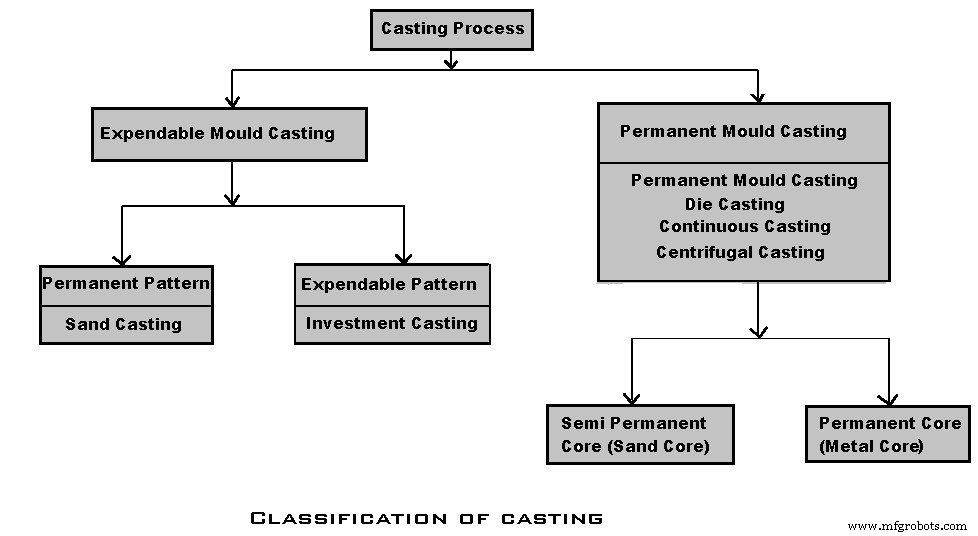
- The modern casting process is subdivided into two main categories: expendable and non-expendable (Permanent) casting.
- When the mould is used for single casting, it is made of sand. Such moulds are called expandable moulds since they are destroyed while making out of casting.
- These are used for the production of smaller quantities.
- When the mould is used repeatedly, it is made of metal or graphite and is called a permanent mould.
Don’t Miss: What are the types of Unconventional Machining Process? [PDF]
Types of Metal Casting Process
Following are the four different types of metal casting processes used for large-scale production:
- Sand casting
- Investment casting
- Permanent mould casting
- Pressure die casting
1. Sand Casting
It is the most extensively and widely used types of metal casting process. This is an expendable mould-permanent pattern casting process. The sand casting process involves the use of a furnace, metal, pattern, and sand mould.
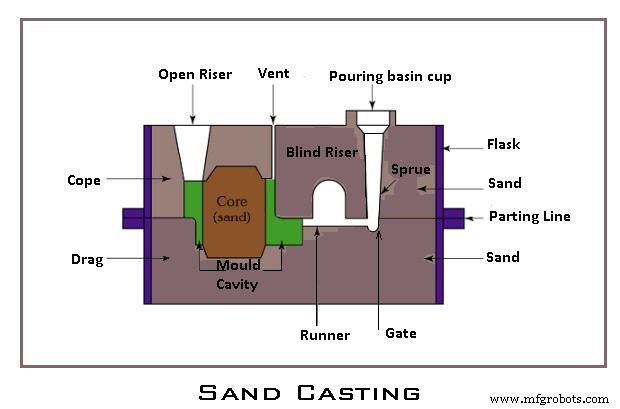
Hand ramming of sand around the pattern is used for simple casting. For complicated castings, the sand mixture is compacted by moulding machines. Moulding machines not only increase the production cost but also improve the quality of casting by improving the application and distribution of forces for ramming.
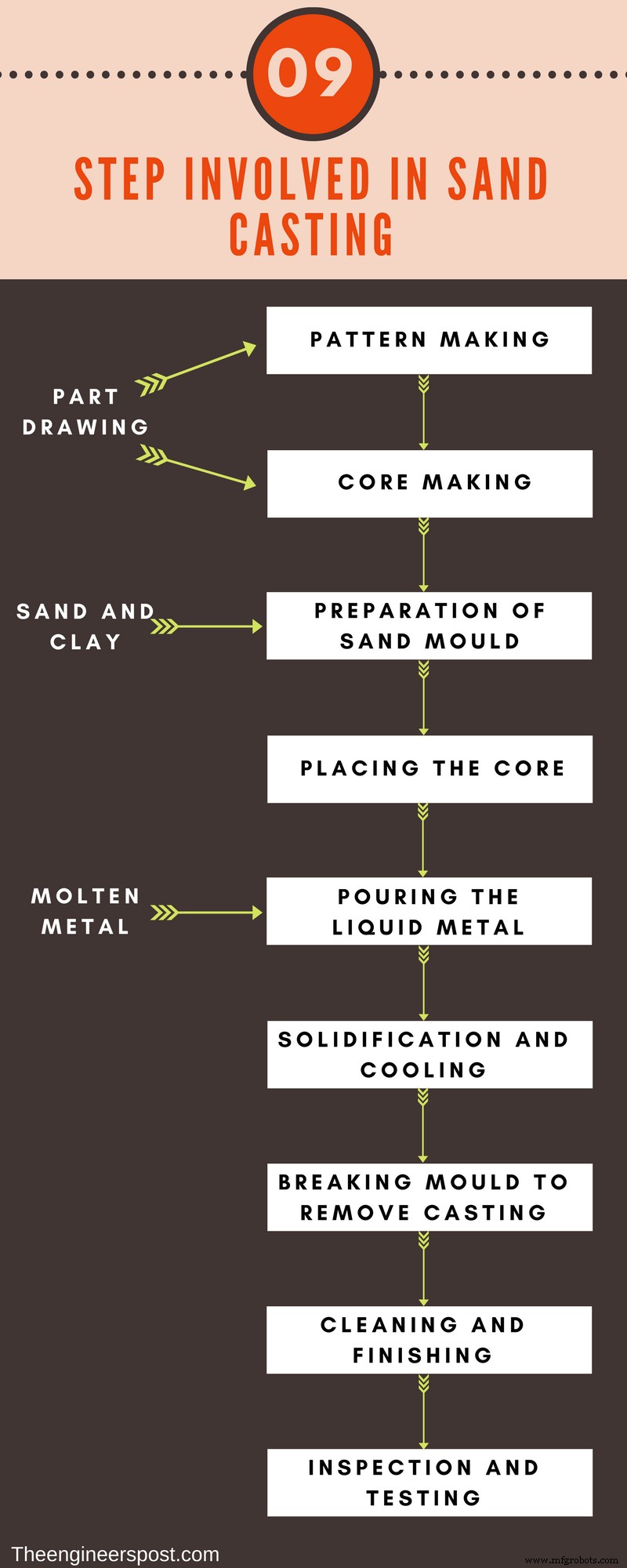
It can be used for all types of metals but the surface finish and dimensional accuracy are not good compared with other casting processes. It is the most economical production process.
Advantages of Sand Casting
- Almost any metal can cast.
- It has no limit on size and shape.
- Low equipment cost.
- Less expensive for low volume production.
Disadvantages or Limitations of Sand Casting
- Coarse finish.
- Dimensional accuracy is not good.
- Still finishing is required for casting.
- It has a low production rate.
2. Investment Casting
The sequence of operations in a shell investment casting is given below:
- Fabrication of a master pattern: The master pattern is made using a material like wood or plastic.
- Fabrication of master dies: A die can be cast out of low melting point metal using the master pattern. steel or wooden dies are used.
- Preparation of wax patterns: Wax patterns are made by pouring molten wax into die. After the wax has solidified, it is taken out of the die.
- Assembly of wax patterns: Depending upon the size of casting several wax patterns are assembled together in the form of a tree or a cluster with central spruce and runners.
- Coating of a cluster: The cluster is now coated with a thin layer of refractory material. This step is performed by dipping the whole cluster into a thin slurry of very fine refractory material mixed with hydrolyzed ethyl silicate, alcohol and a gelling agent.
- Producing a final layer of refractory material: Here the coated cluster is dipped repeatedly in the relatively coarsely ground refractory material to achieve the desired thickness of the coating.
- Hardening of coating: The coated cluster is left out for drying up and hardening for some time (few hours).
- Melting of wax patterns: The mould is placed in the oven upside down and the wax is allowed to flow out of the mould which is collected for reuse.
- Preheating the mould: The is fired at 700-1000°c to impart strength to the mould and ensure the flow of molten metal to all the intricate and thin sections.
- Filling the hot mould: Molten metal is filled in the mould by gravity, vacuum pressure or force.
- Cleaning of casting: spruce and runners are now removed and the casting is cleaned and finished.
Advantages of investment casting
- Almost any metal can be cast,
- Good surface finish.
- Good dimensional accuracy.
- Fairly high production rate.
- Complex shapes can be cast.
- Low finishing cost.
Disadvantages or limitations of investment casting
- High labour cost.
- Expensive mould and pattern.
- Limitation on part size.
3. Permanent Mould Casting
There are so many permanent mould casting processes, a few of them are listed below:
- Gravity-feed permanent mould casting
- Low-pressure permanent mould casting
- Die casting
- Centrifugal casting
- Continuous casting
In these processes, a mould is used repeatedly. The mould is generally on two halves and is designed for easy opening and closing. Ejector pins are provided for the removal of the solidified casting. Metallic mould is not permeable’ therefore’ clearance along the parting planes and the ejector pine serve as vents for the escape of gases.
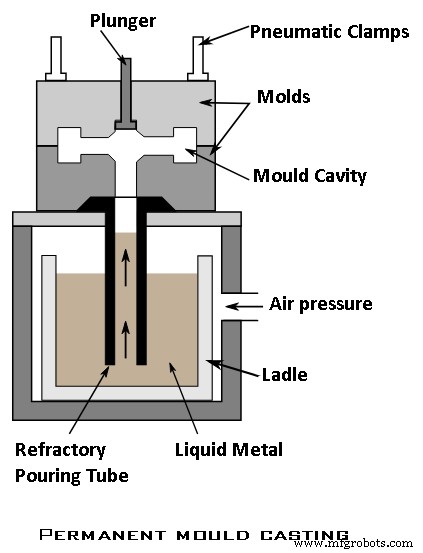
The refractory coating on the thinner walls of the mould not only increases the mould life but also prevents the sticking of casting on the mould walls.
Preheating of the mould and controlled cooling of the mould through water circulation maintain a uniform mould temperature. Permanent with other processes are used for casting low melting point, non-ferrous materials using alloy steel moulds.
In comparison with other processes’ better surface finish and dimensional accuracy are obtained in this process. The initial cost is high, so these processes are economical only when higher production volumes are required.
Advantages of permanent mould casting
- Good surface finish.
- Good dimensional accuracy.
- High production rate.
Disadvantages or limitations of permanent mould casting
- High mould cost.
- It is suitable for high volume production.
- Suitable for casting of simple shapes.
- Suitable for low-melting-point metals.
4. Die casting
Die casting is a very commonly used type of permanent mould casting process. It is used for the production of many components of home appliances like stoves, fans, motors, and toys, etc.
The surface finish and tolerance of die-cast parts are so good that there is almost no post-processing required. Die casting mould are expensive and require a significant lead time to fabricate; they are commonly called dies.
There are two common types of die casting:
- Hot chamber die-casting
- Cold-chamber die casting.
4.1 Hot Chamber Die Casting Process
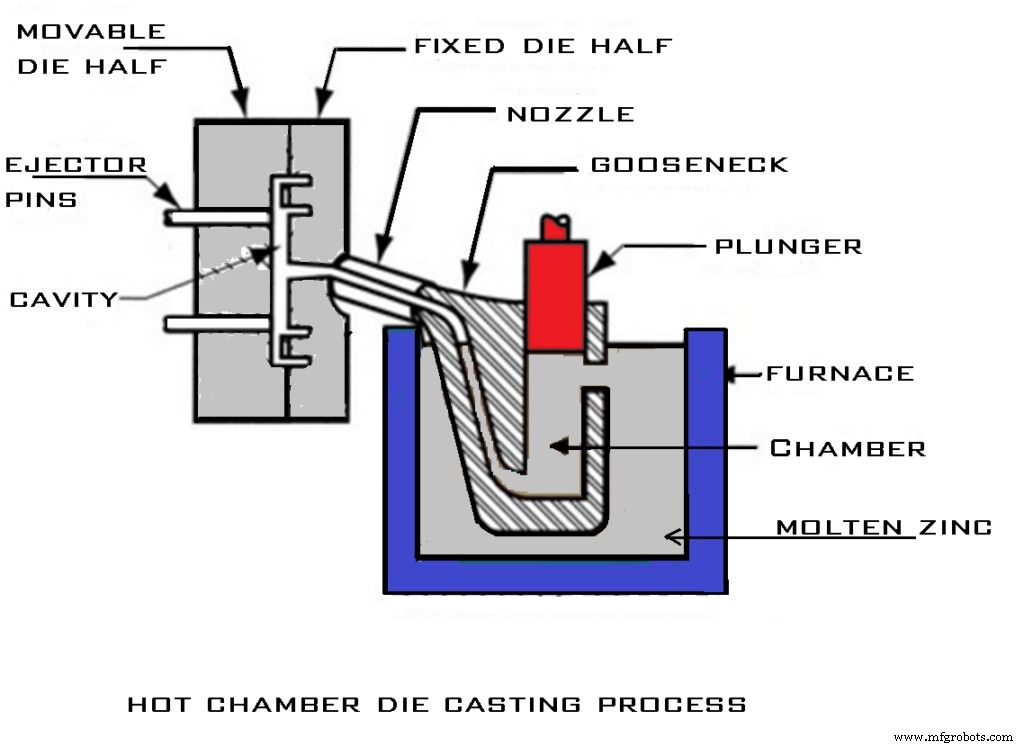
In a hot chamber process (used for zinc alloys magnesium) the pressure chamber connected to the die cavity is filled permanently with the molten metal.
The basic cycle of operation is as follows:
- Die is closed and gooseneck cylinder is filled with molten metal.
- The plunger pushes molten metal through gooseneck passage and nozzle and into the die cavity: metal is held under pressure until it solidifies.
- Die opens and cores, if any, are retracted; casting stays in ejector die; plunger returns, pulling molten metal back through nozzle and gooseneck.
- Ejector pins push casting out of ejector die. As plunger uncovers the inlet hole, molten metal refills gooseneck cylinder.
The hot chamber process is used for metal that (a) have low melting points and (b) do not alloy with die material, steel; common examples are tin, zinc, and lead.
4.2 Cold Chamber Die Casting Process
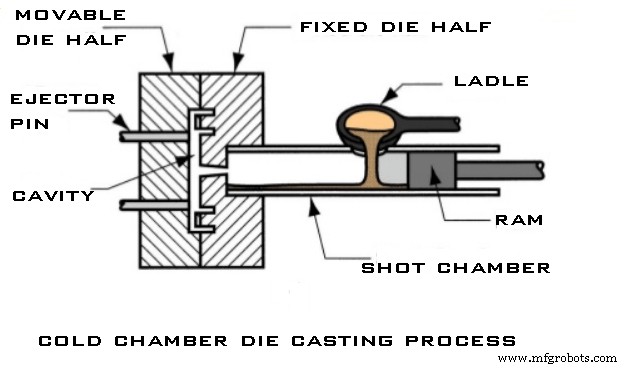
In a cold chamber process, the molten metal is poured into the cold chamber in each cycle. The operating cycle is
- Die is closed and molten metal is ladled into the cold chamber cylinder.
- The plunger pushes molten metal into die cavity; the metal is held under high pressure until it solidifies.
- Die opens and plunger follows to push the solidified slug from the cylinder if there are core, they are retracted away.
- Ejector pins push casting off ejector die and plunger returns to the original position.
This process is particularly useful for high melting point metals such as Aluminum, and Copper (and their alloys).
Advantages of die casting
- Excellent surface finish.
- Excellent dimensional accuracy.
- High production rate.
- Complex shapes can be cast.
- Little or no finishing cost.
Disadvantages or limitations of die casting
- The high cost of the die.
- Limited to the casting of non-ferrous metals.
- Limitation on part size.
You Might Like: What is the types of Welding Defects? Their Causes and Remedies [PDF]
Stages of Metal Casting Process
The following are the metal casting process of producing casting,
- Pattern making
- Moulding and Core making
- Melting and Casting
- Fettling
- Testing and inspection.
The first stage is done outside the foundry shop and the rest four stages are within the foundry shop.
1. Pattern Making
- In pattern making, patterns are designed and prepared as per the drawing of the casting received from the planning section and according to the moulding process.
- The materials of the pattern are selected based on the factors such as a number of castings requires and surface finish desired in casting.
- It is a skilled trade that is related to the trades of the tool and die making and mould making but also often incorporates elements of fine woodworking.
- The materials used for pattern making are wood, metal or plastics.
2. Moulding and core making
- The patterns are sent to the moulding stage, in which moulds are prepared either in sand or a material with the help of pattern so that a cavity of the desired shape is produced.
- To get a hollow portion, cores are prepared in core boxes. The moulds and cores are then baked to impart strength and finally assembled for pouring.
- The moulding can be done either by hand or with the help of machines.
- Proper mould design and arrangement for a flow of molten metal is very important for the production of sound castings.
3. Melting and casting
- The metal of correct composition is melted in a suitable furnace.
- Molten metal is now taken in ladles and poured into the moulds.
- The moulds are then allowed to cool so that the molten metal in the mould solidifies.
- Casting is then taken out by breaking the moulds and they are sent to the cleaning section.
4. Fettling
- The casting is sent to fettling section where the unnecessary projections, the adhering sand removed, and the entire surface made clean and uniform.
- Some castings required heat treatment also, which is done during this state only
5. Testing and Inspection
- The inspector test and inspect the casting before dispatching from the foundry to ensure that it is flawless and conforms to the desired specifications.
- If any defects are found in casting, then they have been completely rejected.
Read also: List of Mechanical Properties That Every Mechanical Engg Should Know
That’s it, Thanks for reading. If you like this article then please share it with your friends. If you have any questions about the “types of metal casting process” you can ask in the comments.
Subscribe to our newsletter to get notification of new articles:
Industrial Technology
- Casting Explained: Definition & Types of Manufacturing Processes
- Metal Casting Explained: Definition, Types & Process
- Process Planning Explained: Steps, Types & Key Benefits
- Heat Treatment Explained: Types, Methods & Benefits for Metals and Alloys
- Comprehensive Guide to Metal Casting: Definitions, Types, and Processes
- Understanding the Rolling Process: Definition, Mechanics, Types, Benefits, and Applications
- Explore 6 Key Casting Processes in Metal Foundries
- Understanding Sand Casting: The Step‑by‑Step Process Explained
- Choosing the Right Sand: Key Types for Superior Sand Casting
- Casting Explained: Definition, Types, and Applications