



Electron Beam Welding: Definition, Process, Applications, Pros & Cons (PDF Notes)
Today in this article I am going to give you an in-depth overview of Electron Beam Welding Machine.
This Welding Process was first developed in 1949 by Karl-Heinz Steigerwald who was a German physicist.
In this article first, we will see the Definition, How it's Work after that I'll also show you the Applications, Advantages, and Limitations of EBW Machine as well.
So without further delay let's jump into the article.
What is Electron Beam Welding?
Electron Beam Welding is a liquid state welding process in which two similar or dissimilar metals are joined by the use of heat and that heat is generated by high energy electrons. When an electron strikes with a high speed to the workpiece there are two forms of energy conversion that take place kinetics energy and thermal energy.
Construction of Electron Beam Welding Machine:
Electron Beam Welding Machine consists of following parts:
- High Voltage Power Supply
- Electron Gun
- Cathode Grid
- Anode
- Optical Viewing System
- Magnetic Lens
- Deflecting Coil
- Vacuum chamber
- Workpiece
- Workpiece Holding Device
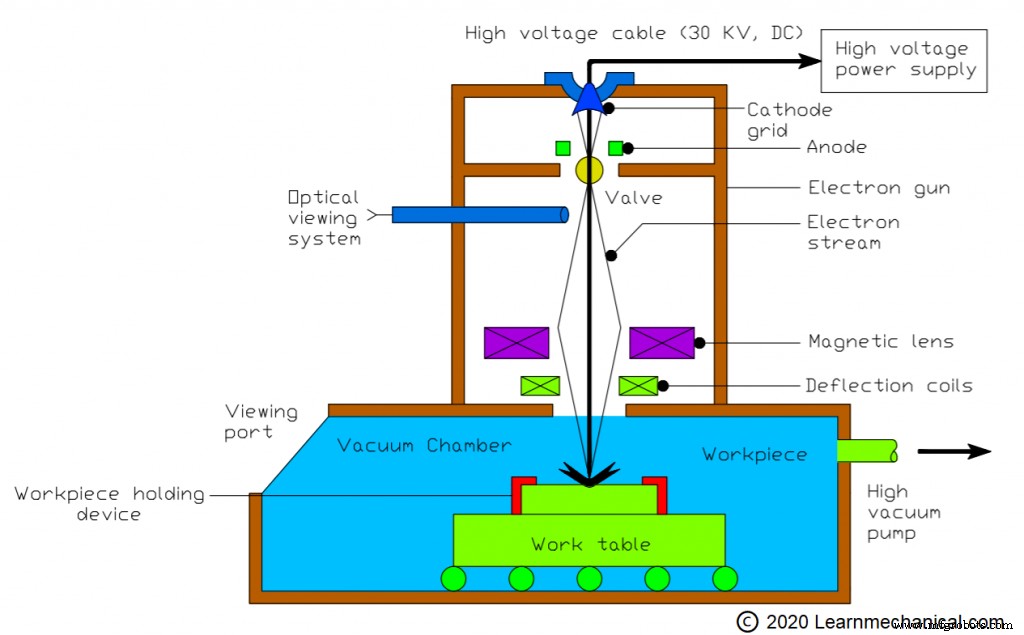
So now let me show you these parts in details.
High Voltage Power Supply:
The Power supply is categorised into two ways one as low, and the other is high voltage.
- Low voltage range of the thin welding is between 5 to 30 kV.
- High voltage range for thick welding is between 70 to 150 kV.
Electron Gun:
In electron gun, the free electrons are generated by means of thermo-emission from a hot metal strap or wire.
The main purpose of the electron gun is to convert free electrons into an electron beam by the help of cathode grid, anode, magnetic lens, and deflection coil.
Cathode Grid:
By this part, the free electrons are generated. However the voltage of generated free electrons is very much low eV. To accelerate this free electrons, they are passes through high electric field which is produced by Anode and emitter (Cathode).
Anode:
The anode is used to accelerate the electrons which are generated by the cathode grid.
Optical Viewing System:
Optical viewing system helps us to determine and set up the point of action where the electron beam is impacted on the workpiece.
Magnetic lenses:
Magnetic lenses allow only the converging electrons to pass. It absorbs the low energy of divergent electrons and It provides a high intense electron beam.
Deflecting Coil:
- The deflection coil is a type of magnetic lens and It is used in cathode ray tubes.
- It helps to scan the electron beam all over the screen.
Vacuum chamber:
- In the vacuum chamber, there is no presence of air. The welding in this machine takes place in a vacuum.
- The pressure presets here is below the atmospheric or at atmospheric pressure.
- It is also known as the Braun tube or chamber.
Workpiece:
- The workpiece is attached to the fixtures.
- The workpiece can be similar or dissimilar metals.
Workpiece Holding Device:
- The workpiece holding device is also called as Fixtures. It is used to hold the workpiece rigidly.
- The fixtures are made up of steel castings, stainless steel, cast iron, high tensile steel, and so on.
Working Principle Electron Beam Welding:
The working principle of electron welding is the same as electron beam machining. Here we use to join similar metals or dissimilar metals with the help of the beam of electrons.
First we supply the power to the system. There is one cathode [It has negative charge] attached as you can see in the diagram and that is made up of Tungsten. And just below the anode is connected.
Now we have to create a potential difference around 30 to 175 kV because when the coherent light produces from the cathodes which pass through the anodes and that anodes help to accelearte it as much as It can.
Now the coherent light appears directly to the workpiece, meanwhile focusing coil is attached which decrease the extra gap between the coherent light.
Now the light direct comes at the workpiece with the help of a deflection coil and here temperature is so high that it melts the workpiece. The kinetic energy is now converted into thermal energy.
The workpiece is attached to the fixtures here and the whole process is done in a vacuum that means there is no air. If air comes, the direction of coherent lights may get deflected and it may appear some other place which we do not want to weld.
Here is a Video of Modern Electron Beam Welding Machine:
Applications of Electron Beam Welding:
Electron Welding has wide range of use. here I have listed some of them and those are:
- It is used for welding and drilling the workpiece.
- Electron beam welding is used for various industries like Marine, Automobile, Aircraft, Manufacturing, and So on.
- It is also used in the defence sector for making various products.
- It is for joining two similar or dissimilar metals.
- For joining of refractory material and those are tungsten, ceramics, and so on.
- It also used in the medical industries.
- The electron welding cuts the narrow slots 25-micron meter.
Advantages of Electron Beam Welding:
So here are some advantages of Electron beam Welding:
- There is no requirement for filler material in electron welding.
- There is very little distortion.
- The welding defects appear also very less.
- Electron welding also welds the hard material.
- The surface finish obtained in this process is high.
- It also provides a high metal joining rate.
- The heat effective zone and welding are narrow.
- This process also helps to join uniform and diffusion metals.
- The welding process is continuous and tight.
- The workpiece has high strength properties and maintains up to 95% of the strength of the base materials.
- This beam welding process is very precise.
- The welding process is fully automated.
Disadvantages of Electron Beam Welding:
The disadvantages of Electron Beam Welding are following:
- The process can not be done by a semi-skilled worker so it requires a high skilled worker that means the person must have knowledge of the electron welding process.
- The workpiece size is not big, It is limited because of the vacuum chamber.
- High maintenance is required.
- The electron welding equipment is costly.
- The Installation and Capital cost is high.
- The electron welding has x-ray radiation and that is a major problem for human and
- The production expenses are also high.
Conclusion:
So there you have it: The In-depth overview of Electron Beam Welding.
I hope you find this article interesting. We have also covered lots of knowledge-based article around Mechanical Engineering subjects, feel free to check those too.
Industrial Technology
- Honing Process Demystified: Definition, Construction, Principles, Benefits, and Industrial Applications
- Lapping Process Explained: Principles, Types, Materials, and Applications (PDF Guide)
- Quick Return Mechanism: Definition, Types, Working Principle & Applications – Advantages, Disadvantages (PDF Guide)
- Extrusion Process: Principles, Types, Applications, and Expert Insights
- Electron Beam Machining: How It Works, Equipment, Applications, and Pros & Cons
- MIG Welding: How It Works, Equipment, Applications, and Pros & Cons
- Mastering Electron Beam Welding: Principles, Process, Equipment, Applications, and Pros & Cons
- Ultrasonic Machining Explained: Process, Components, Benefits, Drawbacks & Applications
- Electron Beam Welding Explained: Process, Benefits, and Applications
- Plasma Arc Welding Explained: Process, Tools, Uses & Benefits