



Ultrasonic Machining Explained: Process, Components, Benefits, Drawbacks & Applications
Ultrasonic Machining is a non-conventional subtractive machining process widely used in industries to machine brittle and harder materials. Due to its high degree of precision, it is a recommended method of machining for critical components. Let us learn more about the ultrasonic machining process, the working principle, key parts, advantages, and disadvantages in this article.
Definition Of Ultrasonic Machining
Ultrasonic Machining comes under a non-conventional machining process that is specifically used for machining hard and brittle materials. Ultrasonic machining is also widely used in the machining of ceramics.
Unlike other non-conventional machining processes like laser beam machining, electrical discharge machining, ultrasonic machining does not generate any heat or any residual stress on the part. This is the reason why ceramics and brittle parts can be easily machined using ultrasonic machining without fracture.
Ultrasonic machining is also called ultrasonic vibration machining as this method uses a tool that vibrates at high frequency and, when combined with abrasive particles, removes materials from the workpiece.
Key Parts Of Ultrasonic Machine
There are mainly five key parts in an ultrasonic machine
- Electromechanical Transducer
- Sonotrode
- Control Unit
- Abrasion Slurry
- Abrasion Gun
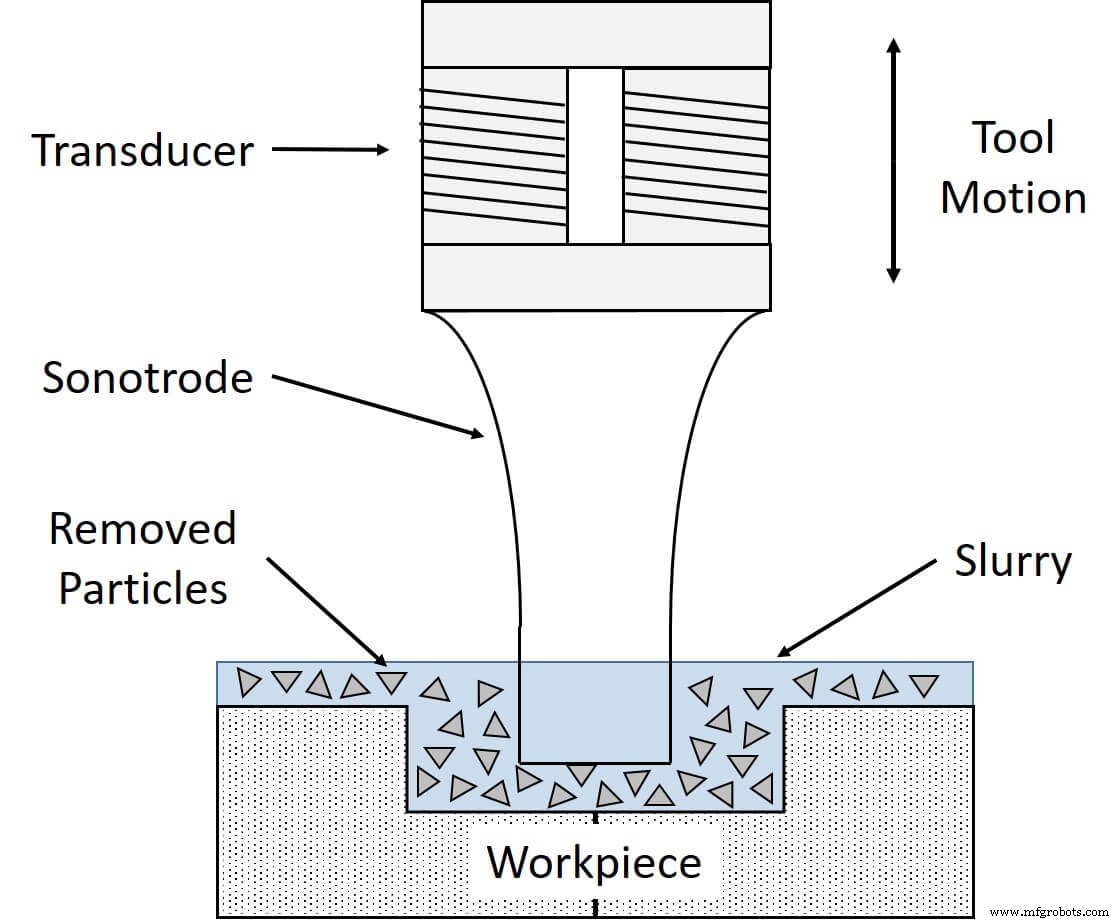
Electromechanical Transducer
The electromechanical Transducer is connected to the control unit. The control unit has an electronic oscillator that creates alternating current oscillating at a high frequency in the range of 28-40 kHz.
The electromechanical Transducer converts that oscillating current to mechanical vibration. There are mainly two types of transducer used in Ultrasonic machines.
- Piezoelectric transducer
- Magnetostrictive transducer
Sonotrode
The transducer drives the Sonotrode at high frequencies and low amplitudes. One end of the Sonotrode is connected to the transducer, and the other end contains the tool. Sonotrode is made of low carbon steel.
Control Unit
Control unit is what that transmits the power. It has electronic oscillator that produces alternating current at high frequencies.
Abrasion Slurry
Abrasion materials like Aluminum oxide, Silicon carbide, Boron carbide, when mixed with water, forms an abrasion Slurry. The water ratio is between 20-60%.
Abrasion Gun
Abrasion gun supplies the abrasion particle and water mixture between the Sonotrode and the workpiece at a controlled pressure.
Working Principle Of Ultrasonic Machining Process
Ultrasonic machining removes material from the workpiece due to Magnetostriction. What does that mean is that any magnetic material changes its size and shape when it under magnetization.
The control unit/power unit provides alternating current to the transducer at high frequency. The transducer converts that electrical energy into mechanical vibration.
The transducer in turn vibrates the sonotrode at high frequency and low amplitude. The frequency varies from 20-30 kHz and the amplitude varies from .01 to .06 mm.
When the sonotrode vibrates and presses against the workpiece, the abrasive slurry flows between the sonotrode and the workpiece. The impact of the sonotrode vibration and friction between abrasive particles and the workpiece surface chips away from the desired metal particles from the work surface.
The machining time purely depends on how hard and tough the workpiece is, what is the size of abrasive particles, the amplitude of sonotrode vibration, and the water ratio in the abrasion slurry. The smoothness and precision in ultrasonic machining depend on the material’s hardness and toughness. Softer metals offer very smooth and precise machining whereas hard and brittle metals form rough surfaces.
Types Of Ultrasonic Machining
There are two types of ultrasonic machining process.
- Rotary Ultrasonic Machining
- Chemical Assisted Ultrasonic Machining
Rotary Ultrasonic Machining
In rotary ultrasonic machining, the tool oscillates along the vertical centerline. No abrasive slurry is used in this process. Instead, the diamond is impregnated at the tip of the tool that grinds down to the workpiece. This process is suitable for machining ceramics, quartz, etc. Rotary ultrasonic machining can also create deep holes as there is no abrasive slurry that needs to reach the end of the hole.
Chemical Assisted Ultrasonic Machining
Chemical-assisted ultrasonic machining is similar to traditional ultrasonic machining but uses a chemical like hydrofluoric acid instead of water to form the abrasive slurry. This helps in faster material removal rate and better finishing compared to the traditional ultrasonic machining process.
Application Of Ultra sonic Machining
- Machining of brittle and harder materials.
- Machining parts where precision is important
- Profiling holes and slots
- Machining of glasses and ceramic.
- Electromechanical parts where small and intricate machining is important.
- Engraving and threading
- Slicing and broaching of hard materials
Advantages Of Ultrasonic Machining
- It can be used for machining hard and brittle material
- It can be used for any small and complex shape
- Can easily machine glass without fracturing it
- During machining, ultrasonic machining does not alter the physical properties of the metals.
- Higher precision and accuracy can be obtained at relatively less cost
- No distortion in part geometry as no heat is generated.
- Suitable for both conducting and non-conducting metals
- A skilled technician is not required.
- Capable of producing precise tolerance parts
Disadvantages of ultrasonic machining
- The metal hardness value needs to be 45 HRC minimum for ultrasonic machining.
- The production rate is very slow. Not suitable for mass production
- The slow material removal rate
- The high rate of sonotrode wear and tear.
- Difficult to machine deep holes as the abrasive particles can not even reach extreme end of the hole.
- Ultrasonic machining is limited to machining small holes and cuts.
Conclusion : Ultrasonic Machining
That’s all we have in this article. I hope you got the basic idea of the ultrasonic machining process, how the ultrasonic machining process works, and its advantages and disadvantages. If you still have any questions on ultrasonic machining, you are always welcome to pen down your questions in the comment section, and I will be happy to assist.
You may also like to read:
- Abrasive Jet Machining process
- Laser beam machining process
Frequently Asked Questions ( FAQ) On Ultrasonic Machining
What motion, the ultrasonic machine tool uses for removing materials?
Oscillating Motion
What is the frequency range of tool oscillation in ultrasonic machining
18-20 KHz
Which is softer material in ultrasonic machining? Tool or the Work piece?
The tool is softer that the work piece in ultrasonic machining.
Is there any heat generated during machining in ultrasonic machining?
No heat is generated during ultrasonic machining
Industrial Technology
- Quick Return Mechanism: Definition, Types, Working Principle & Applications – Advantages, Disadvantages (PDF Guide)
- Electron Beam Welding: Definition, Process, Applications, Pros & Cons (PDF Notes)
- Extrusion Process: Principles, Types, Applications, and Expert Insights
- Ultrasonic Machining: Principles, Benefits, and Applications
- Ultrasonic Machining (USM): Core Components, Principles, Pros & Cons, and Practical Applications
- Ultrasonic Machining: Fundamentals, Components, and Industrial Applications
- Electrochemical Machining (ECM): Fundamentals, Components, Advantages, Limitations, and Industrial Uses
- Ultrasonic Machining: Principles, Process, and Key Advantages
- Water Jet Machining: How It Works, Parts, Benefits, and Applications – PDF Guide
- Ultrasonic Machining (USM): Parts, Process, Applications & Benefits – PDF Guide