



Industrial IoT Growth Slows: IIC Expert Richard Soley Explains the Post-COVID Landscape

Also, Digital Twins are in demand as internet companies such as Microsoft and Cisco are providing new solutions for transport, manufacturing, and property management.
With most trade shows and conferences around the world being postponed or canceled, and the way the COVID-19 virus is affecting every industry, we are talking with IoT experts and leaders to understand its impact and the way forward after the crisis.
Sponsored: Choosing the Right IP for Die-to-Die Connectivity
The Industrial Internet Consortium (IIC) is one of the leading organizations promoting Industry 4.0 and Industrial IoT. During the last six years, together with Fira Barcelona, it has been organizing the IoT Solutions World Congress (IOTSWC), the world’s largest conference about industrial IoT.
We reached out to Dr. Richard Soley, Executive Director of the IIC, to talk about the IOTSWC, the industrial internet in this challenging time, and their new industry initiative, the Digital Twin Consortium.
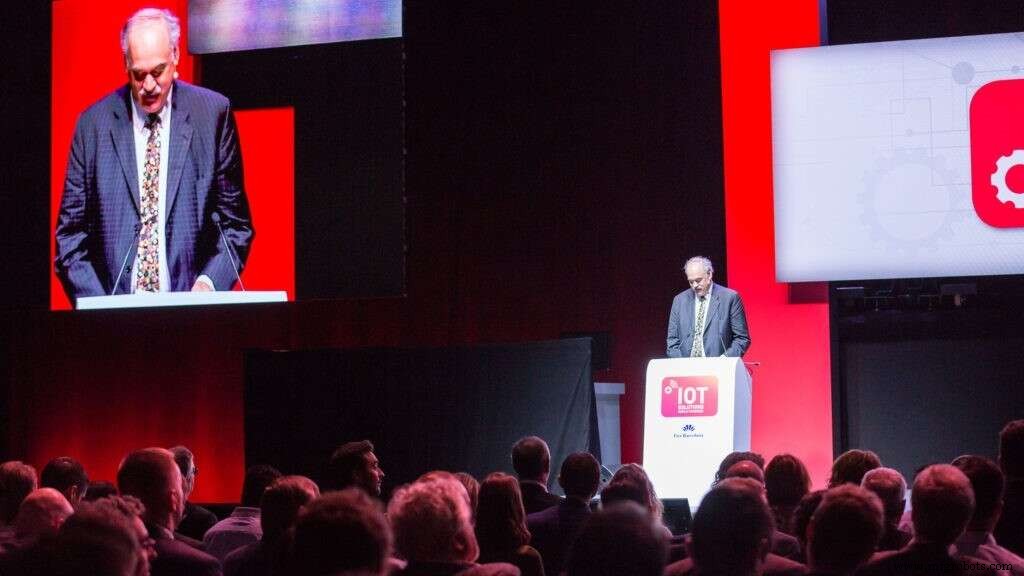
Dr. Richard Soley at IOTSWC
IoT Times
Good morning Richard, thank you for your time this morning. The IIC is now six years old. What can you tell us about the industrial internet, Industry 4.0, and the role of the IIC these years? And, what do you think are today’s challenges in the industrial IoT ecosystem?
Richard Soley
We’re seeing a sea change between the IIC of six years ago and the IIC this year. Significant changes: number one, the industrial IoT market has not taken off as fast as we expected, whereas Gartner expected or as Forrester expected it. It’s taking off more slowly, and of course, Coronavirus is keeping it even slower. So we’re seeing that number one, a slower market increasing, it’s still growing but much more slowly than expected.
And second, the industry is no longer as interested in emerging technologies. They’re more interested in how can you solve my real and user problem today? And, we’ve redirected the consortium completely. It is no longer just about studying new technologies, emerging technologies, and testbeds. Instead, we have a system called “challenges and test drives,” which are very, very short term driven by end-user needs and solve real end-user problems in a short time. And we have end-user leadership councils in several vertical markets. So it’s a structural change in the market, which is reflected in the way that we change the consortium.
IoT Times
Now, let’s talk about the IoT Solutions World Congress, and what’s going on today. I know this is a difficult question. Already many things have changed, especially everything that has to do with large gatherings such as conferences and trade shows. I was hoping that you can share the feedback from the industry, from your partners at IIC, from the IoT Congress organization, etc. How do you feel about the conference this year?
Richard Soley
Right now, we’re planning on holding the IoT Solution World Conference in late October as planned, assuming we’re back in physical conferences. I think we are all tired of doing Zoom and WebEx.
At this point, in late October, the conferences should be back on. So we’re assuming that it’s going to be alive. I have to say, Fira Barcelona is going through some major changes because, as you know, Mobile World Congress was cancelled. That’s the largest show at Fira Barcelona. And they had 120,000 people registered for that show and it didn’t happen. I think it’s even worse for the hotel industry: 750,000 hotel room nights went empty in one week. It’s horrible! It’s terrible! Probably they will have to reorganize Fira Barcelona, and would probably have to take more money from their institutional shareholders, the city, region, and country.
IoT Times
Recently you have launched the Digital Twin Consortium. Digital Twins, as I understand it, has been around for many years in some industries, such as airspace and transport. And, now companies such as Microsoft, Cisco, and other internet companies are joining the trend, launching products. Why the sudden interest in digital twins?

Richard Soley
You know, it’s funny. I used to be a VLSI chip designer 40 years ago, when I was negative ten years old. And we didn’t design a chip from scratch. We could specify the number of inputs, the number of outputs, the circuit design, the circuit description, and a compiler generated the chip. That was effectively a digital twin of the chip, and you simulated the chip electronically before you built it because it was expensive to manufacture.
So, when I was approached by someone in property management to do a digital twin. I said, what’s the big deal? It’s something that’s been around forever. We did it at General Electric, I did it at VLSI design. It’s nothing new. He said it is new in property management. And, in property management, you’re designing a building that has a certain number of inputs and a certain number of outputs, and, in an emergency, everyone has to be out of the building in a certain number of seconds. So, you just design it. You don’t feed it to a compiler, and then tweak the result; you design it by hand, which is really absurd. In 2020, it’s just ridiculous that the digital twins are completely not found in property management, construction, transportation, and so forth.
So, at the Digital Twin Consortium, we have two aims. One aim is to introduce digital twins in markets where there hasn’t been any use of digital twins at all. Such as property management, but also in manufacturing areas where there’s no use of digital twins, in defense in aerospace, and natural gas, and mining, and other natural resources. It is a great opportunity.
You do find some digital twins in some of those markets, but not in other markets. So number one, introduce digital twin technology in markets where there hasn’t been any use. Number two, terminologies shared by shared standards and open source so that digital twins work between applications in a vertical market and between vertical markets. It’s a tall order, but it’s really important. We have four founder members: Lendlease, Dell, Cisco, and Microsoft. And, we have a couple of dozen new members we’re going to announce on May 18.
IoT Times
Thank you again for your time and insights. Hopefully, we’ll be out of the woods soon and meet in person again, in Barcelona for IOTSWC.
Industrial Technology
- Securing the Industrial IoT: A Practical Roadmap
- Unexpected Shifts in the IoT and Industry 4.0 Vendor Landscape
- Harnessing Industrial IoT for Growth: Beyond Cost Savings
- Podcast: Accelerating Edge Connectivity in Industrial IoT
- Industrial IoT: A Reality Check on the Promise of Smart Factories
- Industrial IoT: A Strategic Imperative for Modern Manufacturing
- Industry 4.0 vs. Industrial IoT: Understanding the Key Differences
- Industrial IoT Drives Growth as Connectivity Yields Tangible Benefits
- Analog Devices Ascends to Second Place in Industrial Semiconductor Market
- Richard Soley on Industrial Internet, AI, and the Future of Distributed Computing