



Industrial IoT Drives Growth as Connectivity Yields Tangible Benefits
While the Internet of Things for consumers is gaining the lion’s share of the publicity, the technology is quietly finding its way into industrial applications. Industrial adopters tend to stay quiet about their plans and progress in order to avoid tipping their hand to their competitors.
Stories are now coming to light about the IoT in industry, and the business case for adoption of connectivity is starting to sound compelling. The promises of increased efficiency and cost savings that form the siren’s call for industrial IoT can be compelling, leading the bold to try things out.
For example, Fujitsu has applied its sensor technology and distributed service platform along with Intel’s IoT Gateway with the aim of showing how the IoT can provide measurable value in an industrial setting. The factory, which primarily produces laptop PCs, sought to reduce cost by using the IoT to explore a specific pain point – unexplained repair/rework problems. Now, if the unit fails during this final test, it goes into a rework department for repair.
One problem the factory had was that all too often the rework department was unable to replicate the reported failure and thus was unable to identify if the root cause was a manufacturing error or a testing error. With the root cause unknown, it was impossible to reduce the amount of repair rework.
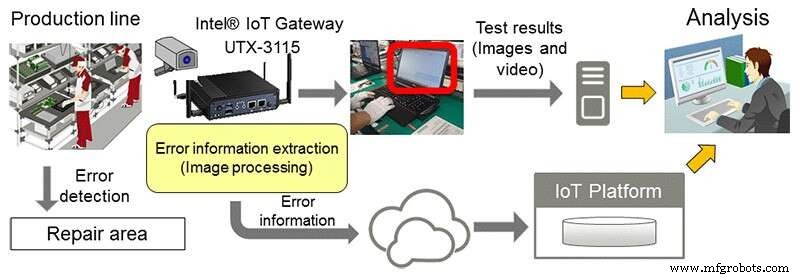
(Source: Fujitsu)
In the first part, video cameras watch device screens during final testing, while the gateway aggregates the video streams and sends them to the cloud for processing using text recognition technology to detect and recognize any error codes displayed on screen.
For the second part, the factory attaches beacons to any devices sent to the rework department, enabling the real-time tracking of device movement by every worker in the department.
The system annotates the location of each device with information on its shipping deadline, allowing workers to independently prioritize their work and to help out in processes that were causing delays.
The analysis of error reports allows the company to identify the misdetection of faults, which helps reduce the incidence of rework.
The ability to prioritize rework in real-time resulted in a 30% reduction shipping costs by minimizing missed deadlines.
This kind of trial helps take the hype out of the IoT and grounds the benefits in hard numbers. With solid examples as a guideline, potential industrial IoT users gain the ability to perform cost/benefit analysis with confidence in the results.
As the IoT proves its benefit, even the risk-adverse will start to adopt the technology, fueling growth in the industrial IoT market.
Read the full story on our sister site EDN.com
Industrial Technology
- Securing the Industrial IoT: A Practical Roadmap
- Industrial IoT: A Practical Guide to Successful Implementation
- Designing Security into the Industrial IoT: Expert Guidelines for Protecting IIoT Systems
- How Industrial IoT Sensors Drive Modern Factory Efficiency
- Industrial IoT Rises on 5G: New Opportunities for Smart Manufacturing
- Harnessing Industrial IoT for Growth: Beyond Cost Savings
- Podcast: Accelerating Edge Connectivity in Industrial IoT
- Industrial IoT Growth Slows: IIC Expert Richard Soley Explains the Post-COVID Landscape
- Industry 4.0 vs. Industrial IoT: Understanding the Key Differences
- Analog Devices Ascends to Second Place in Industrial Semiconductor Market