



Network Rail Modernizes the World’s Oldest Railway with IoT, AI, and Deep Learning
With 20,000 miles of rails, 30,000 bridges, tunnels and viaducts, and thousands of signals, the oldest rail network in the world is undergoing digital transformation.
London. During the recent AI and Big Data Expo, we talked to Nikolaos (Nick) Kotsis, Chief Data & Analytics Officer at Network Rail.
Kotsis, who joined Network Rail in 2019, gave a presentation about how Network Rail uses data from different sources, including over 30,000 IoT devices, to monitor the rails, detect potential maintenance issues, manage vegetation, and perform predictive maintenance.
 “Network Rail is an amazing machinery.” says Kotsis, “But, you know, they will ask me the question: why do we have delays? We have delays because it’s a very complex machine. A track is open to many factors, such as weather and vegetation.”
“Sudden changes to weather conditions can break the tracks. And up to maybe five years ago, the only way we could prevent that was only by foot Inspections. Engineers had to walk on the track to identify possible cracks and defects.”
“Now we have a multi-sensor environment,” he says.” We have a very advanced sensor technology which looks at the track, and then we pull down actual video of cameras focusing on the rails.”
“We receive almost a half petabyte of data every week,” says Kotsis. “Cloud analytics doesn’t give you all the answers. You need to make sure that you safely transfer data. For processing, the amount and quality of the data are significant. And this is what the data science team does.”
Network Rail Intelligent Infrastructure (II) Programme
In 2019, Network Rail launched the Intelligent Infrastructure (II) programme to turn data into intelligent information that can effectively deliver improved services for passenger and freight customers.
By capturing and exploiting accurate data on Network Rail’s assets across the entire 20,000- mile network, II is shifting work from traditional planning and maintenance schedules to a proactive ‘predict and prevent’ approach. It will allow teams to see where assets are, how they are behaving, how they are degrading, and when they will fail.
The program uses data captured by its sensors, high-definition aerial imagery and 3D LiDAR, footage from inspection trains, information from the train operators (private companies operate the passenger trains in the UK), additional video from drones and helicopters, and other sources. Data consolidated by workstreams on Network Rail’s cloud platform is uploaded to Microsoft’s Azure Cloud, where AI algorithms turn the information into actionable predictive maintenance schedules.
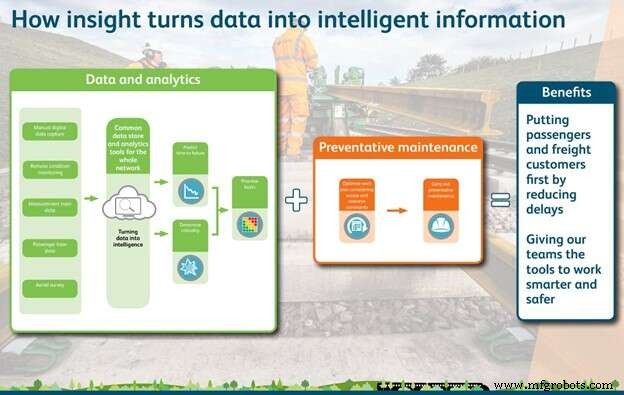
The first version of Insight entered pilot service six months ago. It incorporates track and signaling capabilities. For example, the tool aligns run-on-run track data (a digital representation of the track condition) taken over time and warns maintenance teams when faults are likely to happen – this could be 28 days, 90 days, or even longer before the repair is needed.
AI not going to replace humans soon
“One last thing to mention is that many people talk about replacing humans,” says Kotsis, “and how AI could replace humans. At some point in the future, I think it’s worth having the debate. But I don’t think we are at the stage where we need to worry too much about this moment.”
Industrial Technology
- The Cloud Revolution: How Cloud Computing Transforms IT, Security, and Careers
- Harnessing Machine Learning to Optimize MRO Supply Chain Management
- Outsourcing AI and Deep Learning in Healthcare: Protecting Data Privacy
- How IoT and Cloud Computing Shape the Future of Enterprise Data
- IoT World: Inside Vertica’s Big‑Data Solution for IoT Analytics
- Edge Computing & IoT Strategy Insights from IoT World 2019
- IoT Meets LPWA: Why Low‑Power Wide‑Area Networks Are the Future of Connected Infrastructure
- Sprint and Ericsson Launch 5G-Ready IoT Edge Intelligence Platform
- Eliminate Errors & Boost Production Quality with an Effective QMS
- Machine Learning vs Deep Learning: Everyday Applications and Key Differences