



Leverage Your Team’s Expertise: A Digital Transformation Expert’s Guide to Start Small and Scale
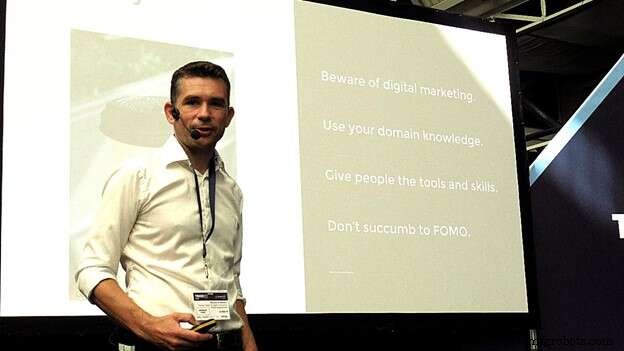
For over fifteen years, Richard Allbert led Pirelli’s digital transformation, advocating for creating value by listening to its workforce, as they are the real experts in every organization.
During the recent IoT Tech Expo, there were several talks about digital transformation. Besides some technology companies present at the conference, some of the talks focused on the experience of digital transformation leaders in different industries.
One of the most exciting recounts was given by Richard Allbert, who led Italian tire manufacturer Pirelli’s digital efforts for over fifteen years.
During his time with Pirelli, Allbert developed a program of education and training to stimulate and “kick-start” the digital transformation process, with great success. Using this as a foundation, he now works independently, helping other organizations with their digital transformation.
In his talk and later in a panel session, Allbert, who is now consulting for other companies, insisted on starting the digital transformation from the ground up, leveraging the expertise of the company’s workforce, including factory managers and operators.
He argues that many companies are embracing complex and lengthy technology projects because they “Fear of Missing Out” (FOMO), without realizing that taking the time to evaluate small steps, one at a time, is a much better approach.

We had the opportunity to talk to Richard Allbert after his presentation. Following is a transcript of our conversation.
IoT Times: Good morning Richard, during your talk at the conference and the panel session about digital transformation, you insisted on starting small, with baby steps. Can you elaborate on that?
Richard Allbert: Yes – on the panel, one of the key items to start the discussion was the growth of IoT in recent years. Tellingly, it is measured in the quantity of devices/uptake rather than the value returned. This “quantity not quality” approach is something that is preventing companies from taking real advantage of what IoT (and digital in general) has to offer.
Imagine your company decided to develop a new product. The starting point would be with a small proof of concept before testing and evaluation. Once the idea is proven, the product goes to market. Imagine doing the opposite – mass-producing something new before you even know if it’ll work or not. The former is clearly a better approach than the latter.
The same applies to continuous improvement – you analyze the problem or potential –or value proposition–, use your workforce’s domain knowledge and expertise to identify and collect the information you need, develop a solution, and test it. If it works, you expand it. You don’t ignore your domain knowledge, guess what the answer might be, and implement it without first being sure it will bring you your value.
Unfortunately, most non-tech companies who are trying to digitally transform industries take the latter approach. This usually takes the form of a multi-year digital road map –despite having little idea of the outcomes of even the first few weeks of the roadmap– followed by the purchase of hardware and software with little thought of precisely what the measurable value is.
IoT is one of many technologies that can create value – nothing more, nothing less. It’s the approach that is important, not what you buy.
IoT Times: Each organization has unique challenges and culture, affecting the path to digital transformation or Industry 4.0. Based on your experience at Pirelli, what can you tell us in this respect?
Richard Allbert: In my experience, digital transformation is a change management problem as opposed to a technical one. It’s something that Pirelli understood very early on and an issue that many companies seem to miss.
To explain why – in the 1990s, Pirelli, and many other companies, underwent a massive transformation with the implementation of Toyota’s Total Productive Maintenance (TPM), or Lean manufacturing. It was hugely successful – primarily because the essence of TPM is autonomy. It gave the workforce, at all levels, the tools and methodologies to innovate, develop ideas, and solve problems. Toyota realized that their own people were the experts; they just needed the tools to innovate. Speaking from experience, it is motivating to have the tools and freedom to solve your problems and innovate. Many companies went through this process and reaped the benefits.
Fast forward to the 21st century we are facing another transformation, this time digital.
Strangely, most companies have abandoned the approach that previously worked so well. Instead of investing in the people – asking them for their ideas, giving them the tools to build digital solutions, allowing them freedom with digital technology, the investment is focussed entirely on the technology itself. The basic digital tools most people have to work with remain pretty much the same as in the 1990s. I remember when MS Excel and Access arrived. Everyone was given extensive training. We were encouraged to develop – to create. 25 years later, the majority of non-IT Data Engineers are still using the same tools.
Digitally we have become users. We used to be the creators. If you don’t invest in your people, you won’t succeed.
IoT Times: Especially for manufacturing industries starting or thinking about their digital transformation. What would be your suggestions to avoid the most common mistakes?
Richard Allbert: Firstly, admit when you don’t have the technical expertise. Time and again, I see digital plans, roadmaps, strategies being created by people who have little or no actual technical expertise. We have plenty of project managers. What we need are people who can do something.
Secondly, leverage your workforce. The irony of the ‘digital struggle’ that many non-tech companies have is that they have deep domain knowledge – they know the process and the product. This is where the ideas and innovations are coming from. Ask them what they need. Give them the tools. Let them develop the prototypes and give them the digital solutions they need.
Thirdly, ignore digital marketing. On the panel at the TechEx event, one of the leading AI companies was asked how much of their work was actual AI and how much was actually simple tasks, such as database provision and dashboards. The answer was less than 10% AI.
Fourthly, identify fundamental value propositions. Make sure you can measure the return. Start small, simple; deploy your losses; identify the problem. Collect the data you need and prototype a solution. Above all, measure the improvement.
IoT Times: Richard, thank you so much for your time today. Hope you have a successful show.
Industrial Technology
- How Digital Transformation is Reshaping the Paper Industry's Future
- Accelerating Digital Transformation in Manufacturing: Roadmap, Challenges, and Benefits
- Strategic IoT Integration: A Proven Path to Business Growth
- Effective Advertising & Growth Tactics for Industrial Cleaning Companies
- Proven Strategies to Expand Your Steel & Metals Manufacturing Business
- How Digital Transformation is Reshaping Supply Chains: Lessons from COVID-19 and the Future
- Enhancing Supply Chain Outcomes with Phygital Integration: Bridging Physical and Digital Realms
- Integrating Supplier Management with Digital Transformation for Resilient Supply Chains
- Driving the Future: How Digital Transformation & IoT Revolutionize Automotive Manufacturing
- Blue Prism’s RPA: Accelerating Digital Transformation & Agile Sprints