



IoT Meets LPWA: Why Low‑Power Wide‑Area Networks Are the Future of Connected Infrastructure
Twenty years ago a vending‑machine manufacturer approached me with a challenge: monitor each machine’s compartment temperature to the nearest tenth of a degree and record the data remotely. The goal was to guarantee a cold soda, but the required precision was excessive—what mattered was simply whether the temperature was above or below 38°F. By compressing the data into a far smaller payload, the company saved on transmission costs while still meeting its service promise.
This anecdote illustrates a critical question for industrial, civic, and commercial IoT leaders: should you pay for data that is finer than you actually need? If the answer is “no,” consider adopting a Low Power Wide Area (LPWA) network.
More data, more problems
The chasm between consumer data requirements and those of industrial or civic IoT projects has never been wider. Cellular networks, the de facto standard for IoT, were designed for smartphone users who demand high bandwidth and fast connections. Consumers pay a premium for large data plans and for the ever‑evolving hardware that keeps pace with cellular advancements. For industrial or civic deployments, that paradigm is simply not cost‑effective.

One key drawback of cellular for large‑scale IoT is longevity. To stay current with LTE and beyond, organizations must continually upgrade radios—akin to smartphone users buying a new phone every 3–4 years. For cities or enterprises managing hundreds of thousands or millions of devices, that cycle is prohibitively expensive and logistically complex.
Cellular networks also demand significant power. Even the most efficient smartphones require daily charging because they transmit large volumes of data. Industrial and civic devices, however, need batteries that can operate for years on a single charge.
When data needs are modest, LPWA networks deliver a specialized solution that mitigates these longevity and power challenges.
Reduced data for a reduced cost
The primary incentive for LPWA adoption in industry and municipalities is cost. By dedicating a network to lightweight telemetry, LPWA avoids the constant evolution that drives cellular costs. Radios and sensors built for LPWA remain relevant for a decade or more, and their batteries can last up to 15 years in some configurations—dramatically lowering maintenance labor and replacement expenses.
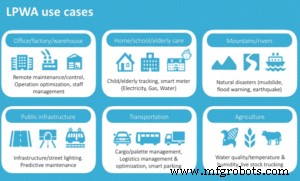
The trade‑off is slower transmission speeds. LPWA latency ranges from a few seconds to a couple of minutes, depending on protocol and payload size. This makes LPWA ideal for non‑time‑critical monitoring—such as detecting water leaks on farms or tracking city traffic patterns—but unsuitable for life‑or‑death applications like real‑time heart monitoring.
Minimizing both transmission time and payload size conserves battery life. LPWA protocols are engineered to send concise information that fits into just a few bytes—perfect for M2M scenarios where the data is a simple operational flag or basic metric such as temperature, moisture, or volume.
Bluetooth is the only wireless technology that rivals LPWA on price, yet its range—roughly 100 meters—falls short for large‑scale industrial or municipal deployments. LPWA can cover up to 5 miles in open terrain, making it far more suitable for networks that span entire cities, farms, or factories.
Under budget and ahead of the curve
Budget constraints are paramount when establishing an IoT network. In addition to longer battery life and equipment longevity, LPWA radios and modems typically cost below $5, compared to $15–$25 for cellular counterparts—a $10–$20 saving per module that scales to significant savings across thousands of devices.
Whether you’re starting from scratch or migrating existing cellular sensors, LPWA offers flexible solutions. Open‑source frameworks from the LoRa Alliance can accelerate new deployments, while commercial LPWA platforms can bridge current cellular infrastructure to a new, low‑power network, requiring only a licensing fee for their protocol.
Wide‑area coverage is essential for city‑wide and industrial IoT. According to Machina Research, LPWA connections are projected to exceed three billion by 2023. If these figures hold, LPWA will become the dominant M2M connectivity technology.
Industries and municipalities that combine IoT with LPWA are poised to transition from unconnected products to connected services efficiently and sustainably.
Internet of Things Technology
- MQTT vs. DDS: Choosing the Right M2M Protocol for IoT
- Harnessing Connected Product Data: How IoT Analytics Drive Innovation and Trust
- IoT Fuels Data Analytics: A Practical Guide for Business Success
- How IoT Connectivity Drives Business Disruption in a Post‑COVID Economy
- Harnessing IoT Data for Manufacturing Excellence
- IoT and AI: Transforming Everyday Life and Industry
- Ingram Micro’s IoT Insight: Delivering Value to Partners & Customers
- Connected Farming: Harnessing IoT to Boost Yield, Cut Costs, and Drive Sustainability
- Seamless Payment Orchestration & Open Banking: A Unified Solution for Modern Merchants
- Harnessing Edge Computing for IoT, AI, and Emerging Technologies