



Lathe Machines Explained: Components, Operations, and Types – Free PDF Guide
Being a Mechanical engineer you must’ve come across the lathe machine or heard of it. This machine can be said as the most popular machine among mechanical engineers due to its various uses.
This is The Mechanical post and today you would be reading about What is a lathe machine? its parts, operations, important terms, and its types.
Get your PDF on Lathe Machine at the end of the article.
A lathe is a very important machine tool used widely by manufacturing industries today. It is an important machine tool in manufacturing industries due to its versatility.
As time passed by, metalworking lathes were invented during the industrial revolution.
What is a lathe machine?
A lathe is a machine tool that holds the workpiece between rigid and strong supports. It removes material by turning it against the cutting tool which will remove metal from work in the form of chips.
Now a days CNC lathe machines i.e automated lathe machines are quite well known.
A variety of operations can be performed on a lathe machine which includes drilling, thread cutting, turning, step turning, facing, taper turning, etc.
Parts of Lathe Machine
#1 Lathe Bed
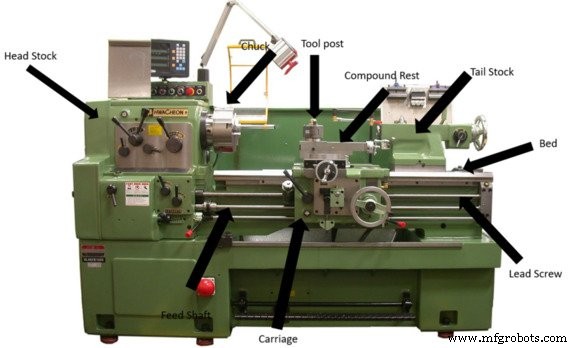
The lathe bed forms the base of the machine, the headstock and tailstock are located at either end of the bed and the carriage rests over the lathe bed and slides over it.The lathe bed is the guiding member of the lathe machine so it needs to satisfy the following condition.
- It should be sufficiently rigid to prevent deflection
- It must be massive with sufficient depth and width to absorb vibration
- It must resist the twisting
- To avoid distortion the bed material should have high compressive strength, should be wear-resistant, and absorb vibration. For this purpose Cast iron is alloyed with nickel and chromium is used for manufacturing lathe beds.
#2 Headstock
The headstock is secured permanently on the inner ways at the left-hand end of the lathe bed.It comprises essentially a hollow spindle and mechanism for driving and controlling the spindle speed.
#3 Chuck
One end of the spindle is connected to the headstock and the other end is connected to the chuck. The chuck is a clamping device for the workpiece.The spindle attached to the chuck causes it to rotate and the speed of the rotation can be varied y the controls on the headstock.
The most commonly used chuck are the Four jaw chuck and the Three jaw (universal) chuck.
#4 Tailstock
The tailstock is located on the inner ways at the right-hand end of the bed.This has two main use:
- It supports the other end of the work
- It holds a tool for performing an operation such as drilling, reaming, tapping, etc.
#5 Lead screw
The lead screw of the lathe is an externally threaded shaft having a square thread profile. It converts rotational motion into linear motion. It is used for thread cutting in a lathe machine.It is the lead screw which moves the carriage automatically during thread cutting operation.
#6 Feed rod or Feed shaft
The feed rod is the cylindrical rod placed just below the lead screw. It does not have any external threads as the lead screw.The feed rod is used to move or slide the carriage from the left side of the lathe to the right side of the lathe and vice versa.
#7 Carriage
The carriage of a lathe has various parts which serve to support, move and control the cutting tool. Parts are following below :- Saddle
- Cross-slide
- Compound slide
- Tool post
- Apron
#8 Saddle
The saddle is an H-shaped casting that fits over the bed and slides along the way. It carried the cross-slide and tool post.#9 Cross slide
The cross-slide consists of a casting machined on the underside for attachment to the saddle. The cross slide moves the tool to and fro perpendicular to the axis of the workpiece.#10 Compound slide
The compound rest or slide is mounted on the top of the cross-slide which is used for obtaining angular cuts and short taper.#11 Tool post
It is located on the top of the compound rest to hold the tool firmly and to enable it to be adjusted to a working position.#12 Apron
It is fastened to the saddle and hangs over the front of the bed. The Apron contains gears, clutches, and levers for operating the carriage by hand or power feeds.Check out this animated video for a better understanding of the construction of lathe machine.
#13 Feed Mechanism
Feed is the movement of the tool relative to the work. A lathe tool may have three types of feed :Longitudinal (For length)
Latitudinal (For depth)
Angular (For taper)
Working of Lathe machine
via Gfycat
The operator first loosens up the jaws of the chuck, inserts the workpiece, and then tightens it up firmly with the help of a chuck key.
The chuck is connected to the motor via gear drive or belt drive and hence provides rotary motion to the workpiece. The tool is fed against the revolving work, the cutting tool is rigidly held and supported as you can see above.
The cutting tool is fed either parallel, perpendicular, or at an angle to the workpiece axis.
The workpiece is given the desired shape by removal of workpiece material in the form of chips by the tool.
In a lathe machine the workpiece rotates whereas the tool slides in the longitudinal, latitudinal, and crosswise direction.
Operations performed on Lathe machine
The following are the operations that can be performed on a lathe machine:- Straight turning
- Shoulder turning
- Chamfering
- Thread cutting
- Facing
- Knurling
- Filling
- Taper turning
- Eccentric turning
- Polishing
- Grooving
- Spinning
- Spring winding
- Forming
- Drilling
- Reaming
- Borning
- Counterboring
- Taperboring
- External thread cutting
- Internal thread cutting
- Tapping
- Undercutting
- Parting-off
- Grinding
- Milling
Important terms related to lathe machine
Cutting Speed of lathe
The cutting speed of the lathe is cutting tool is the speed at which the metal is removed by the tool from the workpiece.Feed of lathe
In a lathe machine, the feed of the cutting tool is the distance the tool advances for each revolution of the work.Feed is expressed in millimeters per revolution.
Depth of cut
The depth of cut is the perpendicular distance from the machine tool surface to the surface of the workpiece.Depth of cut = d1-d2 / 2
Where,
d1 = Diameter of the surface before machining
d2 = Diameter of the machined surface
The depth of cut varies inversely with the cutting speed.
Types of Lathe Machine
The following are the types of lathe machine:- Speed Lathe.
- Engine Lathe.
- Bench Lathe.
- Toolroom Lathe.
- Capstan and Turret Lathe.
- Special purpose lathe machine.
- CNC lathe machine.
That’s an overview of the Lathe Machine. If you like this post, do let us know about it in the comments and share it with fellow engineers with the social links below.
Also, do consider subscribing by clicking the subscribe button and never miss a post by us!
Till then Keep learning and read The Mechanical post!
Industrial Technology
- Lathe Machines Explained: Types, Functions, and Applications
- Slotting Machine Explained: Definition, Parts, and Types
- Planer Machines Explained: Definition, Parts, and Types
- Understanding Drilling Machines: Definition, Components & Types
- Types of Lathe Machines: A Comprehensive Overview
- The Ultimate Guide to 22 Essential Lathe Machine Operations
- Lathe Machines Explained: Types, Functions & PDF Guide
- CNC Machines Explained: How They Work, Types, Benefits & Applications – PDF Guide
- What Products Can Be Created with CNC Machines
- Drilling Machine Explained: Definition, Components, and Types