



Ferrite Beads: The Tiny Cylinders Protecting Your Power Cords & Cables
What is the Tiny Cylinder in Power Cords & Cable?
Have you ever noticed a little cylinder in the shape of a lump in a power cord and cable? Have you ever seen the same in your laptop charger cord, USB cord, Mobile charger cable cord, Printer Cord, Monitor cord, etc. even in Mouse and keyboard cable cords? Today, we are going to tell you the secret story behind Ferrite Bead.
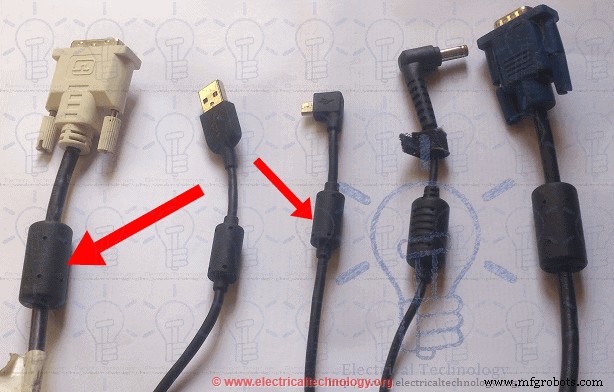
Theoretically, this Tiny Cylinder in Power Cords & Cable is ferrite choke or ferrite bead as shown in the above image.
The ferrite choke is an object in the cylindrical shape, which is made up of Ferrite material (which is a magnetic material). A typical Ferrite choke (e.g. Solenoid) consists of an insulated wire around a magnetic material. In our case, the cable is an insulator and the ferrite cylinder is magnetic material to make a special kind of lump for the power cable and cords.
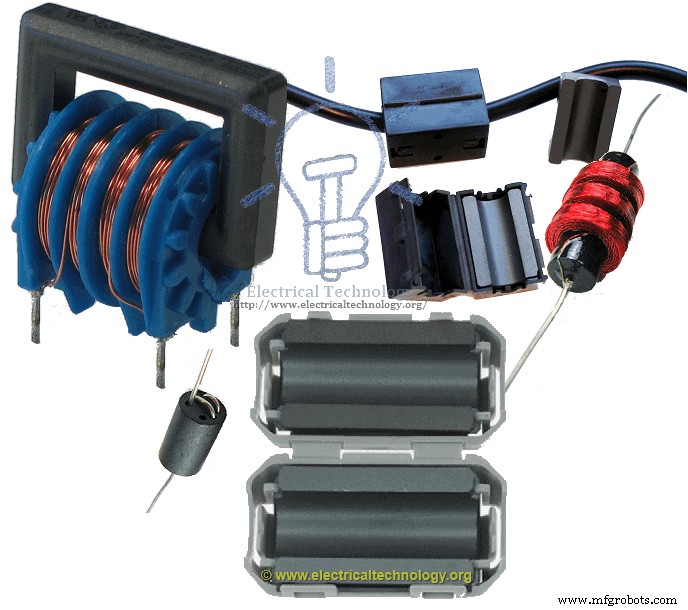
Ferrite Bead (or Ferrite choke) plays a very important rule. As we know, when current passes through the conductors (inside the power cords), it produces EMF (Electromotive Force) or Radio Energy. The power cords and cable transfer this energy outside in the form of noise, which disturbs and interferes with other electronics devices such as nearby radio sound that would be noisy with improper tuning of the channel.
Related Posts:
- Why Earth Pin is Thicker and Longer in a 3-Pin Plug?
- Which One Kills – Current or Voltage and Why? Amps vs Volts
- AC or DC – Which One is More Dangerous And Why ?
In addition, some electrical energy is wasted in the form of radiation, which also reduces the supply power to the battery or other connected devices, which leads to an increase in the charging time of the battery.
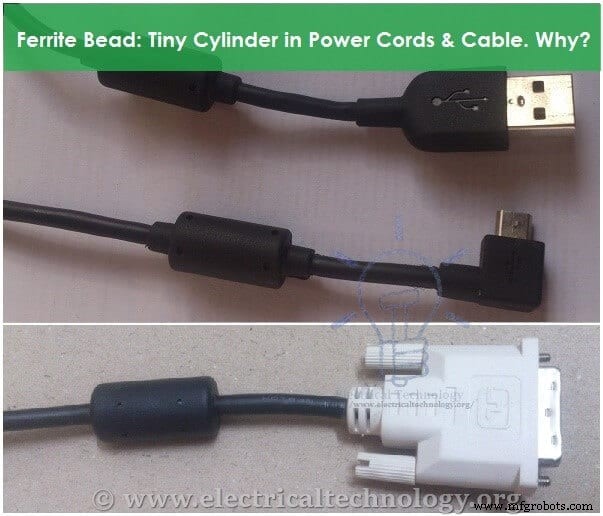
Ferrite Bead has the ability to stop and block the emission of radio waves from the power cords and uses electrical energy for charging purposes only without power losses. Due to this important factor, that’s why there is a tiny cylinder in your laptop or mobile charger cords. Now, I think it is enough because you have a clear understanding of the purpose of this magical tiny object (ferrite bead or ferrite choke) in the cylindrical shape in power cords and cables.
- Related Post: What are the Colored Aerial Marker Balls on Power Lines For?
You may also read the following related but interesting questions and explanatory answers.
- Why Can’t We Store AC in Batteries instead of DC??
- Why are Motors rated in kW instead of kVA?
- What is the Rule of Capacitor in AC and DC Circuit?
- Why A.C needs more insulation than D.C at same Voltage Level?
- Which Bulb Glows Brighter When Connected in Series and Parallel & Why?
- Why Earth Pin is Thicker and Longer in a 3-Pin Plug?
- Why are US Homes Wired Using Solid Wire rather than Stranded Wire?
- Why 3-Phase Power? Why Not 6, 12 or More for Power Transmission?
- If a 1-Phase Supply is 230V, Why is 3-Phase 400V & Not 690V?
- Why are Outlets and Receptacles in Hospitals Upside Down?
- Why Does the Heating Element Glow but Not the Cord of Heater?
- Why are Stones laid in an Electrical Substation?
- Why Does A Capacitor Block DC But Pass AC?
- Why a Transformer Can’t be Operated on DC Supply?
- Why Don’t Birds and Squirrels Get Electrocuted on Power Lines?
- Why Do Electronic Circuits Use DC Current instead of AC?
- What happens if You Connect a 3-Φ Induction Motor to 1-Phase Supply?
- What happens to the 3-Phase Motor When 2 Out of 3 Phases are Lost?
- What happens to the 3-Phase Motor When 1 Out of 3 Phases is Lost?
- What Happens if We Connect a Polar Capacitor the Wrong Way?
- What Happens if a Battery is Connected to the AC Supply?
- Is Lightning AC or DC ?
- Basic Electrical & Electronics Interview Questions & Answers
- 65+ Basic Electronics Engineering Interview Questions & Answers
Industrial Technology
- Power Sources: AC and DC Explained
- AMS Launches AS621x Series: Ultra‑Low‑Power, High‑Accuracy Temperature Sensors in a Tiny Package
- Unlocking Real-Time Value: Why Your Business Must Embrace IoT
- Benefits of Using Concentric Springs in Auxiliary Engine Cylinder Heads
- Choosing Low‑TBN Cylinder Lubricants for Low‑Sulphur Diesel Fuel
- How Cushioning Enhances Pneumatic Cylinder Performance and Longevity
- Ensuring SCBA Performance: Why Facepiece and Cylinder Compatibility Is Crucial
- Why Power Factor Matters: Key to Efficient Electrical Systems
- Why Pneumatic Cylinders Fail and How to Repair Them Effectively
- Understanding Power, Communication, and Magnet Wire Cables: A Comprehensive Guide