



MCB, MCCB, ELCB, and RCD (RCB/RCCB): Understanding Circuit Breaker Differences
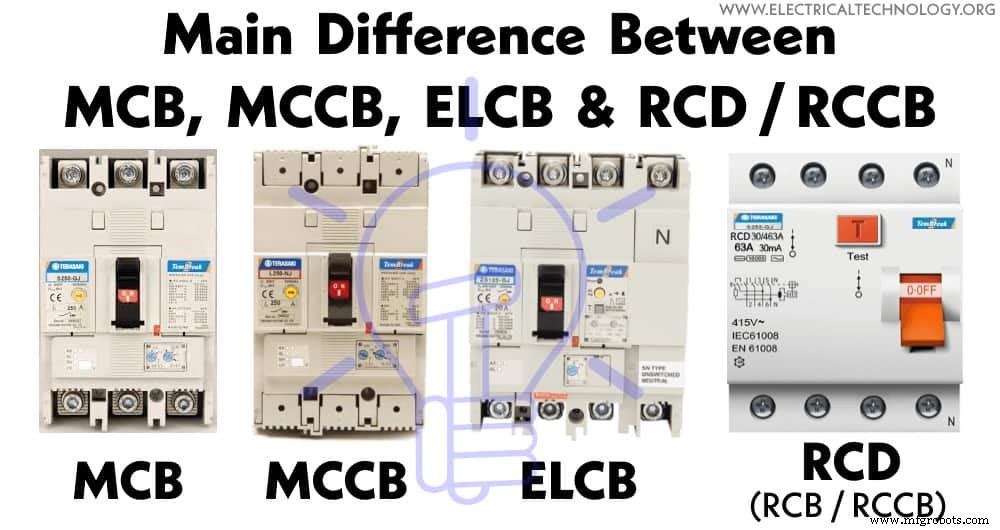
Difference Between MCB, MCCB, ELCB and RCCB (RCD or RCB) & RCBO Circuit Breakers
Different types of Circuit breakers are installed and used for safety purposes in both residential as well as commercial and industrial areas. In power distribution, we need circuit breakers at different levels. Depending on the current carrying capacity, breaking capacity and other functions, we select a suitable circuit breaker according to our needs i.e. VCB, ACB (Air Circuit Breaker), MCCB and then MCB , this is a common hierarchy being followed in power distribution systems.
- Related Post: Difference Between a Battery and a Capacitor
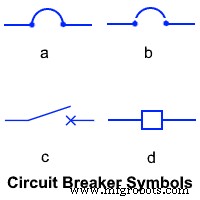
What is a Circuit Breaker (CB) ?
A CB (Circuit breaker) is a device which:
- Control (make or break) a circuit manually or by remote control under normal and fault conditions.
- Break a circuit automatically under fault conditions (like overcurrent, Short circuit, etc).
Air Circuit Breaker
- Operates in air (where air-blast as an arc quenching medium) at atmospheric pressure.
- It has completely replaced by oil circuit breaker.
- No chance of oil fire like in oil circuit breaker.
- Rated Current up to 10k A.
- Trip thresholds and delays are adjustable.
- Electronically and microprocessor controlled.
- It is used in large industrial plant for main power distribution.
To know more about ACB, read the article “Air Circuit Breaker (ACB) – Construction, Operation, Types and Applications.
What is MCB (Miniature Circuit Breaker) ?
- MCB stands for “Miniature Circuit Breaker”.
- Rated current under 100 amps.
- Interrupting rating of under 18,000 amps.
- Trip characteristics may not be adjusted.
- Working principle based on thermal or thermal magnetic operation.
- Suitable for low current circuits (low energy requirement), i.e. home wiring.
- Generally, used where normal current is less than 100 Amps.
To know more about the MCB, check the previous post “MCB (Miniature Circuit Breaker) – Construction, Working, Types & Applications”.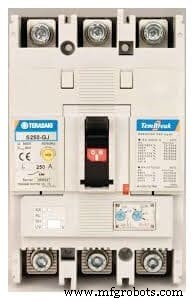
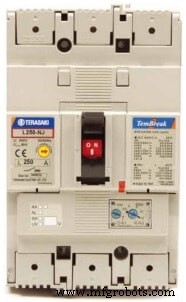
What is MCCB (Molded Case Circuit Breaker) ?
- MCBB stands for “Molded Case Circuit Breaker“.
- Rated current in the range of 10-2500 amps.
- Thermal operated for overload and & magnetic operation for instant trip in SC (short circuit conditions).
- Interrupting rating can be around 10k – 200k amps.
- Trip characteristics is adjustable.
- Suitable for high power rating and high energy i.e. commercial and industrial use.
- Generally, used where normal current is more than 100 Amps.
Main Difference between MCB and MCCB
The main different between MCB and MCCB is the interrupt current rating which is up to 1800 amperes for MCB and 10k – 200k Amperes for MCCB.
- Related Post: Main Difference between Contactor and Starter.
The following table shows the comparison and major differences between MCB and MCCB for different characteristics.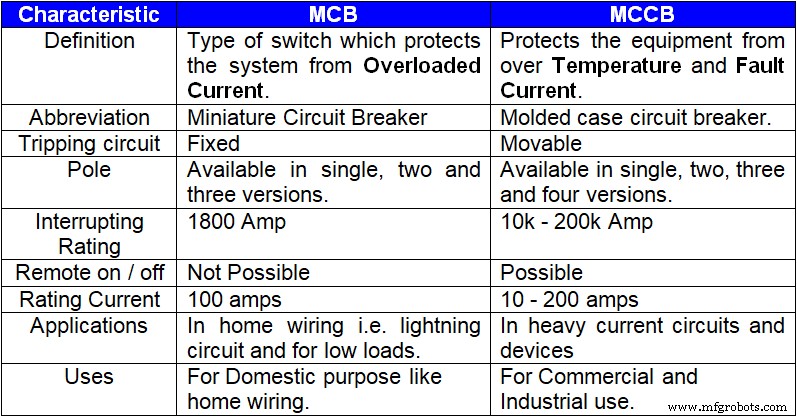
Keep in mind that both MCB and MCCB are classified as low voltage circuit breakers and the operation principle is based on thermo-magnetic for both devices.
- Related Post: Difference Between Relay and Circuit Breaker
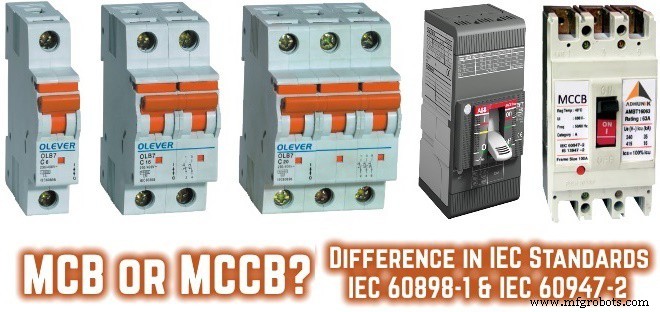
MCB and MCCB Selection
Now the question is that for a situation, where standard current carrying capacity needed is 100A with breaking capacity of 15KA, what should be used? An MCB or MCCB? We assume cost is not very different.
Both are in molded case and having almost similar features especially when we are comparing with fixed thermal setting option of MCCB and they are classified as low voltage circuit breakers. For magnetic setting, we can select MCB as per curve and MCCB will have either fixed setting or can be adjusted.
- Related Post: Difference between Circuit Breaker and Isolator / Disconnector
So what is the criteria to make a selection of MCB or MCCB? Space can be a point of consideration as MCBs are more compact but it doesn’t make a big point as bigger size of MCCB brings many advantages too like better fault clearing mechanism. keep in mind that both MCB & MCCB are low voltage circuit breakers and created to respond to IEC 947 standards (We are going to discuss these standards below)
Actually there is difference in standards they follows. An MCB is supposed to function in accordance to IEC 60898-1 (Unless mentioned otherwise) and so is tested accordingly. While an MCCB is tested in accordance with IEC60947-2. So to understand the difference between MCB and MCCB we need to get a brief idea of these two standards.
- Related Post: Main Difference Between Electrical and Electronic Engineering?
Difference between IEC 60898-1 and IEC 60947-2
IEC60898-1
It defines behavior of circuit breaker having rated operational voltage not exceeding than 440V (between Phases), Rated current not exceeding than 125A (We have range 0.5A-125A) and rated short circuit capacity not exceeding than 25KA ( Usually it is 10KAin MCB). This is designed for unskilled user (or say uninstructed user) and for devices not being maintained consequently. Also pollution degree covered is zero pollution to maximum pollution (degree 2). These are the circuit breakers we find in residential homes, shops, school & offices electrical distribution switchboards.
- Related Post: What is the Difference Between Neutral, Ground and Earth?
IEC60947-2
This standard applies to circuit-breakers, the main contacts of which are intended to be connected to circuits, the rated voltage of which does not exceed 1000 V a.c. or 1500 V d.c.; it also contains additional requirements for integrally fused circuit-breakers. It covers very high range of standard current carrying capacity (We have range of 6A-6300A) and meant for skilled user. The device is also supposed to be maintained properly. Also pollution degree is to be 3 or more. These circuit breakers are industrial applications and protect the power distribution of up to 1000 volts AC. and 1500 volts DC. (For MCBs, MCCBs & ACBs)
So it is clear that these items are different in their fundamentals. An MCB designed for indoor, pollution-free conditions and would not be suitable for harsh, outdoor applications that require pollution degree 3.
Typically, IEC 60898-1 certified Circuit Breakers meet minimally required performance to proof proper protection of household installations: Pollution degree 2, impulse voltage 4kV, isolation voltage is the same as nominal voltage 440V. That is the reason why usually we meet limited number of technical information printed on Circuit Breakers.
It is not necessary that Circuit breakers certified with IEC 60898-1 can’t be certified with IEC 60947-2, but for sure any manufacturer need to obtain certification. Rating of same MCB can be different for different standards, so, it is highly recommended to check the data properly printed on it.
- Related Post: Staircase Wiring Circuit Diagram – How to Control a Lamp from 2 Places by 2-Way Switches?
So, the application and needs will decide that which device is to be used or selected.
Comparison Between IEC 69896-1 & IEC 60947-2
| MCB Characteristic | IEC 60898-1 | IEC 60947-2 |
| Rated Current: In | 6 – 125A | 0.5 – 160A |
| SC Breaking Capacity | <25kA | <50kA |
| Rated Voltage: Ue | 400V | 440V, 500V, 690V |
| Impulse Voltage: Uimp | 4kV | 6kV – 8kV |
| Pollution Degree | 2 | 3 |
| Curves | B,C,D | B,C,D,K,Z,MA |
| Application Current | AC | AC or DC |
| Electrical Auxiliaries | No | Monitoring Control |
How to select MCB or MCCB at Different Circuit Levels?
Well, as we have cleared everything in the above sections as well as, the MCB nameplate rating data also give an appropriate information, but the choice of MCB or MCCB is based on certain factors and conditions like;
- ICS as a % from ICU. (See Difference between ICS & ICU in term of Circuit Breakers)
- Maximum Operating Voltage
- Insulation voltage
- Mechanical operation ( endurance and durability)
- Breaking Capacity for each Operating Voltage
Below are types of MCBs which shows the magnetic fault protection. Also, to prevent the accidental overloading of the cable at no fault, there is a thermal device in MCB to eliminate the chances of unwanted tripping operation of MCB. For short circuit protection in home appliances, the current rating is about to 6kA while for heavy and industrial operation, it is above the 10kA.
| MCB Type | Min Tripping Current (Ir) | Max Tripping Current (Ir) | Operating Time |
| Type B | 3 | 5 | 0.04 – 13 Sec |
| Type C | 5 | 10 | 0.04 – 5 Sec |
| Type D | 10 | 20 | 0.04 – 3 Sec |
by the way, it depends on your needs and requirement for what you want to install. Many other different factors affect the situation, So you will have to read the next article below as we have added some simple calculation and formulas for MCB installation & selection for electrical wiring.
| Applications | Standards to be Followed |
| Residential Buildings | IEC 60898-1 |
| Commercial Buildings | IEC 60898-1 or IEC 60947-2 |
| Industries | IEC 60947-2 |
Anyhow, You will have to read the next article about the proper selection of MCB or MCCB according to your load circuits.
Difference between ICS & ICU in term of Circuit Breakers.
ICS = Service Braking Capacity (means, Circuit breaker can remove the fault, but it may not be usable afterwards.)
ICU = Ultimate Braking Capacity (means, Circuit breaker can remove the fault and remain usable)
Characteristic of MCB and FUSE
- Both MCB and Fuse rated in Amperes which is known as Nominal Current or Rated Current.
- Keep in mind that an MCB or Fuse with rated current of 50A will not trip when current of more than 50A is flowing through it.
- The reason is that MCB and Fuse with same rated current has different properties.
- For a 63A MCB and 60A Fuse where it should trip in 0.2 sec, MCB will trip at 260A and fuse will trip at 600A. It shows Fuse delay is very high as compared to MCB.
- Sometimes, fuse blow itself without a reason. It may be due to the previous overloads for specific time which has not been noticed.
- In case of Fuse, if the rated current is 60A, it will carry up to 80A for an hour or two. This is the same like modern PVC cables hold 50% overload for an hour.
- A previous post can be read for more details under the title of “Main Difference between Fuse and MCB and symbols used for Circuit Breakers, Fuses and Protection devices“.
What is ELCB (Earth Leakage Circuit Breaker)
ELCB stands for “Earth Leakage Circuit Breaker” and it is used for protecting a person from electric shock and injury. The needs of these devices arise because of the number increasing in injuries as well as deaths because of electric shock.
This device is invented almost 50 years ago, but nowadays ELCB is not suitable because of its some disadvantages hence another device RCB (Residual circuit breaker) or RCD (Residual Current Devices) whose functionality is same with more advantages, but theory of operation is entirely different from ELCB. some of ELCB characteristic are as follow:
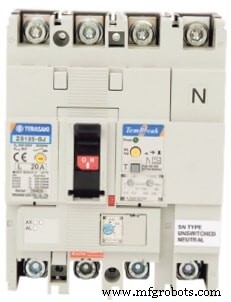
- As name suggest, its operated on earth leakage current.
- Line (Phase or Live), Neutral (N) and Earth Wire connected to the load points through ELCB.
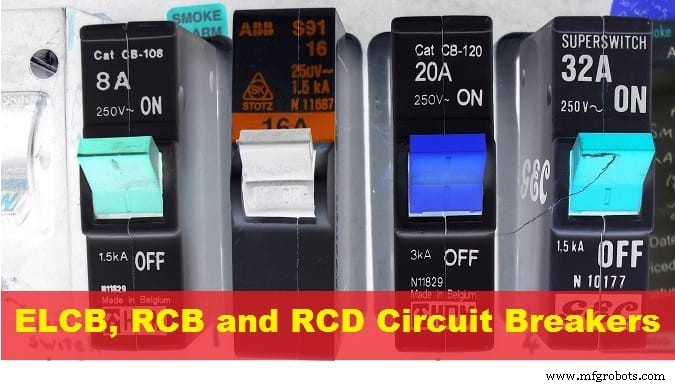
ELCB Construction:
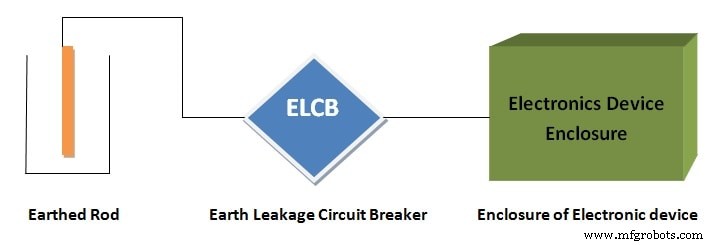
It is international standard that each electronics device enclosure should be earthed. So, there would be no chance of electrocutions. For proper operation of ELCB, its need to bury a metallic rod deep in the soil and ELCB is connected between the wire coming from the rod to the wire attached to the external metallic body of the Electrical device or you can say that ELCB is connected to the Earth wire.
ELCB Operation:
When the live wire (accidentally) touches the metallic body of the connected device or appliance, then there is potential generated between the earthed rod and the metallic enclosure of that device. The circuitry (inside the ELCB) senses the potential difference and when this potential difference reached at 50volt then ELCB cuts off the main supply from the connected device. This way it ensures the safety of the human beings.
- Related Post: How to Connect a Portable Generator to Home Supply System (Three Methods)
To know the operation time of ELCB, lets see the following example.
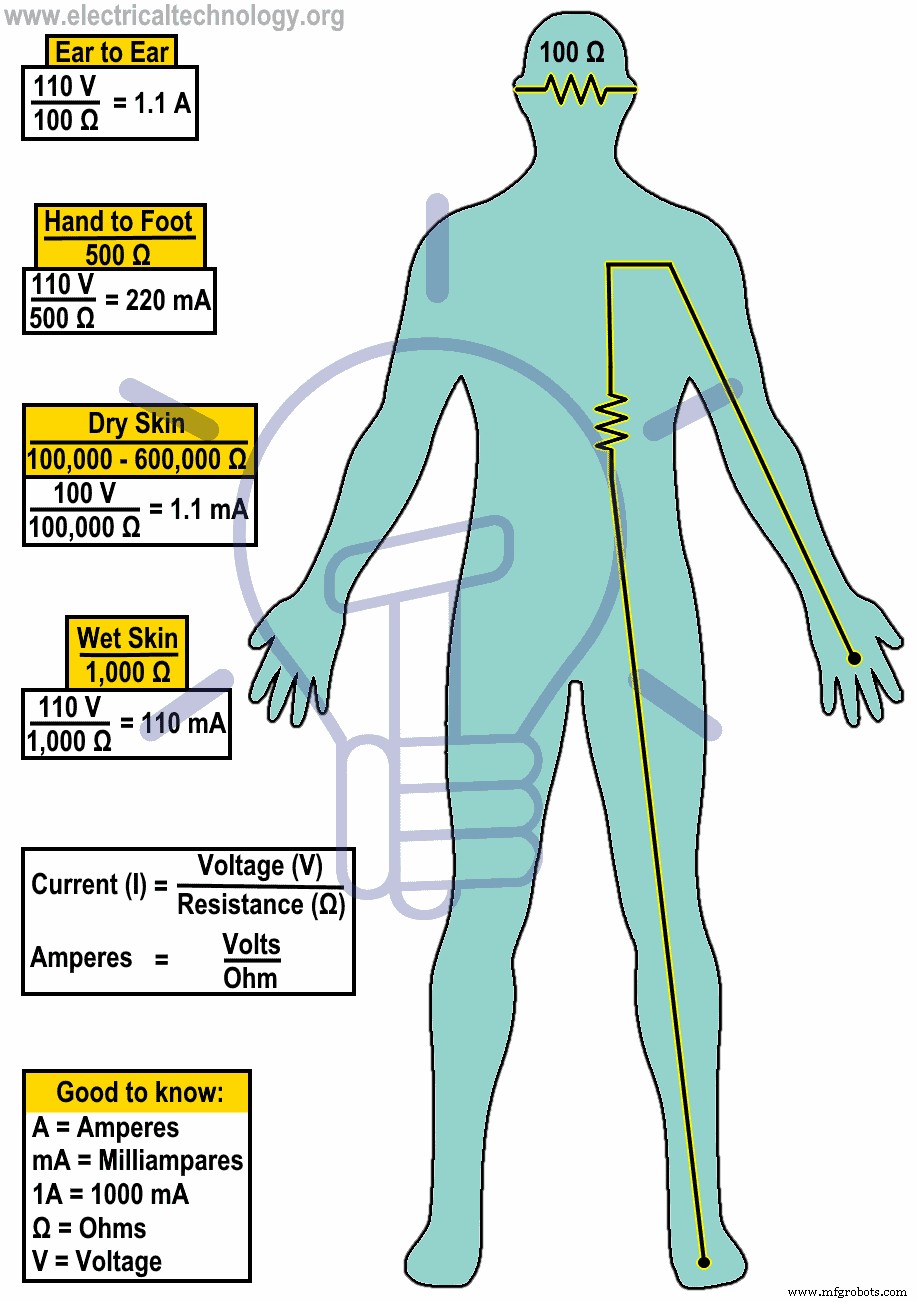
The safest limit of current which human body (depends on multiple factors) can withstand is 30mA sec. Suppose the human body resistance (hands to feet) is 500Ω and he touches to the live wire having voltage of 230V AC to the ground. The current flowing through body to the ground will be:
I = 220V/100Ω = 440mA
Now, The ELCB must be operated in
30mA sec / 440A = 0.068m sec.
However, it is not used widely nowadays because of its some major disadvantages mentioned in the next section.
Disadvantages of ELCB:
- Without proper earth connection, ELCB will not work. If the wire attached to the earthed rode is loose or broken, then ELCB would not able to sense the potential hazardous voltage on the metallic body of the electrical/electronic device.
- ELCB is attached between earthed wire and metallic body of the electrical appliances. But there are many other parallel paths for the currents to flow from the connected device body to earth without going through earthed wire. E.g. there are many metallic pipes in the house, which can provide a parallel path for the current to flow towards the earth. In this way, sometime ELCB is not able to detect the hazardous voltage on the metallic body of the device, which may cause serious injury.
- If someone gets in touch with live phase wire, ELCB will not Trip because in this case, there will be no current flow in the earth wire. In fact, current is flowing from the live wire to earth through the person’s body.
- When a live wire comes in contact with neutral wire, short circuit will occur, hence, ELCB will not trip because there will be no current in the earth wire.
- There are many cases in which, there is a current flow in the earth wire, but the situation is not hazardous in such cases, but it gives false trip e.g. lightening strike, current starts flowing in the earth wire and ELCB trips.
To overcome with the above disadvantages of ELCB, another Device named Residual Current Breaker (RCB) is invented to use for earth leakage protection.
Related Posts
- ELCB (Earth Leakage Circuit Breaker) – Construction, Types & Working
- How to Find the Rated Cable & Wire Size for Electrical Wiring Installations
What is RCD , RCB or RCCB ?
Residual Current Device (RCD) is also known as Residual Current Breaker (RCB) or Residual Current Circuit Breaker (RCCB).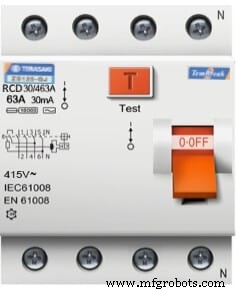
Residual Current Breaker (RCB) works on the assumption that the current going to the electronics device must come out from the neutral wire, if there is no other way for current flow. In simple words, RCB measures the current going inside the connected device and coming out from the device. If both of these current are equal, then there would no problem with the normal functionality of the device.
This device is also known as Current Operated ELCB which is known as RCCB nowadays. This device is more sensitive and accurate than ELCB and its functionality does not (entirely) depend on the earthed rode wire connection like voltage ELCB. Some of RCCB (RCD or RCB) characteristic are as follow:
- Most widely used RCD is 30mA to 10mA.
- 300 to 500mA RCCB are used for fire protection such as in lighting circuits with little chances of electric shock.
- Line (Phase or Live) and Neutral (N) both wires are connected to the load points through RCCB (RCD)
- RCD operate and trip when there is an earth fault current in the circuit.
- The same amount of current should flows through Neutral Wire as current flows in Live (Phase) wire i.e. equal current should flows in both Phase and Neutral Wire.
- If RCD detect unequal current (Phase and Neutral Current should be same as mentioned above) in phase or neutral wire, it will trip the circuit and disconnect the load points in 30m sec.
- RCD devices are very effective for electric shock protection.
- In a home where earthing system is connected only to earth rod and not to the main incoming supply cables, all circuits must be protected by an RCD otherwise, MCB might not get the specified fault current which is important to trip the MCB from connected circuits.
Working of RCD or Current Operated RCCB:
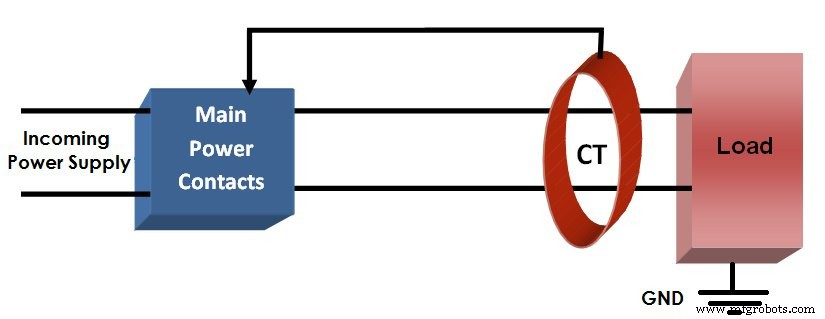
The polarity of the phase winding and the neutral winding is opposite in normal condition. Therefore, EMF generated by the phase wire cancels out by the EMF of the neutral wire. If there is a difference in the incoming and outgoing currents, then the resultant EMF will not be zero and can be sensed by the CT of RCB. The signal from the RCB current transformer is fed to the RCB circuit and it opens the main power contacts.
Advantages of RCD:
- If there is no connection between the ground and the enclosure of the device, and a person touches the metallic body of that device. In this case, incoming and outgoing current will be different and RCB will Trip in contrast with ELCB.
- Functionality of RCB (Residual Current Breaker) does not effect by lightning strikes.
- It does not trip falsely.
Related Post: Types of Switches – Construction, Working & Applications
Disadvantages of RCD:
- RCD don’t provide protection against Current Overload. But the main MCB will trip the circuit as RCCD won’t trip in case of a live or neutral faults i.e. short circuit and overload. For this reason, RCBO (MCB with RCD in a single unit) are used for proper protection.
- It operates only on normal supply wave forms i.e. it will not detect the pulsating DC and half wave rectified waveform. For these reason, special RCCB are used which is also operating on rectified pulsating DC voltage.
- Annoyance operation of RCD in case of sudden changes in load current. RCDs are very sensitive and operate on even a very small amount of faulty current very quickly. In case of switching of old electrical appliances, there is a small constant current flow through earth which lead to trip the circuit.
- RCD will not protect against overheating, Live – Neutral Shocks, and Socket outlet being wired with its Live & Neutral Terminals.
RCBO (Residual Circuit Breaker with Overload)
As we know that RCD won’t provide protection against Overload, hence an MCB and RCD are presented in a single unit known as RCBO (Residual Circuit Breaker with Overload). The operating principles are same as above but it provide more and reliable operation with overload protection in single box.
- Related Post: Different Types of Electrical Wiring Systems and Methods of Electrical Wiring Installation
Difference between ELCB and RCD (RCCB)
The following table shows the key differences between ELCB and RCD (aka RCCB or RCB).
| Characteristic | ELCB | RCCB (Also known as RCD or RCB) |
| Abbreviation | Earth Leakage Circuit Breaker | Residual Current Circuit Breaker |
| Operation | Voltage Operated Device (Old Name, Old Technology). | Current Operated Device (New Name, New Technology). |
| Fault Detection | Only detects earth faults that flow back through the main earth wire. | It will detect any earth fault. That’s why they are using now instead of ELCB. |
| Connection | Connected to Phase, Neutral as well as Earth Wire. | It is only connected to Phase and Neutral Wire. |
| Installation | Needs an earth connection itself. | No need of earth connection. |
| Types |
|
|
| Nuisance Tripping | Less | High |
| Cost | Costly | Less Cost |
| Applications | Not recommended. Replace it with RCCD. | Almost all wiring systems use RCCD nowadays. |
Keep in mind that both ELCB and RCCB are used for the same purpose but wiring connection is different i.e. in RCCB, only phase and neutral wire should be connected through it whereas in ELCB, main earth wire is connected through it.
- Related Post: Difference Between Capacitor and Supercapacitor
Here is the table in image for reference.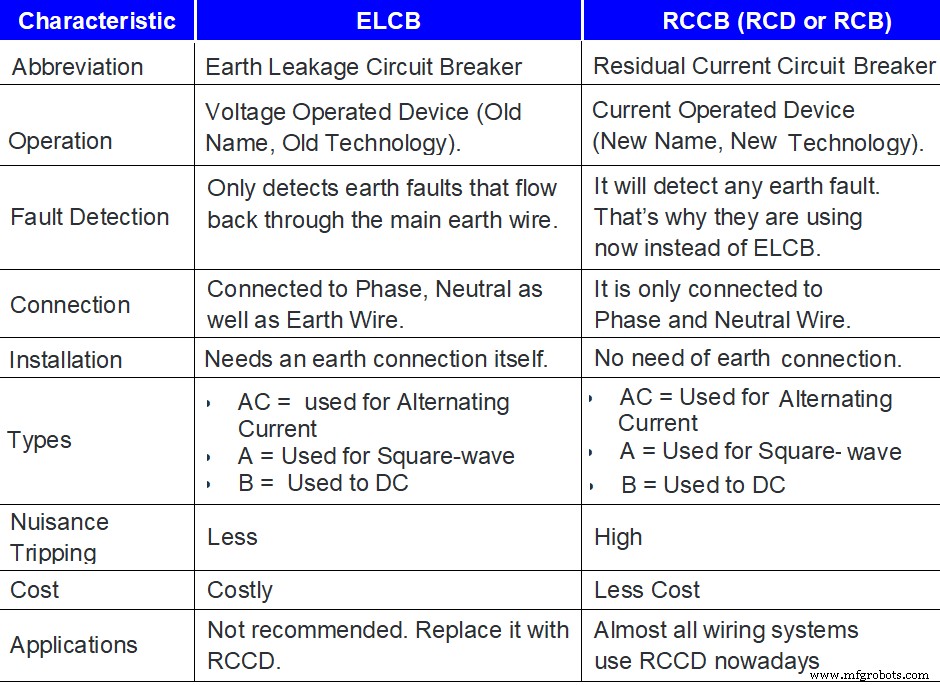
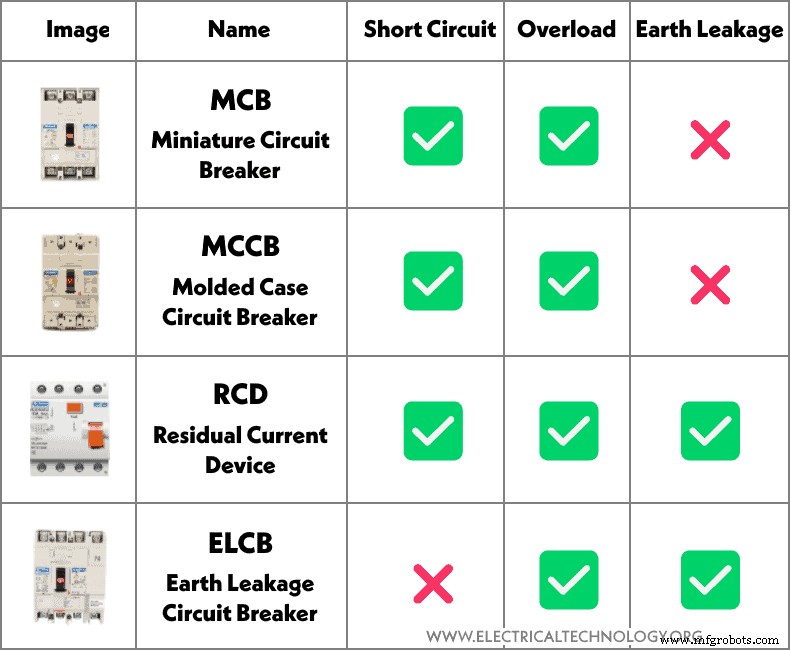
The following comparison table shows the differences between MCB, MCCB, RCD and ELCB with protection features.
| Image | Name | Short Circuit | Over Load | Earth Leakage |
|
MCB
Miniature Circuit Breaker |
✅ | ✅ | ❌ |
|
MCCB
Molded Case Circuit Breaker |
✅ | ✅ | ❌ |
|
RCD
Residual Current Device |
✅ | ✅ | ✅ |
|
ELCB
Earth Leakage Circuit Breaker |
❌ | ️✅ | ✅ |
Here is the chart in image format to downloads as a reference.
Industrial Technology
- Wire Resistance in Circuits: Why Length & Shape Usually Don’t Matter
- AC vs DC Generators: Key Differences Explained
- Chain Drive vs Gear Drive: A Comprehensive Comparison
- Joining vs Welding: Key Differences Explained
- Forehand vs. Backhand Welding: Key Differences Explained
- PV Valve vs PV Breaker in Tankers: Key Differences & Functions
- Key Differences Between Ships and Boats Explained
- Miniature Circuit Breakers (MCBs): Construction, Operation, Types & Applications
- Fabrication vs. Machining: Key Differences Explained
- Casting vs Forging: Key Differences and Applications