



Calculate the Correct Circuit Breaker Size: A Practical Guide & Online Calculator
How to Calculate the Circuit Breaker Size? Breaker Size Calculator with Solved Examples
According to NEC (National Electric Code), IEC (International Electrotechnical Commission) and IEEE (Institute of Electrical and Electronics Engineers), a proper size of circuit breaker is must for all electrical circuits i.e. residential wiring and industrial or commercial installation to prevent the electrocution, hazardous fire and protection of the connected electrical equipment and appliances.
For maximum safety and reliable operation of the electrical machines, it is recommended to use the correct and suitable size of circuit breaker according to the circuit’s current flowing through it. If we don’t use a correctly sized circuit breaker.
- Related Post: How to Find The Suitable Size of Cable & Wire ? – Solved Examples
In case of other (over or lower) size instead of correct sized circuit breaker, the circuit, cables and wire even the connected device may heat up or in case of short circuit, it may start to smoke and burn. That’s why a correct size circuit breaker is needed for smooth operation.
In this post, we will be going to show that how to choose a right size circuit breaker for electrical wiring installation and design with related voltage level, wattage usage and difference in % to the circuit load and current capacity of the CB.
- Related Post: Difference Between MCB, MCCB, ELCB & RCB, RCD or RCCB Circuit Breakers
What is a Circuit Breaker?
A Circuit breaker (CB) is a control and protection device which:
- Control (make or break) a circuit manually or by remote control under normal and fault conditions.
- Break a circuit automatically under fault conditions (like over current, short circuit, etc).
A circuit breaker is used for switching mechanism and protection of the system
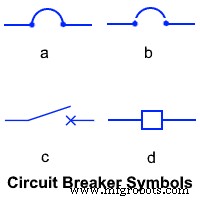
A circuit breaker is a switching as well as protection device used for ON/OFF operation of the circuit as well as prevent the electric shock. For accurate operation an d protection, even complex designs are used with circuit breaker like fuses, relays, switches, earthing & grounding etc.
- Related Post: Main Difference between Fuse and Circuit Breaker
How Does a Circuit Breaker Work?
In normal conditions when the circuit current rating is lower than the circuit breaker rating, the circuit operation is normal and it can be changed by manual operation. In case of fault or short circuit when the value of current exceeds the circuit breaker current, It will automatically trip i.e. break the circuit from the main supply.
For example, a 30 amp circuit breaker will trip at 30 amp no matter if is it continuous or non continuous load. That’s why we must select 20-25% higher size of current for circuit breaker than the flowing current in the cables and wires to the connected device.
If we use a 100A circuit breaker for 30A circuit, it wont protect the circuit from fault currents and may burn and damage the device as more than 30 amperes current won’t trip the circuit breaker. In short, we must use the proper size of circuit breaker according to the device i.e. CB current should not be lower nor highest but 125% of circuit’s current.
Circuit Breaker Size Calculator
The following circuit breaker sizing calculator will show the difference in % to the load, voltage level in different countries and exact size of breaker in amperes.
Related Calculators:
- Wire & Cable Size Calculator in AWG
- Electrical Wire & Cable Size Calculator (Copper & Aluminum)
Circuit Breaker Size Calculation for Single Phase Supply
To determine the appropriate size of circuit breaker for single phase supply, it depends on multiple factors like type of load, cable material and environment temperature etc.
The general rule of thumb is that circuit breaker size should be 125% of the ampacity of cable and wire or the circuit which has to be protected by the CB. Let see the following solved examples:
Example 1:
Suppose, a 12 gauge wire is used for 20 amperes lighting circuit having 120V single phase supply. What is the best size of circuit breaker for that 20 A circuit?
Solution:
Circuit Current: 12A
Circuit Breaker Size: ?
CB size should be 125% of the circuit current.
= 125% x 20A
= 1.25 x 20A
Circuit Breaker Size = 25A
Example 2:
What is the appropriate size of circuit breaker for 2000W, single phase 120V Supply?
Solution:
- Load: 2000W
- Voltage: 120V (Single Phase)
Circuit Current:
According to the ohm’s law,
- I = P / V
- I = 2000W / 120V
- I = 16.66 A.
Circuit Breaker Size:
Simply, Multiply 1.2 or 1.25 to the load current.
1.2 x 16.66 A
Circuit Breaker Size = 20 A
Example 3:
What is the suitable size of circuit breaker for 230V, 1840kW load single phase circuit?
Solution:
- Current = Power / Voltage
- I = 1840W / 230V
- I = 8A
The minimum rating of circuit breaker should be 8A.
The recommended size of circuit breaker should be
= 8A x 1.25
= 10
- Related Post: Smart WiFi Circuit Breaker – Construction, Installation and Working
Circuit Breaker Size Calculation for Three Phase Supply
To find the breaker size for three phase supply voltage, we must know the exact kind of load as there are many factors affecting the load current. In other words, same rule won’t apply to the different types of loads i.e. light, motor, inductive or capacitive load as motor takes initially very high current during the starting process as well as power factor involvement. For residential use, we may follow the same formula as above for single phase with taking the √3 (1.732) due to three phase power formula.
Good to know: For the same load, the breaker size in three phase is less than the breaker size used in single phase AC circuits.
Lets find the correct size of circuit breaker for three phase circuits as follow.
Example 1: Which size circuit breaker is needed for 6.5kW, three phase 480V load?
Solution:
Power in Three Phase: P = V x I x √3
Current: P / V x √3
- I = 6.5kW / (480V x 1.732) … (√3 = 1.732)
- I = 6.5kW / 831.36
- I = 7.82A
The recommended size of circuit breaker is
1.25 x 7.82A = 9.77A
The next closest standard of circuit breaker is 10A.
Example 2: Find the appropriate size of CB for 3-Phase 415V, 17kW load?
Solution:
- Current = Power / (Voltage x √3)
- I = 17000W / (415V x 1.732)
- I = 23.65A
Recommended Size of Circuit Breaker: 1.25 x 23.65A = 29.5A. The next closest value is 30A.
- Related Post: Difference between Circuit Breaker and Isolator / Disconnector
Circuit Breaker Size Calculation for Continuous & Non-contentious Load
As circuit breakers (CBs) and Overcurrent Protection Devices (OCPD) are designed for 100% rated current i.e. a 30A circuit breaker can safely carry the exact 30A current but NEC suggests 80% as a safe current limit as compared to the rated current of CBs. This is because all loads are not same i.e. some loads are simultaneous (continuous) while other are non-simultaneous (non-continuous).
In case of contentious loads for three or more hours, the load current should not exceed 80% of the rated current of circuit breaker and OCPD.
The 80% of a 30A circuit breaker is 24A. This way, a 30A circuit can be safely used for 24A circuit.
In other words, a load circuit having 24A, the appropriate size of breaker would be:
24A / 0.8 = 30A.
Example 1: CB Size for 30A Non-contentious Load
- An exact 100% rated for 30A circuit breaker can be used for 30A non-continuous load.
Example 2: CB Size for 28A Contentious Load
- In case of continuous load, rate of %125 is applicable.
- 1.25 x 28 A = 35A
Example 3: CB Size for 30A Non-contentious Load & 28A contentious Load
- = 125% Continuous Load + 100% Non-continuous load
- = (1.25 x 28A ) + (30A)
- = 75A
Related Post: Difference Between Relay and Circuit Breaker
Good to Know:
- An over sized breaker used for protection can damage the water heater or other connected appliances even leads to the fire due to overheat.
- An undersized breaker or same rating with load current breaker can trip and reset the circuit again and again. Use the correct size breaker.
- A single phase circuit breaker can’t be used for three phase supply voltage levels.
- A 3-Poles circuit breaker can be used on 3-Phase system using either 2 or 3 poles.
- A 3-Poles circuit breaker can be used on 1-Phase system only and only if indicated by the markings or instructed by user manual.
- 30A Breaker and 10 gauge wire can be used on 240V AC Supply.
- Breaker cannot be larger than ampacity of wire except for some loads like more loads.
In addition, A Circuit breaker rated for:
- 120V can only be used for 120V.
- 240V can be used for 120V, 240V but not for 277V (Commercial applications)
- 120-277 can be used for 120V, 240V and 277V.
- 120V can’t be used on 240V circuit and vice versa.
- 15A, 120V can’t be used on 20A, 120V circuit.
Related Post: How to Find Voltage & Ampere Rating of Switch, Plug, Outlet & Receptacle
Circuit Breaker Size % and Amps Charts
The maximum safe current limit is 80% of the rated size of breaker except some motors. Keep in mind that the breaker size should not increase the max amperage rating of cable and wire. Below is the given chart showing the % of max current rating of breaker size for different types of load currents.
| Load Type | Maximum Circuit Breaker Size % of Current |
| Resistive Loads, Heat, Stoves, Toasters, Water Heater etc. | 125% |
| Lighting Loads | 125% |
| 430-152 Motors Hermetically Sealed*, Air conditioners And heat pumps | 175% |
| Welders | 200% |
| MCP Breakers for Motors | 125% or next larger size |
* Motors except Hermetically Sealed 00-250% NEC
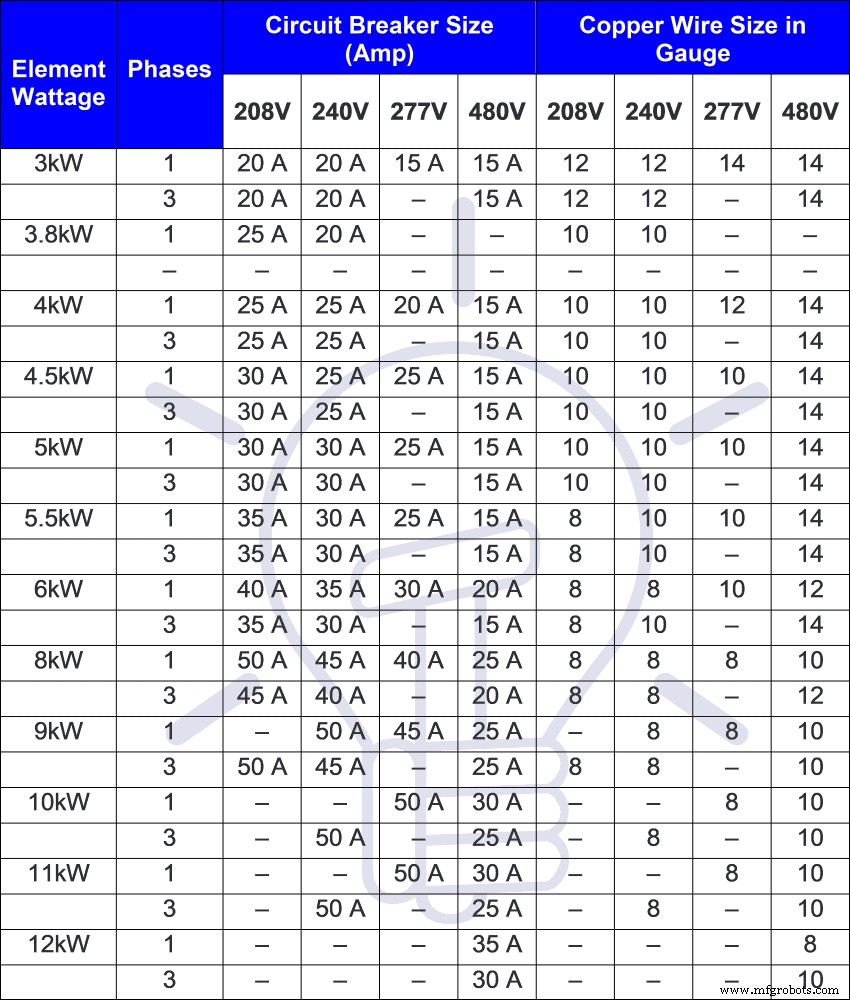
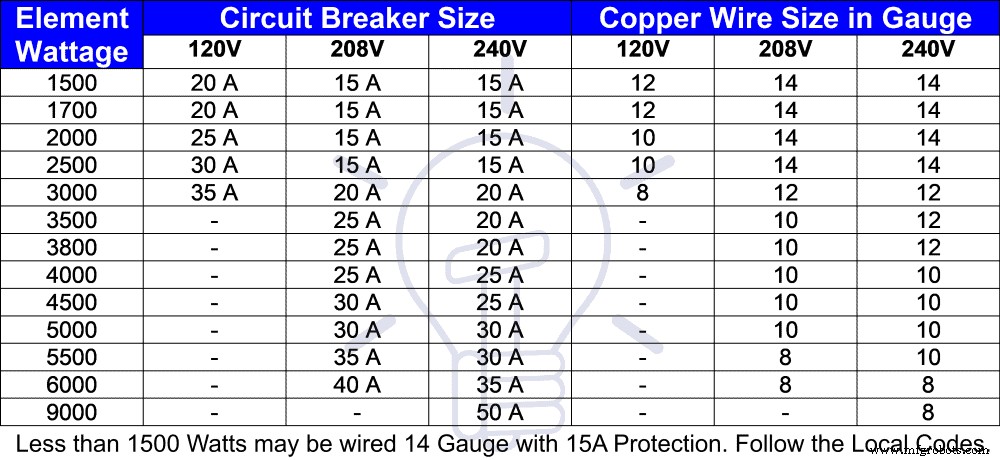
The following two charts shows the suitable circuit breaker sizes with wire gauge and different level of voltages.
Industrial Technology
- Decode SMD Resistor Codes: Quick Guide to Determining Resistance Values
- Choosing the Right Cable Size for Electrical Installations – Imperial & Metric Examples
- How to Determine the Proper Size of Earth Conductors, Earthing Leads, and Earth Electrodes
- Step‑by‑Step Guide: Wiring GFCI Circuit Breakers for 1‑ to 4‑Pole Systems
- Power Factor Correction Calculator: Find Capacitor Size in µF and kVAR Quickly
- How Many Lights Can Fit on a Single Circuit Breaker? Expert Guide for 15A, 20A & 10A Circuits
- Determining the Number of Outlets per Circuit Breaker: A Practical Guide
- Choosing the Correct Capacity for Your Subpanel: A Practical Guide
- Calculate the Ideal Battery Bank Size: A Practical Guide & Calculator
- Avoiding the Pitfalls of Non‑Standard Material Sizes